The Names and Natures of Osiris and Isis
Updated: Sep 1
“O Unas, you have not gone dead, you have gone alive to sit upon the throne of Osiris.”
— Pyramid Text Utterance 213
In the Pyramid Texts of the Old Kingdom, Osiris and Isis appear not as distant, abstract deities but as the immediate ancestors of the king—the sacred pair upon whom the entire edifice of Egyptian kingship and eternal life was built. They are the first human-born gods to conquer death, the templates for every soul that hoped to join the radiant stars.

The Names and Their Hieroglyphs
The Symbol of the Throne: More Than a Chair
Before we can understand the roles of Osiris and Isis, we must first understand their names. The hieroglyphic symbols that compose their names— particularly the "throne" or "seat" sign— reveal their essential natures. The hieroglyph known as Gardiner Q1 (𓊨) is conventionally translated as "throne" or "seat." However, its meaning in the Pyramid Texts is far richer than a simple piece of furniture. It carries two interconnected layers of meaning:
1. "Place" or "Position" (st): The symbol serves as an ideogram for the word st, meaning "seat," "throne," or, most significantly, "place." In the Pyramid Texts, it is used in phrases like st nṯr ("place of God"), referring to a temple or sacred location. It represents not just a physical seat but a dwelling place or established position within the cosmic order.
2. The Core of Divine Names: It is the foundational element in the names of both Osiris and Isis—the two deities most intimately connected to divine kingship, death, and resurrection.
Osiris (𓁹𓊨𓀭)

The name Osiris (Egyptian: wsjr) is written with the eye (𓁹) and the seat/throne/place (𓊨) signs. This combination can be interpreted as "the one who sees the place" or "the eye of the throne." Osiris is the god who is placed or seated in his sacred position—the ruler of the underworld, the "place of the dead."
His identity is established through his relationship to this seat. The Pyramid Texts repeatedly describe the king as "sitting upon the throne of Osiris"—not merely occupying a physical chair, but assuming the stable, eternal position that Osiris himself occupies. He is the one who has been securely placed in the realm of the dead, ruling over the "place" of the blessed dead.
Isis (𓊨𓏏𓆇𓁐)

The name Isis (Egyptian: ꜣst) is written with the seat/throne/place sign (𓊨), the feminine t ending (𓏏), and the egg determinative (𓆇). Her name means "she of the seat" or, more profoundly, "she of the place."
Isis is not merely a goddess who sits upon a throne; she is the embodiment of the throne itself. She is the sacred place where kingship is established, the foundation upon which the divine order rests. She is the place from which legitimate rule emerges, the position that Osiris occupies, and the sacred space that protects and nourishes the king.
In this understanding, Isis is the stable foundation of the cosmos—the "place" of order, legitimacy, and resurrection. Her name, like her nature, is inseparable from the concept of a sacred, established position.
The Voice of the Old Kingdom: Osiris Before the Myth
Before the fully-developed Osiris myth of later periods, the Pyramid Texts reveal a figure of immense power and fundamental authority, defined primarily by his lineage and inheritance.
Osiris as the Son and Heir
The most fundamental definition of Osiris in the Pyramid Texts is his identity as the son and heir. This is not a minor detail; it is the foundation of his authority.
“Raise thyself up, Osiris N., son of Geb, his first-born, before whom the Great Ennead tremble.” — Utterance 483
“Thou standest as chief of the gods, eldest son, as heir on the throne of Geb.” — Utterance 578
“O Geb, wise-mouth, hereditary prince of the gods, it is thy son, Osiris N.” — Utterance 592
"thy mother Nut has brought thee forth" — Utterance 366
As the firstborn and heir of Geb, Osiris holds a position of supreme authority among the gods. His "place" is established by his lineage, and his "seat" is the throne of Geb itself. The Litany of Identification explicitly names each deity in the lineage as the parent or ancestor of Osiris.
"Osiris is called the eldest son of Shu" — Utterance 592
"Shu, this Osiris here is your son." — Litany of Identification
"Tefnut, this Osiris here is your son." — Litany of Identification
"Atum, this Osiris here is your son." — Litany of Identification
"Atum has given thee his heritage; he has given tee the whole Ennead." — Utterance 592

Osiris as the Mightiest God
The texts do not shy away from proclaiming his supreme power.
“O Osiris N., thou art the mightiest god; there is no god like thee.” — Utterance 365
"Osiris N., thy mother Nut has spread herself over thee... Thou art the greatest among her children." — Utterance 588
“Osiris N., thou art the ka of all the gods.” — Utterance 589
“Thou art standing on the earth; thou judgest at the head of the Ennead; ... thou art More powerful than any god.” — Utterance 592
Osiris as Lord of the Earth and the Waters
Even before his association with the underworld, Osiris is connected to the fertility of the land and the waters of life.
“The watercourses are full, the canals are inundated on account of the purification (which) comes forth from Osiris.” — Utterance 455
Osiris and the Great Ennead
Osiris is firmly placed within the Heliopolitan creation, a member of the Great Ennead—the nine gods who brought the cosmos into being.
“O great Ennead which is in Heliopolis—Atum, Shu, Tefnut, Geb, Nut, Osiris, Isis, Seth, Nephthys—children of Atum.” — Utterance 600
Osiris is the firstborn son and the heir of those before him, and through his inheritance he holds supreme authority among the gods. He is the "mightiest god," the "ka of all the gods," and the judge who presides over the Ennead. This is the Osiris before the myth.
The Voice of the Old Kingdom: Isis Before the Myth
Before the elaborate myths of later periods, Isis appears in the Pyramid Texts in a defined, powerful role. She is not a shadowy figure but an active and essential presence.
Isis as Sister, Wife, and Mother
“N., I have given to thee thy sister Isis, that she may take hold of thee, that she may give thy heart to thee which belongs to thy body.” — Utterance 4
“Thy sister Isis laid hold of thee, when she found thee complete and great.” — Utterance 593
“thy mother Isis has given birth to thee at Chemmis.” — Utterance 607
Isis as Protector and Healer
Her role as a protector and healer is established early.
“Thy two sisters Isis and Nephthys come to thee; they heal thee.” — Utterance 366
“Isis and Nephthys protected thee in Siût.” — Utterance 366

Isis as the Mourner of Osiris
The Pyramid Texts depict Isis as the chief mourner, whose grief is a powerful act of devotion and healing.
“The ḥȝ.t-bird comes, the kite comes; they are Isis and Nephthys. ... weep for thy brother; Isis, weep for thy brother.” — Utterance 535
“Isis sits, her hands upon her head.” — Utterance 535
Isis is the sister, wife, and mother; the protector and healer; the chief mourner whose grief is a form of healing. Her role is not passive but active— she lays hold of Osiris, she heals him, she sits in mourning with her hands upon her head. This is Isis before the myth— the devoted sister whose love and persistence will make transfiguration possible.
The Osiris Myth in the Pyramid Texts
The Pyramid Texts allude to the key elements of the Osiris myth—the death, the scattering, the gathering, and the resurrection.
The Murder of Osiris by Set
The murder of Osiris by his brother Set is a foundational event.
“He who smote (my) father; he who has killed (one) greater than he; thou hast smitten (my) father, thou hast killed one greater than thou.” — Utterance 580
“I have smitten for thee him who smote thee as an ox; ... him who killed thee as a wild-bull.” — Utterance 580
Isis and Nephthys Find Osiris
“Two sisters, Isis and Nephthys, come to thee; they hasten to the place in which thou art. Thy sister Isis laid hold of thee, when she found thee.” — Utterance 593

The Resurrection of Osiris
The resurrection is the central event of the Osiris myth. The king is repeatedly addressed as Osiris and commanded to rise.
“O Osiris N., stand up, lift thyself up.” — Utterance 366
“Raise thyself up, Osiris N.” — Utterance 483
“Awake, Osiris, awake.” — Utterance 487
“Thou art gone, thou art come; thou art awake, thou wast asleep; thou remainest alive.” — Utterance 476
“Thou livest; thou movest every day.” — Utterance 365
The Pyramid Texts do not tell the Osiris myth in a single narrative, but they allude to its key elements: the murder of Osiris by Set, the search for his body by Isis and Nephthys, and the resurrection accomplished through the combined efforts of the gods. The king, identified with Osiris, is commanded to rise, to awaken, to live again. This is the sacred drama at the heart of the Pyramid Texts— the promise of transfiguration for all who follow.
The Stellar Transfiguration: Osiris as Sah (Orion) and Isis as Sopdet (Sirius)

Beyond their earthly roles, the Pyramid Texts reveal that Osiris and Isis transcend the Ennead to become celestial beings—the very stars themselves.
Osiris as Sah (Orion)
In the Pyramid Texts, Osiris is identified with the constellation Sah (Orion). The king, having become Osiris, is promised:
“Behold, he is coming as Sah; behold, Osiris is coming as Sah.” — Utterance 820
“O king, you are this great star, the companion of Orion.” — Utterance 882
“You shall rise with Orion in the eastern sky. You shall set with Orion in the western sky.” — Utterance 442
“The king has come that he may glorify Orion, that he may set Osiris at the Head.” — Utterance 925
“The Duat has grasped your hand at the place where Orion is.” — Utterance 802
“May you ascend to the sky, may the sky give birth to you like Orion.” — Utterance 2116
“Live and be young beside your father (Osiris), beside Orion in the sky.” — Utterance 2180
“In your name of Dweller in Orion.” — Utterance 186
Osiris becomes a stellar being, dwelling in the higher mansion—the realm of the imperishable stars, far above Nut's “lower mansion.” In the Pyramid Texts, Sah is frequently mentioned as “the Father of Gods” . The pharaoh was thought to travel to Orion after his death.

Isis as Sopdet (Sirius)
Isis, in turn, is identified with the star Sopdet (Sirius), the brightest star in the night sky. The name Sopdet means “(she who is) sharp” in Egyptian.
“Your third is Sothis, pure of thrones. She is your guide on sky's good paths, in the Field of Rushes.” — Utterance 442
Sopdet is the guide for Osiris-Orion, leading him across the sky. She is the celestial Isis, the faithful companion who ensures the resurrection of her beloved. As early as the Pyramid Texts, Isis is connected to Sopdet, who, as the star Sirius, is the Herald of the Inundation.
“Your [Osiris'] sister Isis has come to You, rejoicing/aroused for love of You.” — Pyramid Texts
The ultimate goal of the Osiris myth is not merely resurrection in the underworld, but transfiguration into a celestial being. Osiris becomes Sah—the constellation of Orion, the "Father of the Gods." Isis becomes Sopdet—Sirius, the brightest star in the night sky, the guide who leads Orion across the heavens. The king, having become Osiris, rises as a star among the imperishable stars. This is the final transformation: from earth to sky, from mortal to eternal.
The Stellar Ancestors: A Pan-African Legacy
The belief that human beings can ascend to become stars is not unique to the Nile Valley. It is a thread that runs through the spiritual traditions of many African peoples, from the San of the Kalahari to the Dogon of Mali.
The San: Starlore of the First Peoples
The San people of southern Africa see Orion's Belt as three male tortoises hung on a stick, while Orion's Sword is three female tortoises on another stick—a way of reading the sky as a narrative. They call Sirius the “Grandmother of Canopus” and believe the Milky Way is a supernatural footpath across the sky, walked by ancestral spirits.
The Dogon: Cosmic Knowledge and the Sirius System
The Dogon people of Mali preserve traditions centered on the Nommo, celestial beings who descended from the sky along the Milky Way. They are famous for their claimed knowledge of the Sirius system, including the existence of Sirius B (Po Tolo), though this knowledge is sometimes debated.
The Shared African Heritage
These traditions share a common thread: the belief that human beings can become stars, and that the stars themselves are ancestral spirits watching over the living. This is precisely the understanding we find in the Pyramid Texts, where Osiris becomes Sah (Orion) and Isis becomes Sopdet (Sirius).
Conclusion: The Sacred Pair Above the Stars
Osiris and Isis are not merely gods of the underworld or of magic. They are the first ancestors of every soul that seeks eternal life. Osiris is the model of the akh, the one who showed that a human-born being could become an imperishable star. Isis is the mother and protector who made that transformation possible.
In the Pyramid Texts, the king does not simply worship Osiris and Isis—he becomes them. He dies as a mortal and rises as Osiris-Orion, guided across the sky by Isis-Sirius. He transcends the Ennead, the earth, and even the canopy of Nut, to dwell among the imperishable stars in the highest mansion.
References
Pyramid Texts (Old Kingdom, c. 2400–2300 BCE): Utterances 4, 186, 213, 365, 366, 368, 442, 455, 476, 483, 487, 535, 578, 579, 580, 589, 592, 593, 600, 607, 802, 820, 882, 925, 2116, 2180
About the Author
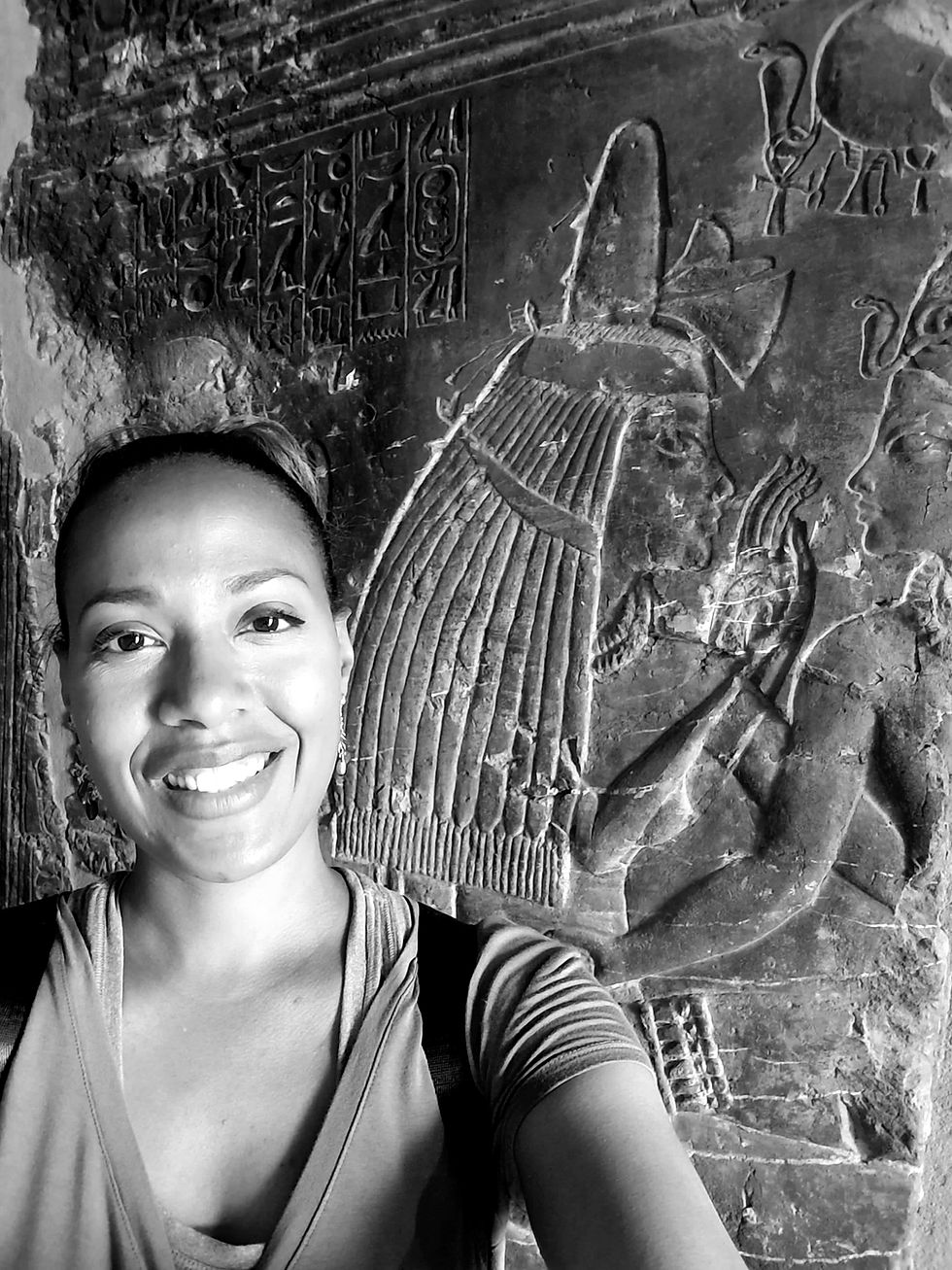
Amanda Victoria Chance, MD, is an Internal Medicine board-certified physician reviving ancient healing practices. Also board-certified in Lifestyle Medicine, she bridges millennia-old vibrational wisdom with evidence-based lifestyle interventions-- including nutrition, stress resilience, and non-pharmacological therapies-- to activate whole person care. She co-leads transformative healing journeys in Egypt with her husband-- including resonance-based experiences inspired by Saqqara's legendary "healing hospital," a site documented in Gaia's The Pyramid Code through her husband's grandfather's archival legacy.


Comments