Complete Map of the Human Energy System in Ancient Egypt
Updated: Sep 3
Long before the meridians of China or the chakras of India, the physicians of the Nile mapped a subtle anatomy of the human soul—a resonant energy system of nine distinct aspects, each with its own function, its own hieroglyph, and its own role in the eternal journey of the self.
The ancient Egyptians did not separate the physical from the spiritual. For them, the human being was a complex energy system, a layered field of forces that interacted with the cosmos. This understanding, encoded in the Pyramid Texts of the Old Kingdom and reflected in temple reliefs and funerary practices, reveals a sophisticated map of what we might today call the "energy body." Let us explore this ancient blueprint in its complete form.

Part I: The Complete Human Energy System: Nine Aspects of the Self
The Egyptians identified nine distinct but interconnected aspects of the human being. Together, they formed the complete person—both in life and after death.
Aspect | Hieroglyph (Gardiner Reference) | Core Function | Energy Quality |
Ka | (𓂓) Two upraised arms; D28 | Life force, vital essence, ancestral energy | Foundation / Battery |
Ba | (𓅽) Human-headed falcon with incense burner; G53 | Personality, mobility, individual expression | Consciousness / Signal |
Heart (Ib) | (𓄣) Heart with vessels; F54 | Seat of mind, will, morality; the integrator | Processor / Bridge |
Sekhem | (𓌂) Ritual sceptre; S42 | Active power, authority, directed life-force | Application / Will |
Name (Rn) | (𓍷𓏤) Cartouche or mouth (𓂋) with phonetic complements; V10 | Identity, essence, vibrational signature | Signature Frequency |
Sunshade (Šwt) | (𓋺) Sunshade on a stand; S34 | Protective field, boundary, spiritual canopy | Containment / Shield |
Khat (ẖt) | (𓁀) Corpse with raised arms or a mummified form; A55 | Physical body, earthly anchor, remains | Manifestation / Root |
Sahu | (𓀾) Mummy standing upright; A54 | Spiritual body, transfigured form | Vessel / Temple |
Akh | (𓅜) Crested ibis; G25 | Transfigured, luminous spirit (the goal) | Integrated Whole |
Part II: The Pyramid Texts on the Complete Energy Body
1. The Ka: The Ancestral Life Force
The Ka (𓂓) is the most fundamental energy—the life force itself, received at birth and sustained through life. It is depicted as two upraised arms, suggesting embrace, protection, and the reception of vital energy from the ancestors and the gods.
Pyramid Text Utterance 600 establishes the Ka as an inherited, transmitted force:
"O King, receive your Ka which is with your father... The Ka of your father is before you, the Ka of your father is behind you."
Utterance 474 expands this to a lineage force:
"Your Ka is enduring, your Ka is with you... The Ka of your fathers is with you, the Ka of your children is with you."
Utterance 267— The Ka as the Force of the Ancestral Spirits
"Unas has raised himself up as a Ka. The spirits (akh) of the ancestors are with him."
The king's Ka is directly linked to the ancestral spirits. They are "with him," suggesting the Ka is the medium through which the power and presence of the ancestors manifest in the living.
The Ka is not individual; it is the ancestral current flowing through generations. To be "high of Ka" was to be filled with this vital, inherited power.
2. The Sekhem: Power in Action
The Sekhem (𓌂) is written with the hieroglyph of a scepter or staff of authority. Its name derives from the verb sekhem, meaning "to be powerful," "to have control."
The scepter hieroglyph is significant: it is an instrument held in the hand, something used to exert will and authority. This distinguishes Sekhem from Ka:
Aspect | Hieroglyph | Meaning | Analogy |
Ka | Two upraised arms (receiving) | The reservoir of life force | The battery, the stored energy |
Sekhem | Scepter (wielding) | The directed application of that force | The power flowing through a circuit, the tool in use |
Pyramid Text Utterance 318 mentions the Sekhem directly:
"The King's Sekhem is before him, his Sekhem is behind him, his Sekhem is with him wherever he goes."
The Sekhem accompanies the king constantly—not as passive potential, but as active, manifest power that accomplishes things, that commands respect, that exerts will upon the world.
Utterance 539 connects Sekhem to the king's authority:
"O King, the gods come to you bowing, for your Sekhem is great among them."
3. The Ba: The Mobile Consciousness

The Ba (𓅽) is the unique personality, the conscious self that can travel between worlds. Depicted as a human-headed bird, it represents the soul's ability to move, perceive, and express.
Pyramid Text Utterance 25 describes its release:
"O Osiris the King, take your Ba... You shall not perish, you shall not be destroyed, your Ba shall live."
Utterance 474 shows the Ba in relation to the whole self:
"His Ka is with him, his Ba is not held back from him."
4. The Heart (Ib): The Central Processor

The heart (ib, 𓄣) is the most crucial organ in the energy system. Its hieroglyph shows an actual heart with vessels—the physical organ that was understood as the seat of mind, will, memory, and morality. It is the bridge between Ka and Ba, the place where they integrate.
Pyramid Text Utterance 410 reveals its dual connection:
"O King, receive your ib which belongs to your Ka, your ib which belongs to your Ba."
The heart literally belongs to both—it is the point of resonance where life force (Ka) meets individual consciousness (Ba).
Utterance 26 ties the heart directly to spiritual transformation:
"O King, receive your heart (ib) which was yours upon earth. Your heart is yours, and you are an akh thereby."
5. The Name (Rn): The Vibrational Signature
The name (rn, 𓍷𓏤) was not a label but an essential aspect of being—the unique frequency or vibration that identified the soul. Its hieroglyph is the cartouche or the birth name written within it, a rope encircling the name to protect and define it.
To speak a name was to invoke its power; to erase a name was to destroy its existence.
Pyramid Text Utterance 373 emphasizes the name's eternal nature:
"Your name endures upon earth, your name flourishes in the mouth of the living."
Utterance 407 connects the name to the king's power:
"I know your name, I know the name of your barque, I know the name of the god who is in it."
6. The Sunshade (Šwt): The Protective Field
The šwt (𓋺) is written with the hieroglyph of a sunshade on a stand—a protective canopy designed to shield from the sun's intensity. This is a crucial distinction: it is not a "shadow" (an absence of light) but a deliberate, protective covering that works with light.
In the intense Egyptian sun, a sunshade was essential for survival. Nobles were depicted with attendants holding sunshades over them. The sunshade:
Protected from the sun's destructive power
Defined the sacred space of the person
Marked status and importance
Allowed the person to exist comfortably in harsh conditions
Pyramid Text Utterance 577 speaks of this protective function:
"Your šwt is with you, O King. It is not driven away by those who would harm you."
Utterance 366 describes it surrounding the king:
"The King ascends to the sky among the gods... His šwt is before him, his šwt is behind him, his šwt is with him wherever he goes."
The Sunshade and Mehen

This concept becomes clear when we consider Mehen, the coiled serpent who wraps around the solar barque during Ra's nightly journey through the Duat. Mehen is the cosmic sunshade—his coils do not create darkness but a protected space where Ra's light can pass safely through dangerous realms.

For the Akh, the šwt serves the same function. It is not darkness trailing behind the light, but the coiled, protective field that surrounds the luminous being when it travels through realms not its own.
7. The Khat: The Physical Body
The Khat (transliterated ḫꜣt) is the physical, mortal body—the fleshy vessel that houses the other aspects of the soul during earthly life. It is the most tangible part of a person, yet it is also the most vulnerable, for it is subject to decay, disease, and ultimately, death.
The word is written with a specific set of hieroglyphs that provide clues to its meaning:
𓁀 (A55) A mummy lying on a bier. This is the primary determinative for the word. It leaves no doubt that Khat refers to the physical body, particularly in its state of recumbancy.
𓂝 (D36) An arm. A common phonetic sign used in the spelling of many words.
𓏏 (X1) A bread loaf. The feminine ending (-t), showing the word is feminine in gender.
𓀀 (A1) A seated man. An additional determinative sometimes used to reinforce the meaning of “person” or “body.”
The choice of the mummy on a bier (A55) as the primary determinative is significant. It reveals that the word Khat is intimately connected with the corpse and the mummified body. Furthermore, Egyptologists have noted that the word Khat seems to be connected with the idea of something which is “liable to decay” or “perishable”. It stands in direct contrast to the immortal, incorruptible aspects of the soul, such as the Ba or the Akh.

The Khat in the Pyramid Texts
While the specific word khat may not appear in every single resurrection spell, the concept is central to the Pyramid Texts. The entire purpose of the funerary rituals was to protect, preserve, and ultimately transform the Khat.
A classic example is found in the resurrection spells of the Pyramid Texts, such as this one from the pyramid of King Teti:
“Rise up, O thou Teti! Thou hast received thy head, thou hast knitted together thy bones, thou hast collected thy members.”
This passage does not use the word khat itself, but it is undeniably referring to it. The physical body (the Khat) has been dismembered or scattered, and the spell is a command to reassemble it, to restore its integrity, so that the king can rise again.
In essence, the Khat is the anchor of the soul in the physical world. Its preservation through mummification was essential, for without a physical anchor, the other aspects of the soul—the Ka, the Ba, and ultimately the Akh—could not achieve their full potential in the afterlife.
8. The Sahu: The Spiritual Body
The Sahu (transliterated sꜣḥ or sꜣḥw) is the spiritual body, the incorruptible, transfigured form that the soul inhabits after death. It is the vessel of the Akh—the luminous, effective spirit—and represents the ultimate goal of the incarnated soul: the transformation of the mortal Khat into an immortal, divine body capable of dwelling with the gods in the afterlife.
The Hieroglyphs and Their Meaning
The word Sahu is written with a specific set of hieroglyphs that provide clues to its meaning:
𓋴 (S29) A folded cloth. A common phonetic sign (s)
𓄿 (G1) An Egyptian vulture. A phonetic sign (ꜣ)
𓎛 (V28) A wick of twisted flax. A phonetic sign (ḥ)
𓅱 (G43) A quail chick. A phonetic sign (w)
𓀾 (A54) A mummy standing upright. The primary determinative. It indicates a body that is upright, transfigured, and animated—not a recumbent corpse

The determinative of a standing mummy (Gardiner A54) is crucial. While the Khat (the physical body) is written with the determinative of a mummy lying on a bier (A55)—passive, recumbent, awaiting transformation—the Sahu is depicted as standing upright, active, and alive in the spiritual realm. The difference in posture is a visual statement of the soul's resurrection.
The word Sahu also carries the connotation of something that has “sprouted” or “germinated” from the physical body. It is the body that has “obtained a degree of knowledge and power and glory whereby it becomes henceforth lasting and incorruptible”.
The Sahu in the Pyramid Texts
The Pyramid Texts provide explicit references to the Sahu, confirming its role as the spiritual body that ascends to heaven:
“The body which has become a sahu has the power of associating with the soul and of holding converse with it. In this form it can ascend into heaven and dwell with the gods, and with the sahu of the gods, and with the souls of the righteous.”
“Thou hast received thy sahu, not shall be fettered thy foot in heaven, not shalt thou be turned back upon earth.”
“I am a sahu with his soul.”
“His duration of life is eternity, his limit of life is everlastingness in his sahu.”
The Sahu and the Constellation of Orion
The term Sahu is also intimately connected with the constellation of Orion, the celestial form of Osiris. The Pyramid Texts speak of the king rising as Sahu—Orion—in the eastern sky:
“Behold, he is coming as Sahu; behold, Osiris is coming as Sahu.” — Utterance 820
“O King, you are this great star, the companion of Orion, who traverses the sky with Orion, who navigates the Duat with Osiris.” — Utterance 882
The identification of the Sahu with Orion underscores its nature as a stellar, luminous body—a form that is not only incorruptible but also celestial, dwelling among the imperishable stars.
Summary: The Sahu in the Soul System
Aspect | Body Type | Determinative | State |
Khat | Physical Body | Mummy lying on a bier (A55) | Recumbent, mortal, subject to decay |
Sahu | Spiritual Body | Mummy standing upright (A54) | Upright, incorruptible, celestial |
The Sahu is the incorruptible vessel of the Akh. It is the form that allows the soul to “ascend into heaven” and “dwell with the gods”. Its connection to Orion, the celestial Osiris, places it among the eternal stars, fulfilling the promise of resurrection that lies at the heart of the Pyramid Texts.
9. The Akh: The Integrated, Luminous Self
The Akh (𓅜) is the ultimate goal—the complete integration of all eight other aspects into a luminous, effective spirit that dwells among the stars. Its hieroglyph, a crested ibis on a stand, suggests something that has ascended and become radiant.
Pyramid Text Utterance 474 describes this unified state:
"His Ka is with him, his Ba is not held back from him, he is the akh of the akhs."
Utterance 365 places the Akh among the celestial bodies:
"The king is an akh with the akhs, a star in the sky, a light on the path of the Duat."
The akh is sustained by reconnecting with the ultimate source— the primordial ground of being from which all life emerges and to which all life returns in the endless cycle.
Utterance 600 (Merenre) connects the king to Nun, the primordial waters, directly:
"I am the outflow of Nun, I am the flood... I came into being from primeval matter."
The akh, in its highest state, recognizes itself as an emanation of the primordial— a wave returning to the ocean of Nun, yet retaining its individual radiance.
Part III: How the System Works Together
The nine aspects form an integrated, dynamic system:
Aspect | Role | Relationship |
Ka | The life force battery | Provides foundational energy |
Sekhem | The directed power | Applies Ka with authority and will |
Ba | The unique consciousness | Expresses individuality, travels |
Heart | The central processor | Integrates Ka and Ba, records truth |
Name | The signature frequency | Identifies the unique configuration |
Sunshade | The protective field | Surrounds, shields, contains |
Khat | The physical anchor | Roots the system in earthly manifestation |
Sahu | The spiritual vessel | Houses the transformed self |
Akh | The luminous whole | The complete, eternal being |
The Journey of Transformation
1. In life: The Ka flows through the generations into the physical body (khat). The Ba develops as unique consciousness. The Heart (ib) records every thought and action. The Sekhem directs the Ka toward action. The Name (rn) identifies the individual. The Sunshade (šwt) surrounds and protects.
2. At death: The Ba may travel, but remains connected to the body. The Heart is weighed against Ma'at. If true, the integration can begin.
3. After judgment: The Ka and Ba, unified by the true heart, merge into the Akh. The Akh receives a Sahu—a spiritual body modeled on Orion/Osiris. The Sunshade continues to protect the Akh as it travels through the Duat and sky. The Name endures through offerings and memory. The Khat remains in the tomb, the earthly anchor for the entire transfigured system.
4. In eternity: The Akh travels with Ra, rises with Orion, and navigates the Duat—complete, protected, and eternally effective.
An Invitation to Experience
We invite you to explore this resonant heritage firsthand.
On our journeys, you will:
Stand in chambers where the Ka was believed to be recharged through ritual.
Pass through spaces where the Ba was invoked to return to the body.
Witness the false doors where the Sunshade-protected spirit was believed to pass between worlds.
Feel the silence of Nun in the desert, and the light of Ra at dawn—the same light that first revealed Atum and created the cosmic sunshade, Mehen.
To understand the nine aspects of the self is to understand yourself as a complete resonant instrument of the cosmos. And to walk the land of Egypt is to learn, finally, how to play that instrument in perfect tune.
Explore our journeys and begin your own resonant transformation.
About the Author
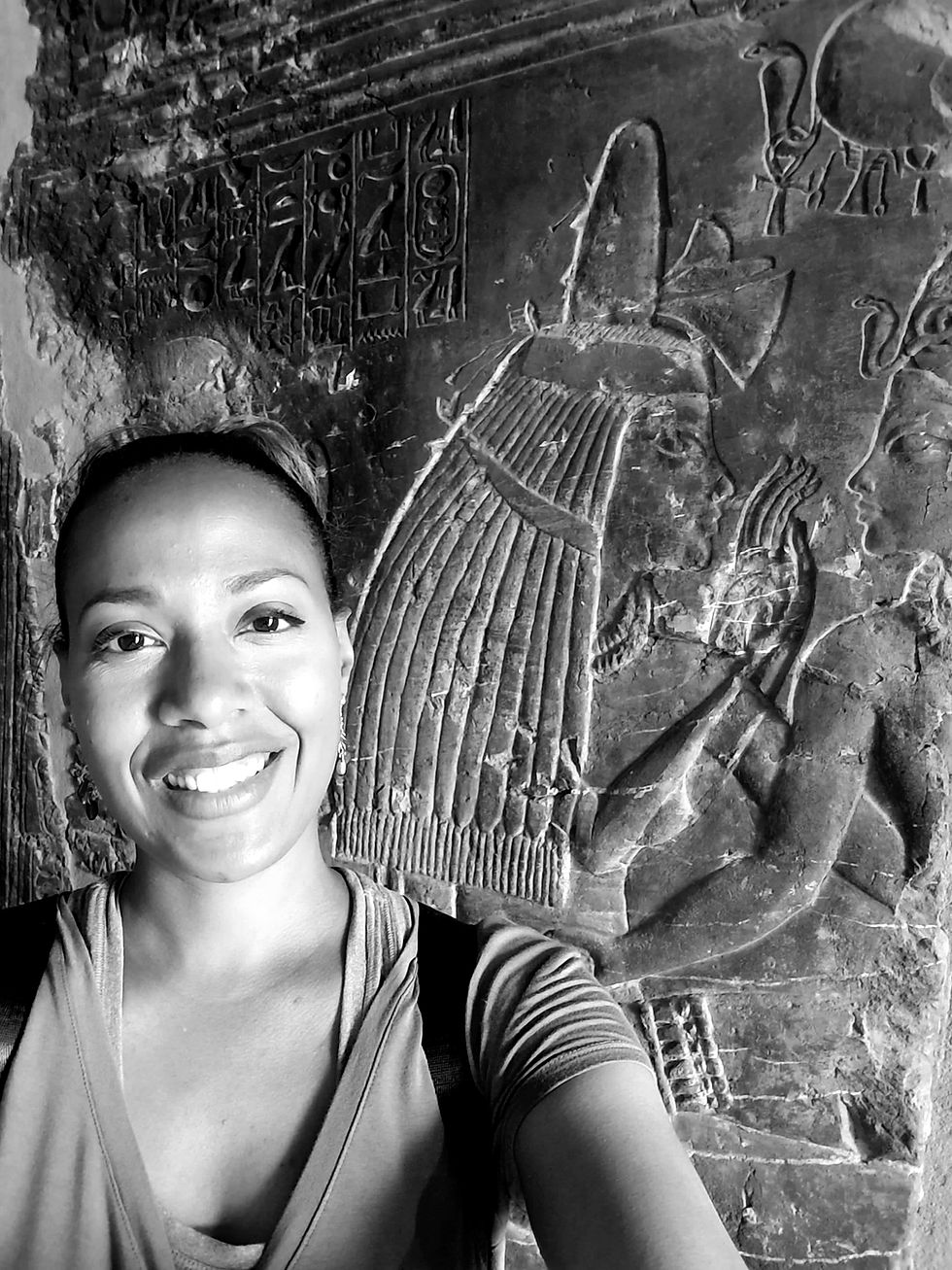
Amanda Victoria Chance, MD, is an Internal Medicine board-certified physician reviving ancient healing practices. Also certified in Lifestyle Medicine, she bridges millennia-old vibrational wisdom with evidence-based lifestyle interventions-- including nutrition, stress resilience, and non-pharmacological therapies-- to activate whole person care. She co-leads transformative healing journeys in Egypt with her husband-- including resonance-based experiences inspired by Saqqara's legendary "healing hospital," a site documented in Gaia's The Pyramid Code through her husband's grandfather's archival legacy.


Comments