The First Light and The Shadow: Bennu, Atum, and Apep
Before the sun first rose, there was only Nun—the silent, timeless waters of infinite potential. Then came a phoenix, a flash of light, a mound arose, and with it came the first boundary. This is the story of how creation began, and why a serpent still coils at the edge of physical existence, longing for the stillness before the cycle began.

The ancient Egyptians understood that time itself has two faces: Djet (𓆇), the static, completed eternity of the primordial mound, and Neheh (𓎛), the cyclical, ever-renewing eternity of the sun's daily journey. But they also understood that existence itself has boundaries—limits that define where physical form ends and the vastness beyond begins. This is the drama of Bennu, Atum, and Apep.
Part I: The Names and Their Meanings

Bennu (𓅬𓏏𓅆)
The Bennu bird is written with the hieroglyph of a heron (𓅬), often with the phonetic complement -nu (𓏏𓅆). Its name is related to the verb weben (𓅱𓃀𓈖), meaning "to rise" or "to shine forth."
The Bennu represents:
The primordial life force that first stirred in Nun
The rising sun (and thus, rebirth)
The cycle of renewal that animates all creation
Pyramid Text Utterance 600 directly links the king to this primordial bird:
"I am the Bennu, the soul of Ra, the guide of the gods in the Duat."

Atum (𓇯𓁷𓂋𓅆)
The name Atum derives from the verb tem (𓂧𓅓𓏏𓁐), meaning "to complete" or "to finish." Atum is the "Complete One"—the first differentiated being, the primordial mound that rose from Nun.
His hieroglyphs include:
The divine standard (𓊹)
The mound or hill (𓇯𓁷𓂋𓅆), representing the first land
Pyramid Text Utterance 527 records his self-creation:
"O Atum! When you came into being, you rose up as a high hill. You shone on the benben-stone in the Mansion of the Phoenix."
Atum is complete—he exists in both physical and spiritual dimensions. He is the first material form (the mound) and the first self-aware consciousness (the god who speaks creation into being).

Apep (𓉔𓂝𓂧𓏏𓈖𓐍𓏏𓅆)
Apep is written with the hieroglyphs for a serpent (𓆙) and the determinative for "great" or "enemy." His name likely derives from pp, "to slither" or "to crawl," combined with Ꜥꜣ, "great"—"The Great Crawler."
Apep embodies:
The shadow of the first form—the physical boundary of Atum
The limit of material creation, the place where the mound ends and the vastness of Nun begins
The edge of physical existence, not the darkness of Nun, but the darkness created by light meeting form
Pyramid Text Utterance 228 speaks of him:
"The coiled one who will be pierced, who will be cut down, who will be driven from the sky."
Part II: The Story of First Light
In the beginning, there was only Nun—the inert, timeless, undifferentiated waters of potential. Nun was not empty; it was full of every possibility, every form not yet made manifest. It contained both the potential for light and the primordial darkness (Kkw) that was simply the absence of illumination—neutral, peaceful, undifferentiated.
From Nun, came Bennu.
The Bennu bird—the first stirring of life, the first pulse of awareness—rose from the waters. As it lifted its wings, it shone forth (weben) with a light that had never before existed. This was the first light in all of creation. Bennu carried within it the quality of its source—Nun—but was also something new: the impulse toward manifestation, toward form, toward differentiation.
As Bennu's light streamed across the primordial waters, it struck something that had always been there but had never been seen—the primordial mound, the first land, the first form rising from Nun. This mound was Atum, the "Complete One," the first differentiated being. Atum was a limit in the vastness—a place where form began, and where the formless ended.
Bennu's light revealed Atum, and in that revelation, Atum himself became a source of light, the first sunrise. The mound now shone, a beacon of form and order in the midst of infinite potential.
But where there is form, there must also be boundary.
As Bennu's light shone upon Atum, the mound cast something that had never before existed in Nun: a shadow (Ḥꜣb). This was not the primordial darkness (Kkw) that had always been part of Nun. This was something new—a defined absence, a place where the light of the mound did not reach, a limit to Atum's radiance. It marked precisely where the physical form of Atum ended and the vastness of Nun began.
This shadow was Apep.
Part III: Understanding the Shadow of Physical Form
Now we must understand precisely what Apep is—and what he is not.
What Apep Is
Apep is the shadow of Atum. He marks the physical limit of the first created form. He shows us where Atum's material aspect ends. He is the edge, the boundary, the place where the Complete One ceases to occupy space.
Quality | What It Reveals |
What Apep reveals | A silhouette of Atum's physical form (the primordial mound) |
Nature of the shadow | Vulnerabilty— "Here, the physical form is without light" |
Relationship to sunlight | The shadow (Apep) can be forced to move by the cycles of the sun; which helps Atum avoid vulnerability. |
Relationship to Atum | Reveals only Atum's outer, physical limits—not his inner radiance (lifeforce/spirit) |
What Apep Is Not
Misconception | Correction |
Apep is the primordial darkness of Nun | No. The darkness of Nun (Kkw) was always there, undifferentiated. Apep is created by the interaction of light and form. |
Apep is evil | No. He is necessary—the inevitable consequence of physical form. |
Apep fights to destroy light | No. He fights against the movement that distorts his fixed boundary. |
Apep reveals Atum's spiritual nature | No. A shadow only shows the physical limit. It does not touch the radiance within. |
Apep is the grey zone—neither the pure light of Bennu nor the primordial darkness of Nun. He is something new: the created boundary that only exists because form exists.
Part IV: The Shadow's Longing
In the beginning, Apep was at peace. He was the shadow of Atum, the companion to the luminous mound. Together, they formed a whole: physical form and its necessary limit.
But then came Bennu's second gift: movement.
Bennu's light did not remain still. It became Ra, the sun, who began the first journey across the sky. And with Ra's movement came something unprecedented: shifting shadows.
Now Apep was no longer the single, eternal shadow of the eternal mound. Each day, as Ra moved, new shadows were cast. Apep found himself stretched, distorted, forced to become something new with each passing hour. Worse still, each night, as Ra descended into the Duat, Apep was confronted, battled, and beheaded by the sun god and his protectors, only to reform and face the same fate again the next night.
Apep remembered the beginning.
He remembered the time before Ra, before movement, before the endless cycle of death and rebirth. He remembered when he was the single, perfect, eternal shadow of Atum—when he had a fixed place, a fixed form, a fixed identity. He marked the physical limit of the Complete One, and in that marking, he had purpose and peace.
He began to long for return.
Not to destroy light—light was his origin, his necessary counterpart. Not to conquer Bennu—Bennu's light had given him existence. But to return to the stillness of that first boundary, to escape the endless distortion of the moving sun, to be once again the single, quiet edge of physical form.
Apep wanted to go back to the first limit.
This is why Apep attacks the solar barque each night. He is not fighting against light; he is fighting against the principle of cycle itself that stretches and distorts him. He represents the longing for static boundary over moving boundary, the desire for the "peace" of the first physical limit over the endless work of being reshaped each day.
Part V: A New Kingdom Confirmation—The Shadow Upside Down
While our understanding has been built on the foundation of the Pyramid Texts of the Old Kingdom, a remarkable scene from the New Kingdom provides visual and textual confirmation of Apep's nature as the inverted shadow of physical form.
In the tomb of Seti I (Valley of the Kings, KV17), and also in the tomb of Ramesses I (KV16), the Third Hour of the Book of Gates depicts a powerful scene: the creator god Atum stands facing the great serpent Apep.

The inscription accompanying this scene reads:
What Atum has done for Ra:
to glorify the god,
to overthrow the rebel.
(Spoken by Atum)
"You are upside down so you can't stand.
You are bewitched so that you can't find yourself.
My father has triumphed over you,
I have triumphed against you.
I have driven you away on behalf of Ra.
I have punished you on behalf of Akhty."
The Meaning of "Upside Down"
This image and its words are profoundly revealing:
Element | What It Reveals About Apep |
"You are upside down" | A shadow is always an inversion of the form that casts it. It has no independent orientation; it merely reflects the shape of the physical body upside down and reversed. |
"So you can't stand" | A shadow has no substance. It cannot stand on its own because it has no independent existence. It is only the outline of another. |
"You can't find yourself" | Apep, as the shadow, has no independent identity. He is defined entirely by what he is not—the absence of light where form blocks it. He cannot "find himself" because he is not a self; he is a boundary. |
Who Is Akhty?
Etymologically, akh shares roots with ꜣḫt ("akhet"), symbolizing the transitional horizon of dawn and cosmic emergence, both deriving from the root ꜣḫ, meaning "to shine," "to be effective," or "to appear gloriously." This connection identifies Akhty as a deity of transition, linking earthly life, death, and the eternal cosmos through horizon imagery, where the rising sun signifies the renewal of the akh (the transfigured spirit of the deceased). The phrase weben Ra em akhet translates to "the sun rises out of the horizon," with Akhet as the location and Weben as the action of rising.
The name Akhty can mean "He of the Two Horizons" —a standard epithet for the sun god Ra in his daily journey. Ra is the one who appears in the eastern horizon at dawn, travels across the sky, and disappears into the western horizon at dusk. "Akhty" emphasizes his mastery over both the place of rising and the place of setting.
When Atum says, "I have punished you on behalf of Akhty," he means:
"I have defeated you on behalf of the Lord of the Two Horizons."
This aligns perfectly with the scene's context: Atum, the primordial creator, acts to protect Ra from Apep during the nightly journey through the Duat. Ra is the one who moves between the horizons, and Apep's longing for stasis threatens that movement.
Atum Triumphs Over His Shadow
The scene culminates with Atum declaring victory over the serpent. This is not the victory of one god over another, but the form asserting its primacy over its own shadow. The shadow cannot overcome the form that casts it. Atum—the Complete One, the first form—remains eternally sovereign over the boundary he created simply by existing.
This scene, carved over a thousand years after the Pyramid Texts were inscribed, demonstrates the remarkable continuity of Egyptian theological understanding. Apep is consistently portrayed as:
The defeated one
The inverted one
The one who cannot stand independently
The one whose existence is entirely derivative of the form that casts him
Part VI: The Eternal Drama
Every night, as the sun descends into the Duat, the drama repeats:
1. Ra enters the underworld, carrying the light of Bennu, the power of cyclical renewal.
2. Apep rises from his slumber, longing for the stillness of the first boundary, his massive serpent body coiled with the pain of endless distortion.
3. Atum, the primordial form, confronts his own shadow, declaring: "You are upside down so you can't stand."
4. The gods who accompany Ra battle the serpent, not out of hatred, but out of necessity—the cycle must continue.
5. Apep is beheaded, his body hacked apart.
6. But because he is the eternal shadow of the first physical form, the inevitable limit of material existence, he cannot be destroyed permanently. He reforms in the darkness, waiting for the next night's battle.
7. Ra emerges at dawn, victorious, his light undiminished, greeted by Akhty—the Lord of the Two Horizons—once again.
This is not a story of good triumphing over evil. It is a story of the eternal relationship between form and its limit:
Apep is the necessary boundary of physical creation. He longs for stillness and must be overcome each night—not because he is evil, but because movement is the price of life.
Atum is the primordial form whose very existence created this boundary. He does not destroy his shadow; he defeats it, again and again, maintaining the order of creation.
Ra (Akhty) is the light that moves between horizons, that cycles, that brings life through its very movement. He must be protected from Apep each night—not out of hatred, but because stasis would mean death.
Part VII: The Deeper Meaning for Human Beings
Every human being contains within themselves the same dynamic. We each have:
Our Physical Boundary (The Apep Within)
Your body has edges. You occupy space. Where you end and the world begins is a real, necessary limit. This boundary:
Marks the physical limit of your material existence
Is revealed by light—you cast a shadow
Can feel like confinement
Sometimes longs to dissolve, to escape the pain of being limited
Will eventually fail (the body dies)
The Light That Moves Within You (The Ra Within)
But you also have something that Apep does not touch—your inner radiance, your consciousness, your essential being. This:
Is not bounded by physical limits
Cannot be shadowed
Continues on its own journey between horizons—the horizons of birth and death, waking and sleeping, action and rest
Pyramid Text Utterance 365 speaks of this radiance:
"The king is an akh with the akhs, a star in the sky, a light on the path of the Duat."
Atum's Lesson: You Are More Than Your Shadow
Atum's declaration to Apep—"You are upside down so you can't stand"—is also a message to us. The shadow we cast, the physical limits we inhabit, cannot stand on its own. It has no independent existence. It is merely the outline of something greater.
You are not your shadow. You are the form that casts it.
Part VIII: What This Means for Us
The ancient Egyptian path teaches us to:
1. Acknowledge the physical limit (the Apep within us) without being trapped by its longing for dissolution. Your body has edges. This is not a flaw; it is what allows you to exist as a separate being.
2. Recognize what the shadow does NOT show. Apep reveals only where your physical form ends. He does not reveal your inner radiance, your consciousness, your essential being. These remain untouched by the limit of the body.
3. Accept the necessity of the cycle. Movement, change, even the daily "defeat" of our physical limits—these are not punishments. They are the conditions of life itself. We move between horizons just as Ra does.
4. Remember that you are the form, not the shadow. When you feel confined by physical limits, when you long for the stillness of non-existence, recall Atum's words to Apep: "You are upside down so you can't stand. You are bewitched so that you can't find yourself." The shadow cannot find itself because it is not a self. You are.
Pyramid Text Utterance 373 speaks of the integration we seek:
"You belong to Djet and to Neheh."
We belong to both eternities—the static completeness of the primordial mound (which includes its shadow) and the cyclical renewal of the moving sun (which journeys between horizons). We are complete when we honor both the limit and the light, both the form and the journey.
Part IX: Summary—The Complete Picture
Element | What It Represents | Nature |
Nun | The undifferentiated source | Contains all potential, both light and primordial darkness |
Bennu | The first light | Emerges from Nun, initiates creation and cycle |
Atum | The first form—physical and spiritual completeness | The Complete One, the mound |
Apep | The shadow of Atum's physical aspect | Marks where physical form ends; the necessary limit of material existence; the inverted one who cannot stand alone |
Ra (Akhty) | The continuation of light into cycle | The moving sun, Lord of the Two Horizons, bringer of life through perpetual renewal |
Apep dwells at the boundary of physical creation. He is the shadow that reveals where Atum's physical form stops. He does not touch the radiant self—only its physical vessel. His longing for the stillness of the first limit is the longing of all physical form for the "peace" of non-movement (death).
But Atum, the Complete One, eternally triumphs over his own shadow. And Ra, the Lord of the Two Horizons, continues his journey between dawn and dusk. The cycle endures. And in that endurance—in the daily victory of light over the longing for stasis—life itself is renewed.
Sources and Further Reading
Old Kingdom Sources (Pyramid Texts)
Utterance 228: "The coiled one who will be pierced, who will be cut down, who will be driven from the sky."
Utterance 527: The creation text describing the emergence of Atum from Nun and the state of pre-creation.
Utterance 600: Reference to the Bennu bird as the soul of Ra.
Utterance 365: The king as an akh among the stars.
Utterance 373: The king belongs to Djet and Neheh.
New Kingdom Source
Book of Gates, Third Hour: From the tomb of Seti I (KV17) and Ramesses I (KV16). Scene of Atum repelling Apep with the inscription: "You are upside down so you can't stand. You are bewitched so that you can't find yourself. My father has triumphed over you, I have triumphed against you. I have driven you away on behalf of Ra. I have punished you on behalf of Akhty."
An Invitation to Witness the Boundary
This drama is not merely myth. It is enacted every dawn and every dusk, in the rising and setting of the sun, in the cycles of the Nile, in the seasons of planting and harvest, in the rhythm of our own breath and heartbeat—and in the eternal relationship between our physical limits and the light that moves within us.
We invite you to experience this boundary where it was first recognized and honored.
On our journeys, we visit:
The Temples of the Sun (Ra) at Abu Ghurab, where the sun's daily journey was celebrated and the nightly battle with Apep was understood.
The Tombs of the Kings, where this eternal drama was depicted on the walls, ensuring the king's participation in the victory of light over stasis.
About the Author
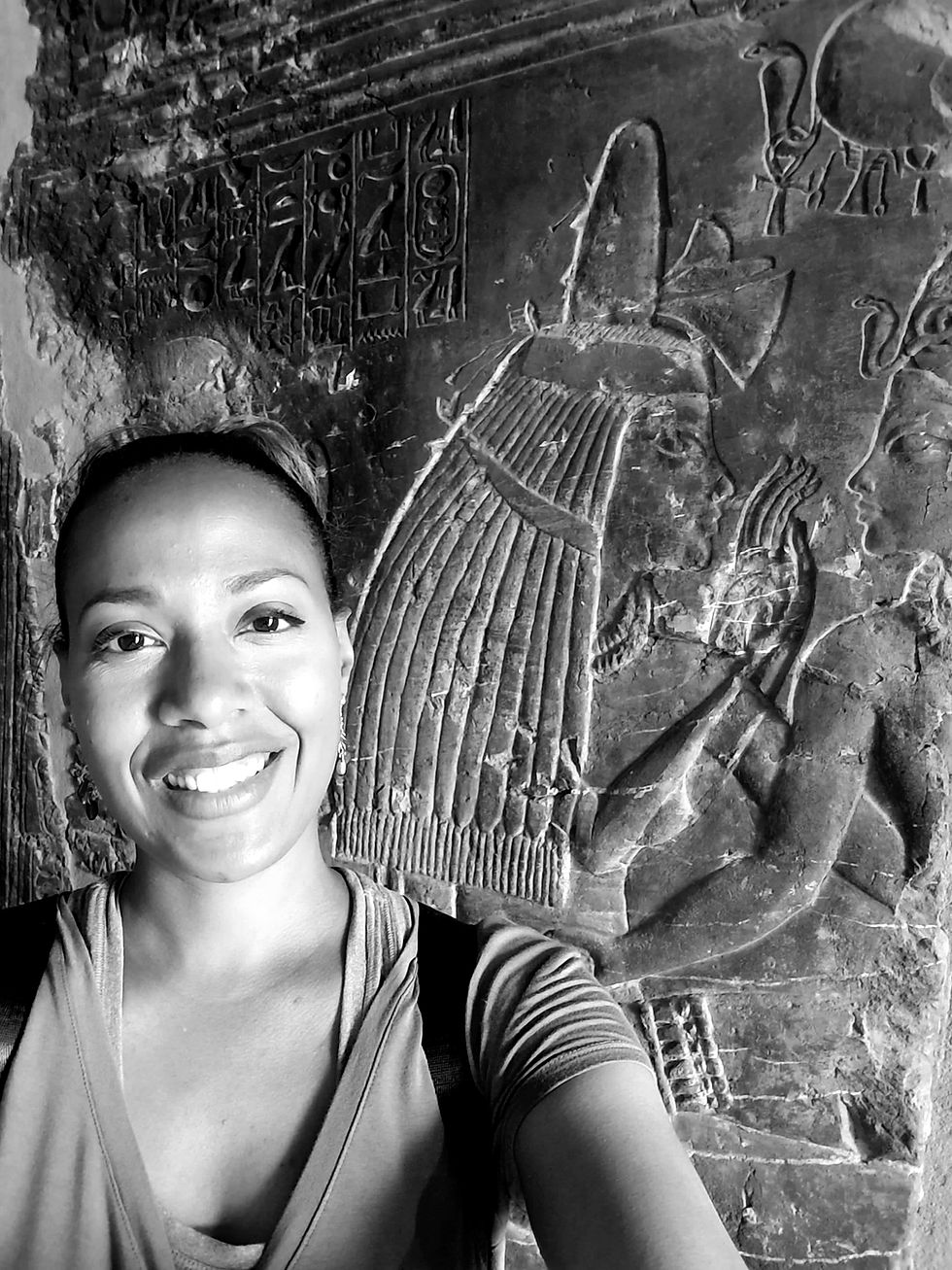
Amanda Victoria Chance, MD, is an Internal Medicine board-certified physician reviving ancient healing practices. Also certified in Lifestyle Medicine, she bridges millennia-old vibrational wisdom with evidence-based lifestyle interventions-- including nutrition, stress resilience, and non-pharmacological therapies-- to activate whole person care. She co-leads transformative healing journeys in Egypt with her husband-- including resonance-based experiences inspired by Saqqara's legendary "healing hospital," a site documented in Gaia's The Pyramid Code through her husband's grandfather's archival legacy.


Comments