The Earth and the Sky: Geb and Nut in the Pyramid Texts
“The whole earth lies under thee; thou hast taken possession of it; thou encompassest the earth and all things therein in thine arms.”
— Pyramid Text Utterance 432
The air god Shu lifted his daughter Nut—the sky—above his son Geb—the earth—and in that space between, all life became possible. Geb and Nut are the second generation of the Heliopolitan creation, the children of Shu and Tefnut, and the parents of Osiris, Isis, Set, and Nephthys. They are not distant deities but the very ground beneath our feet and the vast expanse above our heads.

The Names and Their Hieroglyphs
Geb (𓅬𓃀𓀭)
The name Geb (Egyptian: gb) is one of the most ancient divine names in the Egyptian language. Its earliest appearance is in the Pyramid Texts, where it is written with the hieroglyph of a goose (𓅬) followed by the foot sign (𓃀) and the seated god determinative (𓀭). The goose, specifically the Alopochen aegyptiaca, was sacred to Geb, and in some traditions, he was called the “Great Cackler” who laid the cosmic egg from which the sun emerged.
Geb is the god of the earth, the solid ground upon which all life rests. He is said to be the lord of snakes and natural elements, the source of vegetation, and the foundation of the tomb. His laughter caused earthquakes, and his body was the fertile soil that received the seeds of the dead. He is the father—the divine progenitor—of the kings, the one who grants the throne to his descendants, and the minerals of wealth to his heirs. Geb creates and legitimizes the mortal rulers. In the afterlife Geb was appointed as judge of his children— gods and men— establishing him as a final arbiter of justice.
Nut (𓏌𓏏𓀭)
The name Nut (Egyptian: nwt) is written with the hieroglyph of a water pot (𓏌) followed by the feminine ending t (𓏏) and the goddess determinative (𓀭). Her name may be related to the word for “water” (nw), reflecting her connection to the primordial waters from which she emerged.
Nut is the goddess of the lower sky and earth mothers. She is the great celestial arch that stretches from horizon to horizon, her body covered with stars. She is seen from the Earth, swallowing the sun each evening and giving birth to it each morning, making her the "mother of the sun god" himself. She is the protector of the dead, the one who spreads herself over the mummy to shield it from the forces of "chaos."
Core Identity
Geb: Earth God and Divine Ancestor
Geb is one of the Heliopolitan Ennead, the god of the earth, and the husband of the sky goddess Nut. As the son of Shu and Tefnut, he is not only the father of Osiris, Isis, Set, and Nephthys but also a key figure in the entire divine lineage of kingship, and the grandfather of Horus.

Major Characteristics
Divine Creator and Ancestor: The texts explicitly identify Geb as the guarantor of the king's divine origin. For example, Utterance 247 states: "Hail to you, Wise One! Geb has created you, the Ennead has given you birth." The "king" is also frequently referred to as the "heir of Geb."
Guardian and Guide of the Deceased: Geb acts as a benevolent guardian who welcomes the deceased king into the afterlife. Utterance 214 instructs the king: "Enter the place where your father is, where Geb is! He gives you what is upon the forehead of Horus..." In Utterance 368, Geb is described as being gracious to the king and assisting the god Thoth in reassembling Osiris's—the first king's—body.
Arbiter of Fate: Geb appears to possess the power to determine an individual's destiny. Utterance 214 states that anyone who speaks evil against the just king will be "predestined by Geb to be a despised one of his city."
An Authority That Can Be Challenged: Despite Geb's immense power, the Pyramid Texts also show that the king, through potent magic, could challenge or even control his power. In Utterance 231, the king declares: "Unas has bitten the earth, Unas has bitten Geb." This is a highly symbolic act of conquest. The king even threatens to curse Geb, leaving him unable to defend himself.
Personification of the Earth: As the earth god, Geb is intimately connected to the physical world and with the earth as the realm of the dead. However, while he is the god of the earth, the earth itself is often seen as a place of decay to be avoided. The Pyramid Texts state, "the earth is an abomination for the deceased, he shall not enter into Geb so that he will not decay." Therefore, the deceased king seeks to transcend this earthly corruption and ascend to the sky.
A Core Member of the Divine Genealogy: Geb is a member of the Heliopolitan Ennead, the son of Shu and Tefnut, and the father of Osiris, Isis, Seth, and Nephthys. In Utterance 534, Horus even calls upon Geb to make an offering, suggesting he plays a role in divine rituals.
In summary, the Geb of the Pyramid Texts is far more than a simple "earth god." He is a complex, multifaceted deity: he is the divine ancestor who creates the king, the guardian who welcomes him into the afterlife, the arbiter who determines destinies, and an authority whose power can be challenged by the king's magic. He represents both the source of life (as the ancestor) and the realm of death and rebirth (as the earth itself).
Nut: The Starry Sky who Embraces the Dead
Nut is the goddess of the lower sky, which projects the stars, the cosmos, and the universe to the earth as the celestial sphere. She is the daughter of Shu (air) and Tefnut (moisture), the sister-wife of Geb (earth), and the mother of Osiris, Isis, Set, and Nephthys. She is the great celestial arch that stretches from horizon to horizon, her body covered with stars.

Major Characteristics
1. The Divine Mother: Nut is the mother of the king and the mother of the future gods. In Utterance 1 of the Pyramid Texts, she repeatedly claims the first king (Osiris) as her son, her firstborn, the opener of her womb. She gives him the horizons (Utterance 6), the Duat (Utterance 7), and her special love (Utterance 7). She is the source of his divine legitimacy.
2. The Protector of the Dead: In Utterance 446, Nut spreads herself over the king to protect him from all evil. She hides him from Set, guards him from harm, and embraces him in her arms. She is the Great Sieve (protectress) who sifts out evil and the protective canopy that shields the deceased.
3. The Cosmic Encompasser: Nut is the lower sky itself—the vast, starry vault that projects the universe onto the earth. In Utterance 432, she is described as filling every place with her beauty and encompassing the earth in her arms. She is above her father Shu and contains all the earth gods within her.
4. The Source of Rebirth: The Pyramid Texts describe Nut as the one who can make the king “spiritually mighty” in her womb. In Utterance 431 and 432, she is the Granary who sustains life and the one who can establish the king as an “imperishable star”.
5. The Guide to the Afterlife: Nut receives the king as he ascends to the sky, opens her place in heaven for him, and welcomes him among the stars. Utterance 245 states that she is the gateway to the afterlife, the ladder or arms that reach down to guide the deceased up to the sky.
Nut is not a distant, abstract goddess. She is the sky that arches above us, the stars that guide us, and the embrace that welcomes us after death. She is the mother who claims us as her own, and the protector who shields us from harm. When we look up at the night sky, we are looking at Nut. When we feel the vastness of the universe, we are feeling her embrace. And when we die, if the Pyramid Texts are to be believed, she will open her place in heaven for us, and we will become among the stars.
The Pyramid Texts: The Voice of the Old Kingdom
The Pyramid Texts are the oldest body of religious literature in the world, and they contain numerous references to Geb and Nut. These references establish them as the parents of the king, the guardians of the throne, and the eternal witnesses to the king’s transformation.
Utterance 1: Nut Claims the King as Her Son
In Utterance 1 (Pyramid of Unas), Nut speaks directly, claiming the king as her own child:
“To say by Nut, the brilliant, the great: This is (my) son, (my) first born, N., opener of (my) womb; this is (my) beloved, with whom I have been satisfied.”
This is a powerful declaration. The king is not merely a mortal ruler; he is the son of the sky itself, born from the cosmic womb. His legitimacy is divine, rooted in the very fabric of creation.
Utterance 2: Geb Claims the King as His Son
In Utterance 2, Geb responds in kind:
“To say by Geb: This is (my) son, N., of (my) body.”
The king is not only the child of the sky but also the offspring of the earth. He is the union of heavenly vault and earth, the living link between the divine and the mortal realms. This dual parentage—Nut above and Geb below—establishes the king as the axis mundi, the central pillar around which life on earth revolves.
Utterance 3: The Inheritance of Geb
In Utterance 3, the king is described as the heir of Geb:
“To say by Nut, the great, who is within the lower mansion: This is (my) son, N., (my) beloved, (my) eldest (son), (who is) upon the throne of Geb, with whom he has been satisfied, to whom he gave his inheritance in the presence of the Great Ennead.”
The throne of Egypt is not a human invention; it is the throne of Geb, the earth god, passed down through the generations. The king rules not by his own power but as the steward of the earth itself.
Utterance 368: The Protection of Nut and Geb
In Utterance 368 (Pyramid of Pepi I), Nut and Geb are invoked together to protect the king:
“Words spoken by Osiris… Your (mother) Nut (spreads herself) over you in her name… For you are the greatest of her children. Geb is gracious to you… He has given you your head… He has caused Thoth to reassemble you.”
Here, Nut spreads herself over the king like a protective canopy, while Geb provides the foundation and the restoration of the body. Together, they ensure the king’s resurrection and eternal life.
Utterance 429: Geb Praises Nut
One of the most beautiful passages in the Pyramid Texts is Utterance 429, where Geb speaks directly to Nut:
“To say by Geb: Nut, thou art become (spiritually) mighty: thou wast (already physically) mighty in the womb of thy mother, Tefnut, before thou wast born.”
This is a hymn of praise from the earth to the sky. Geb acknowledges Nut’s pre-existence and her power, which was present even before her birth. The utterance continues with a protective command:
“Protect N. with life and well-being. He shall not die.”
Utterance 432: Nut Encompasses the Earth
In Utterance 432, Nut describes her own power:
“Great lady, who didst become heaven, thou didst become (physically) mighty, thou art become victorious, thou hast filled every place with thy beauty. The whole earth lies (lit. is) under thee; thou hast taken possession of it; thou encompassest the earth and all things (therein) in thine arms.”
This is a breathtaking image. Nut is not merely the sky above; she is the encompassing presence that holds the entire world in her embrace. She is both the vault of heaven and the protective mother who shelters all creation.
Utterance 433: Geb Fertilizes Nut
In Utterance 433, Geb speaks of his union with Nut:
“To say: I have fertilized thee as Geb, in thy name of ‘Heaven’; I have united to thee the whole earth in every place.”
This is the cosmic marriage of earth and sky, the creative union that brings forth life. Geb’s fertilization of Nut is not merely a myth; it is the eternal principle of generation that sustains the world.
The Separation: Shu Between Geb and Nut
One of the most iconic images in Egyptian cosmology is that of Shu—the god of air—standing between Geb and Nut, holding Nut aloft with his arms. This separation created the space in which life could flourish. Geb lies beneath, his body covered with vegetation, while Nut arches above, her body adorned with stars.
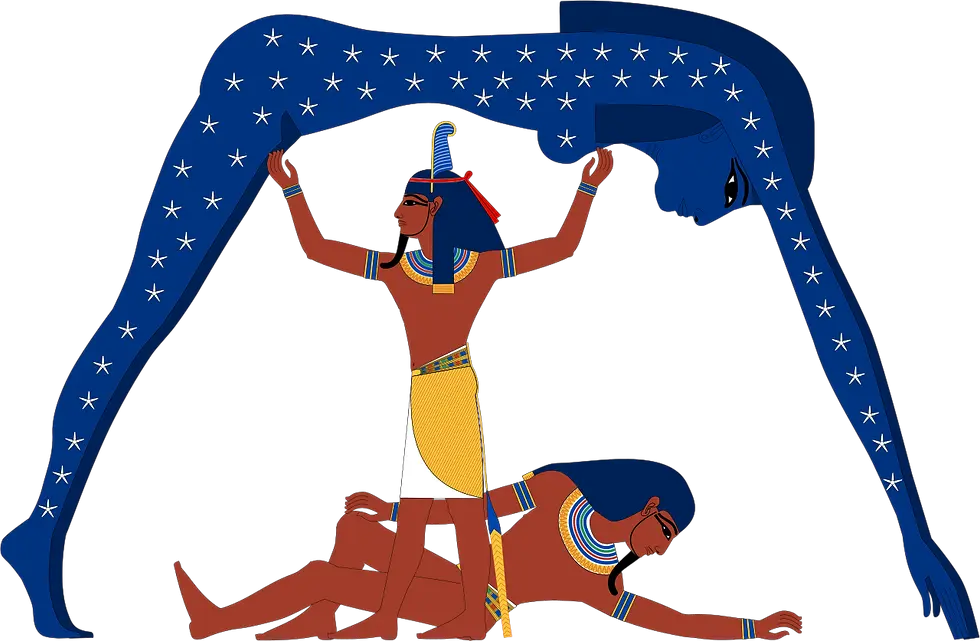
In the Pyramid Texts, this separation is not described directly, but it is implied in the way Nut is said in Utterance 434 to be “above her father Shu.”
"High one over the earth, thou art above thy father Shu, who hast the mastery over him."
The phrase emphasizes her authority, which exists in a state of dynamic tension with her father Shu's supportive role. Shu separates Nut from Geb by lifting her up. In this sense, he supports her, placing himself "under" her. The text asserts that despite being supported by her father, Nut is not a passive recipient of his support, but an active force that has mastered the forces of her father—the breath of life. The separation is not a punishment but a necessary act of creation, allowing life on earth to come into being.
The Egyptian Sky Reimagined: A Three-Layer Model of Protection
The ancient Egyptians saw the sky not as empty space but as a layered, protective system. The ground beneath them was Geb, the solid earth. The air they breathed and the rain that fell were Shu and Tefnut—the dynamic, moving forces of the solar thermal cycle. But above this was Nut: the seemingly vast, starry vault, the "mother" of the sun, the protective shield that encompassed the earth in her arms. Today, we call these layers the atmosphere. The Egyptians called them Shu, Tefnut, and Nut. And they understood, without our instruments, that the sky that contains us is not empty—it is a mother, protecting us from the space beyond.
Geb: The Solid Foundation (The Earth)
Location: The entire earth, including the lithosphere, the solid ground, the stable base
Function: The physical container of all life; the source of minerals, vegetation, and the tomb.
PT Reference: “I have fertilized thee as Geb... I have united to thee the whole earth.” (Utterance 433)
Shu & Tefnut: The Dynamic Atmosphere (The Troposphere & Lower Stratosphere)
Location: The earth's atmosphere where weather, clouds, and the water cycle occur.
Function: The active, moving layer—the solar thermal cycle that drives air and moisture, creating the conditions for life and weather.
Modern Parallel: Shu = warm, rising air; Tefnut = moisture that condenses and falls as rain.
PT Reference: “Atum did spew out as Shu, and did spit out as Tefnut.” (Utterance 600)
Nut: The Protective Shield (The Upper Atmosphere, Magnetosphere, and Cosmic Boundary)
Location: The layers above the troposphere—from the stratosphere (with the protective ozone layer) through the mesosphere, thermosphere, and extending to the boundary of Earth's magnetic influence (the magnetosphere that anchors the upper atmosphere and protects the air we breathe).
Function: The overarching protective container. Nut is the mother who:
Absorbs harmful radiation (like the ozone layer).
Burns up meteors (like the mesosphere).
Deflects solar wind (like the magnetosphere).
Projects the stars (like the exosphere, where satellites orbit and the sky becomes space).
PT Reference: “Great lady, who didst become heaven... thou encompassest the earth and all things therein in thine arms.” (Utterance 432)
A Visual Summary
Layer | Egyptian Deity | Function |
Solid Foundation | Geb | The earth itself— the ground, the tomb, the source of minerals and vegetation. |
Dynamic Atmosphere | Shu & Tefnut | The air and moisture— the solar thermal cycle, weather and the breath of life. |
Protective Canopy | Nut | The sky— the starry vault, the mother of the sun, the protective canopy that projects the stars. |
Cosmic Boundary | Ra | The Sun— the energy that drives the system, the boundary between Earth and the cosmos. |
Why This Works
Nut is described in the Pyramid Texts as the one who spreads herself over the king, hides him from evil, and encompasses the earth in her arms. These are precisely the functions of the upper atmosphere and magnetosphere:
Spreads herself over = The protective canopy that wraps the planet.
Hides from evil = Shields against harmful solar radiation, i.e. Set.
Encompasses the earth = The boundary that contains the entire system.
Shu and Tefnut, by contrast, are the dynamic, moving layer—the air we breathe and the water that falls. They are the active forces of the solar thermal cycle. Nut is the stable, encompassing container within which those forces operate.
A Deeper Insight: The Boundary Between Worlds
Nut is also the boundary between the Earth and the cosmos. In Egyptian thought, she is the "mother" of the sun (Ra), who swallows him each evening and gives birth to him each morning. This is the daily crossing of the boundary between the visible world and the hidden world—the Duat.
In modern terms, the boundary between the atmosphere and space (the Kármán line) is a similar threshold: the point where the Earth's protective bubble ends and the vast cosmos begins. Nut is that threshold, the mother who projects the beauty of the sun and stars from her body, and who protects the Earth from the chaos beyond.
“Great lady, who didst become heaven, thou didst become (physically) mighty, thou art become victorious, thou hast filled every place with thy beauty.” — Pyramid Text Utterance 432
The Children of Geb and Nut: The Ennead
Geb and Nut are the parents of the four principal deities of the Egyptian pantheon: Osiris, Isis, Set, and Nephthys. Together with Atum, Shu, and Tefnut, they form the Great Ennead of Heliopolis, the nine gods who represent and maintain the cosmos.
A Modern Reflection: The Earth and the Cosmos
Today, we still live between earth and sky. We still look up at the stars and wonder. We still plant seeds in the soil and wait for the rain.
Geb and Nut remind us that we are not separate from the cosmos. We are the children of the earth and the sky—the descendants of the great separation that made life possible. When we walk on the ground, we walk on Geb. When we gaze at the stars, we gaze at Nut. And when we die, we return to both: the body to the earth, the spirit to the stars.
“The whole earth lies under thee; thou hast taken possession of it; thou encompassest the earth and all things therein in thine arms.”
— Pyramid Text Utterance 432
About the Author

Amanda Victoria Chance, MD, is an Internal Medicine board-certified physician reviving ancient healing practices. Also certified in Lifestyle Medicine, she bridges millennia-old vibrational wisdom with evidence-based lifestyle interventions-- including nutrition, stress resilience, and non-pharmacological therapies-- to activate whole person care. She co-leads transformative healing journeys in Egypt with her husband-- including resonance-based experiences inspired by Saqqara's legendary "healing hospital," a site documented in Gaia's The Pyramid Code through her husband's grandfather's archival legacy.


Comments