The Stages of the Sun: Oral Tradition from Abd'el Hakim Awyan & the Pyramid Text
“Greetings to you, Atum. Greetings to you, Khepri, who created himself… You come into being, in your name of ‘Khepri’.”
— Pyramid Text Utterance 587
Before the Greeks articulated their ages of mankind, before the Hindus spoke of yugas, the priests of the Nile had already divided the solar journey into sacred stages. This is not merely astronomy; it is a cosmology of the soul. Each stage corresponds not only to a position of the sun in the sky but to a phase of human life, a state of consciousness, and an aspect of the luminous self.

The oral tradition passed down from Abd’el Hakim Awyan to his grandson Mohammad teaches that the sun’s daily arc reveals distinct phases, each with its own lesson for the human spirit. Placed on a 360‑degree circle, the stages are:
Kheper (Khepri): 0° to 45° – the rising sun, emergence, birth
Ra: 46° to 135° – the working sun, from youth to full maturity
Atum: 136° to 180° – the setting sun, completion, the elder
The Hidden Sun: 181° to 360° – the hidden sun, the night journey, the source
Let us walk through a typical Egyptian day, from first light to the hidden dawn, and discover what the Pyramid Texts and living wisdom tell us about each stage—and how they mirror the arc of a human life.
Stage 1 – Kheper (𓆣𓃀𓃀𓂋𓁛): The Rising Sun (0°-45°)
What the Pyramid Text Says
The scarab‑faced god Khepri (also spelled Kheper) represents the rising or morning sun. His name is derived from the verb ḫpr, “to come into being,” which captures the very essence of the moment of emergence from darkness.
Pyramid Text Utterance 587 declares:
"Greetings to you, Atum. Greetings to you, Khepri, who created himself… You come into being, in your name of ‘Khepri’.”
Utterance 600 adds: “I am Khepri, the one who came into being from Nun.”
The Time and Position
Just before dawn, the sun is a small, red‑gold disc on the eastern horizon. It has just emerged from the waters of Nun, the primordial dark ocean of potential. This is stage 1, the solar birth.
The Human Parallel: Infancy and Childhood
Kheper is the stage of pure potential, the moment of awakening consciousness. It corresponds to infancy and early childhood—the years before the individual takes on the active “work” of life. The child receives life force (Ka) and begins to form a unique personality (Ba), but the heavy labor of maturity has not yet begun. This is the seed‑time of existence.
Stage 2 – Ra (𓁛𓁜𓀭): The Working Sun (46°‑135°)
What the Pyramid Text Says
Ra is the Egyptian word for “sun.” In the Pyramid Texts, Ra is the great god who rides in his Mandjet (day barque) across the heavens, providing light and warmth to the world. Ra is a universal deity, who acted in the celestial, terrestrial, and netherworld realms, and was often presented as the supreme creator who emerged from the primordial waters. One source from the period states: “Ra is the Egyptian word for 'sun’. As a solar deity, Ra embodied the power of the sun but was also thought to be the sun itself, envisioned as the great god riding in his barge across the heavens throughout the day.”.
Crucially, the ancient Egyptians believed that the sun god did not rest; he was constantly working. The life of Ra did not boil down to passive existence within the sky, but rather his celestial travel across the sky: during daylight hours, he soared in the skies bringing warmth, light, and growth to plants. Each twelfth of his journey formed one of the twelve Egyptian hours of the day, each overseen by a protective deity. During the evening hours, he battled Apep and rose victoriously the next morning.
In the Pyramid Texts, “Re is perpetually resurrected in the mornings in the form of a scarab beetle, Khepri … the sun god Re had several aspects: Khepri, the morning; Horakhty, the midday; and Atum, the afternoon.” And one ancient text declares: “I am Khepera (Khepri) in the morning, Ra at noontide, and Atmu (Atum) in the evening.”
The Time and Position: From Youth to Full Maturity
Ra is not a single point but a broad arc of the sun’s journey—from 46° (late morning) through 90° (noon) to 135° (early afternoon). This is the long, active middle of the day, when the sun is at its most brilliant and most effective.
Solar Position | Time of Day | Description |
46° | ≈ 9‑10 AM | The sun has risen fully; the world is awake and working. |
90° (zenith) | ≈ 12 PM (noon) | The sun stands at its highest, most powerful, most balanced. |
135° | ≈ 3‑4 PM | The sun is still strong but has begun its gentle descent. |
The Human Parallel: The Working Years
Ra corresponds to the active, working phase of human life—from youth and young adulthood through full maturity. This is the period when a person is most effective, most productive, and most engaged with the world. It is the time of career, family, community contribution, and the building of one’s legacy.
At 46°, the sun is still young in the day, full of promise and growing strength. This mirrors the young adult—the “strong‑minded young adult” of the oral tradition—who has left childhood behind but has not yet reached the fullness of power.
At 90°, the sun reaches its zenith. This is the moment of maximum brilliance, balance, and effectiveness. The modern world would call this “peak career” or “midlife mastery.” In the oral teaching, this is when the man is at his most wise, least jaded, most hopeful—every aspect of the being in perfect equilibrium.
At 135°, the sun is past its peak but still vigorous. This corresponds to the mature elder who still works, still contributes, but now draws on a lifetime of experience.
The king himself was known as the “Son of Ra.” The pharaoh was regarded as Ra’s descendant and successor, and just as Ra put order (Ma’at) in the place of chaos, so the pharaoh’s achievements were described in exactly the same way.. The royal title Sa-Rê (“Son of Ra”) was introduced during the Old Kingdom by Pharaoh Djedefre, the first king to connect his cartouche name with the sun god Ra.
The Three Soul‑Forces at Work
During the Ra phase of life, three essential aspects of the Egyptian soul are fully active and in dynamic balance:
1. The Ka (𓂓) : the life force, the vital battery received from the ancestors. In the working years, the Ka is fully expressed through action, labor, and the maintenance of Ma’at (cosmic order). The king’s Ka was understood to be the foundation of the kingdom’s stability.
2. The Ba (𓅽) : the unique personality, the mobile consciousness. During the working phase, the Ba is the active decision‑maker, the will that chooses how to act in the world. The Ba can travel, perceive, and adapt—essential qualities for the challenges of adult life.
3. The Sheut (𓆗) : often translated as “shadow,” but more accurately a protective sunshade or covering. This is the energetic field that surrounds and protects the luminous self, especially when moving through difficult or unfamiliar realms. In the working years, the Sheut is the unseen shield that guards the individual against the “chaos” (Isfet) of the world, allowing the Ba and Ka to operate effectively.
When these three are integrated—the life force (Ka), the conscious personality (Ba), and the protective field (Sheut)—the individual experiences what the Egyptians called “true of voice” (maa kheru): a state of effectiveness, balance, and alignment with Ma’at.
Iunu (On): The Place of the Working Sun
Iunu (Hebrew transliteration, On, and later called Heliopolis by the Greeks) was the chief cult center of Ra. Its Egyptian name means “Place of Pillars,” referring to the sacred obelisks that marked the temple. Today, these obelisks can be found worldwide.
Iunu is mentioned in the Pyramid Text as the “House of Ra”. Utterance 600 says, "O Atum! When you came into being you rose up as a High Hill, You shone as the BenBen Stone in the Temple of the Benu in Heliopolis."
Iunu is the sacred geography of the working sun—the earthly anchor of Ra’s power. The priests of Iunu believed that they maintained the rituals that kept the sun moving across the sky, just as the pharaoh (the “Son of Ra”) maintained order on earth. The obelisks of Iunu were physical symbols of the sun’s rays, connecting the active, working sky with the active, working kingdom.
Stage 3 – Atum (𓇋𓏏𓂟𓀭): The Evening Sun (136°‑180°)
What the Pyramid Text Says
The name Atum derives from the verb tm, meaning “to complete” or “to finish.” He is the “Complete One” – the sun that has lived through the entire day and now sinks toward the western horizon.
Pyramid Text Utterance 527 (Pyramid of Unas) describes Atum’s first emergence as the primordial mound, but the same utterance is part of a creation theology that also frames his role as the sunset deity:
“O Atum! When you came into being, you rose up as a high hill. You shone on the benben‑stone in the Mansion of the Benu in On.”
This establishes Atum as the original creator, but in the daily solar cycle he is the evening sun. Utterance 363 explicitly places Atum in the west, the direction of sunset:
“Atum, this king has come to you. He is your son, you have made him. He sits upon your throne in the west.”
Utterance 448 (Pyramid of Pepi I) shows Atum exercising his power over the serpentine forces of chaos:
“This is the fingernail of Atum, which is upon the dorsal vertebra of Nehebkau.”
Nehebkau is a great serpent who “harnesses the Kas” (life forces). Atum places his fingernail on the serpent’s spine to subdue and control it – an act of ordering the chaotic potential of the underworld. The image is of the creator god asserting his mastery over serpentine powers.
The Time and Position
From 136° to 180° on the solar circle, the sun descends from mid‑afternoon to the western horizon. At 180° it sets – the moment of completion. The light mellows, shadows lengthen, and the world prepares for rest. This is Atum’s hour.
The Human Parallel: The Elder Years
Atum corresponds to the elder phase of life – the years of completion, harvest, and conscious letting go. The person who has worked through the Ra phase now draws on accumulated wisdom, gives blessing to the next generation, and prepares for the final transition. Like Atum, the elder has “seen everything” and is at peace with the end of the day.
Atum and the Sun: The Setting God
In the Old Kingdom, the solar cycle is often described as a three‑part movement:
Khepri – rising sun (morning)
Ra – midday / active sun
Atum – setting sun (evening)
This is confirmed by later summaries (e.g., Book of the Dead), but the Pyramid Texts already anchor Atum in the west. The king is instructed to “go to the west,” the place of Atum, to join the setting sun and be reborn. Atum completes the daylight journey and hands the sun over to the hidden powers of the Duat (Amun’s realm).
The Soul Aspects at the Atum Stage
During the Atum phase of life, the Ka (life force) is no longer expended in active labor; it is conserved and transformed. The Ba (personality) may begin to turn inward, contemplating the unseen. The Sheut (protective field) remains, but now it shields the elder from the harshness of the world, allowing a peaceful sunset.
Stage 4 – The Hidden Sun (181°‑360°)
What the Pyramid Text Says
When the sun sets, it does not cease to exist; it enters the realm of the hidden. The sun’s nightly journey is a symbolic death and rebirth. In that sense, the sun returns to a state of potential—hidden, silent, yet full of the promise of dawn. The soul rests in Nun and in the protective “shade” of Imn, until it is reborn.
Imn: The Hidden One Who Protects the Potential
In the Pyramid texts, Amun is referenced a single time in conjunction with Nun, the primordial potential. Imn (Amun) is the god whose very name means “the hidden one.” In PT 301, Imn and Imnt are called “sources of the gods” and they “protect the gods with their shade.”
This “shade” (šwt) is not a dark shadow; it is a protective covering, a canopy, a shelter. It is the safe enclosure where the forces of creation can rest and regenerate without being disturbed by chaos.
If Nun is the substance of primordial potential, Imn is the quality of hiddenness that surrounds and protects that potential during the night (or during death). Together, Nun and Imn describe the safe, dark, potent womb from which all life emerges and to which all life returns for renewal.
The Sun at Night: Awareness of Potential
For us, night is the time when our conscious mind rests, but our body and unconscious mind are intensely active. Dreaming, memory consolidation, cellular repair, hormonal regulation—all happen during sleep. We are not “aware” in the daytime sense, but we are participating in a hidden regenerative process.
The Egyptians would say: at night, we enter the realm of Imn. We are not separate from the sun; we are carried with it through the "Duat." In that state, we are closer to the potential of Nun—the raw material of our next day’s life, health, and consciousness.
Night is a time of heightened (though non‑conscious) access to the creative potential of Nun, protected by the hiddenness of Imn.
The Body Heals Most at Night: Modern Science Meets Ancient Wisdom
Human biology confirms what the Egyptians intuited:
Melatonin (released at night) is a powerful antioxidant and regulates sleep.
Growth hormone is secreted primarily during deep sleep, facilitating tissue repair.
Cortisol (stress hormone) is lowest at night, allowing inflammation to subside.
Cellular cleanup (autophagy) and DNA repair peak during rest.
The body does its most profound healing when it is hidden from the active world—when it is in a state of quiet, darkness, and protection. This is exactly the function of Imn’s “shade” and Nun’s potential.
Synthesis: Death, Night, and the Return to Potential
If we extend this to death:
Death is the final night of the physical body.
The soul enters the hidden realm of Imn.
There, it rests in the potential of Nun, undergoing transformation.
After this hidden period, it emerges renewed as an Akh (luminous spirit), just as the sun emerges as Kheper at dawn.
The Egyptians did not see death as an end, but as a return to the source for renewal. Nun is the source, Imn is the hidden protection, and the nightly (or afterlife) journey is the necessary passage through potential back to life.
A Poetic Summary
At night, the sun does not die; it goes home to Nun, wrapped in the shade of Imn. There, in the silence and the darkness, it gathers the power to be born again. Our bodies know this secret. When we sleep, we too return to that hidden source—not in conscious thought, but in the deep, wordless work of healing. Death is the same, only longer. And after that long night, the soul rises, renewed, like the sun over the eastern horizon.
The Arc of a Human Life, Mapped by the Stages of the Sun
Solar Phase | Degrees | Human Phase | Dominant Soul Aspects | Key Quality |
Kheper | 0°-45° | Infancy, childhood | Ka (life force received), Ba (seed of personality) | Potential, emergence |
Ra | 46°‑90° | Youth to early maturity | Ka expressed, Ba active, Sheut developing | Growth, striving, learning |
Ra at Iunu | 91°‑135° | Full maturity, peak effectiveness | Ka + Ba + Sheut in balance | Wisdom, balance, mastery, productivity |
Atum | 136°‑180° | Elder years | Ka complete, Ba at rest, Sheut protective | Completion, harvest, letting go |
The Hidden Sun | 181°‑360° | Afterlife / hidden transformation | Akh (unified Ka + Ba), Sah (spiritual body) | Mystery, renewal, source |
The working years—the Ra phase—are the long, steady arc from 46° to 135°. They encompass the whole of active adulthood: from the young worker learning their craft, through the peak of mastery at noon (90°), to the mature elder who still contributes but now draws on a lifetime of wisdom. This is the stage when the Ka (life force) is most fully expressed through worldly action, when the Ba (conscious personality) navigates the complexities of adult life, and when the Sheut (protective field) shields the individual from chaos, allowing them to be truly “effective” (akh‑like) even before death.
Why the Egyptian Model is Unique
What distinguishes the Five Stages of the Sun from other five‑part models (Hesiod’s ages, Shakespeare’s seven ages) is its daily recurrence and optimistic cyclicity. The sun teaches that after the hidden night, there is always a new dawn (Kheper). The same soul that sets as Atum rises again as Khepri, carrying the wisdom of the whole cycle.
The oral tradition of the Awyan lineage presents this as applied cosmology. Each of us is a sun. We have our own Kheper moments of fresh start, our Ra phases of striving and effective action, our Atum phases of completion, and our Amun seasons of hidden transformation. Recognizing which stage you are in, and honoring it without clinging, is the path of Ma’at.
A Final Reflection
“You belong to Djet and to Neheh.” — Pyramid Text Utterance 373
The sun’s five stages are not only about time; they are about eternity (Djet) and cycle (Neheh). The next time you watch a sunrise, feel the morning light on your skin, stand in the noon heat, witness the golden descent, or lie awake in the dark, remember: you are living the same sequence that the priests of Iunu inscribed in stone five thousand years ago.
The sun does not fear the night. Neither should you. For after Amun, Kheper always returns. And the great hidden sun of the soul shines on, unseen, until the moment of its new dawn. During the long, bright arc of Ra, we are called to work, to strive, to create—and in that active, conscious engagement with the world, we align ourselves with the very force that holds the sky.
About the Author
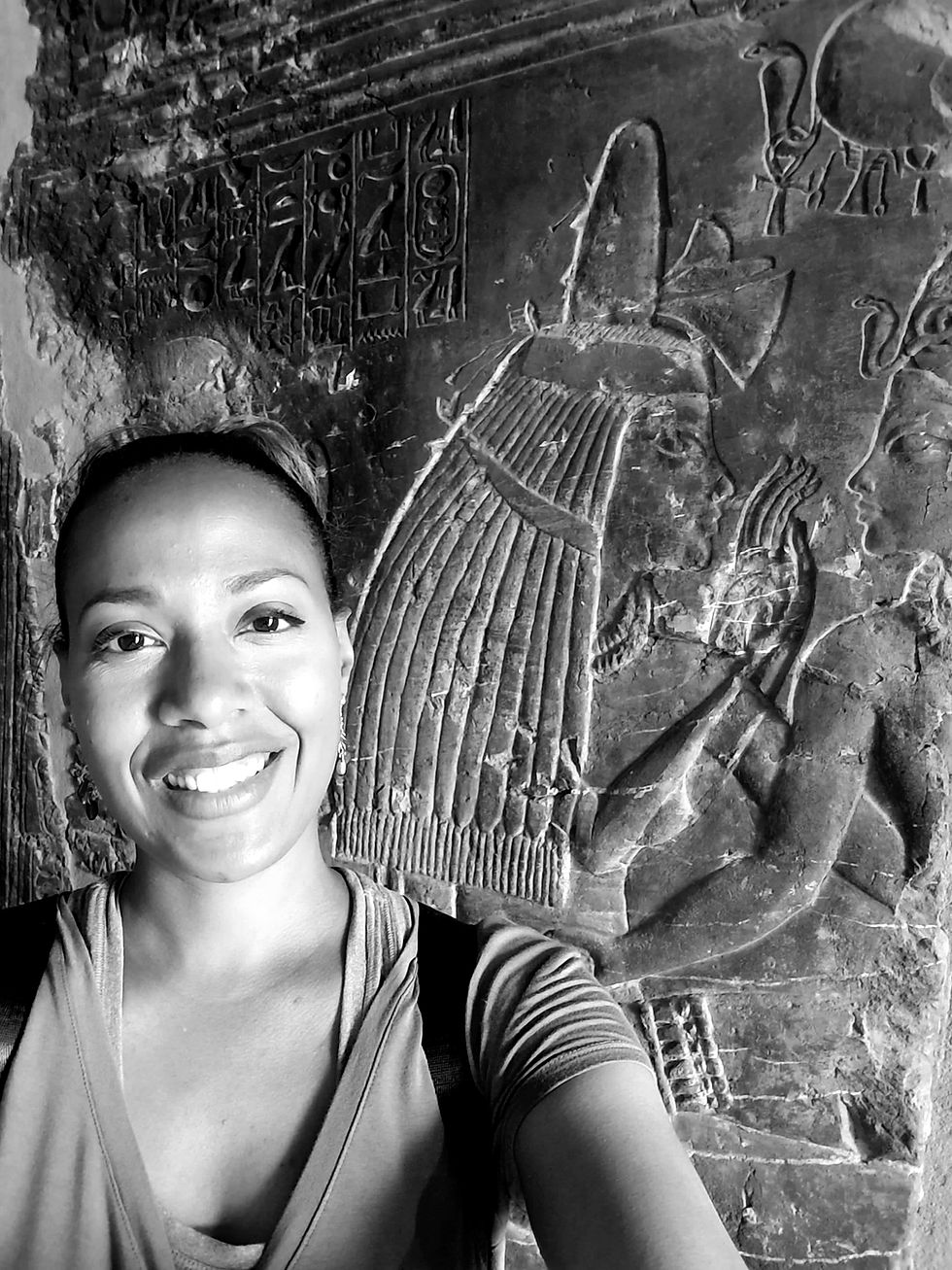
Amanda Victoria Chance, MD, is an Internal Medicine board-certified physician reviving ancient healing practices. Also certified in Lifestyle Medicine, she bridges millennia-old vibrational wisdom with evidence-based lifestyle interventions-- including nutrition, stress resilience, and non-pharmacological therapies-- to activate whole person care. She co-leads transformative healing journeys in Egypt with her husband-- including resonance-based experiences inspired by Saqqara's legendary "healing hospital," a site documented in Gaia's The Pyramid Code through her husband's grandfather's archival legacy.


Comments