Rival Brother and the Seductress: Set and Nephthys
"Remember, Set, put in your heart this word which Geb spoke, this threat which the gods made against you… because you struck Osiris to the ground."
— Pyramid Text Utterance 477
In the pantheon of ancient Egypt, Set is the adversary. He is the murderer of Osiris, the liar who denied his crime, the power-seeker who sought to rule over Horus. He is judged by the gods, subjugated by Horus, and forced to bear the burden of the brother he killed. Yet the Pyramid Texts also record that he becomes an imperishable star, with "no harm" remaining upon him. This is not a story of redemption. It is a story of ritual transformation—the integration of a violent force into the cosmic order.

Alongside him stands Nephthys—his sister-wife, the "Lady of the House," who mourns with Isis, protects the dead, and stands at the threshold of the tomb. She is the sanctuary that Set is not.
Together, Set and Nephthys are two of the four children of Geb and Nut. Their siblings are Osiris and Isis. To understand Set and Nephthys, we must understand them as members of a family—a family system that mirrors the dynamics of every human family.
The Names and Their Hieroglyphs: Set and Nephthys
Set (𓁣𓁣𓀭)

The name Set (Egyptian: stẖ or sṯ) is written with the hieroglyph of the Set animal—a creature with a curved snout, erect forked tail, and square-tipped ears. The precise identity of this animal remains unknown; it may be a composite of a donkey, a fennec fox, or an aardvark, or it may represent a mythical beast whose form was intentionally ambiguous. The name itself may mean "the one who dazzles" or "the one who causes confusion," reflecting his association with storms, disorder, and violence.
Set is the god of the red land—the desert, the foreign lands, and the forces of nature that are beyond human control. He is the lord of thunderstorms, earthquakes, and the fiery heat of the sun. But in the Pyramid Texts, he is first and foremost the slayer of Osiris—the one who disrupted the cosmic order and was judged for it.
Nephthys (𓉠𓏏𓁐)

The name Nephthys (Egyptian: nbt-ḥwt) means "Lady of the House" or "Lady of the Temple." It is written with the hieroglyph of a house or temple enclosure (𓉠) followed by the feminine t (𓏏) and the goddess determinative (𓁐). Her name reflects her role as the guardian of the sacred space—the temple, the tomb, the sanctuary where the dead are protected and transformed.
Nephthys is the sister of Isis, Osiris, and Set, and the sister-wife of Set. She is associated with mourning, the night, darkness, service, protection, magic, and the dead. In the Pyramid Texts, she appears alongside Isis as a protector of the deceased, a force before whom demons trembled, and whose magical spells were essential for navigating the Duat.
The Voice of the Old Kingdom: Set in the Pyramid Texts
The Pyramid Texts present Set without moral ambiguity. He is not a "necessary evil" or a "chaos that makes order possible." He is a murderer, a liar, and a power-seeker who is judged and subjugated by the gods.
Set as the Slayer of Osiris (Utterance 477)
This is the most explicit and detailed account of Set's crime:
"Remember, Set, put in your heart this word which Geb spoke, this threat which the gods made against you in the house of the prince, in Heliopolis, because you struck Osiris to the ground, as you, Set, said: 'I did not do this to him,' so that you might thereby prevail and be declared innocent, so that you might have power over Horus. As you, Set, said: 'It was he who provoked me' — thus his name 'Ik-w-tꜣ' came into being; as you, Set, said: 'It was he who came too near me' — thus his name 'Śȝḥ' came into being."
What this tells us:
Set did strike Osiris to the ground. This is stated as fact by Geb and the gods.
Set denied it: "I did not do this to him."
Set justified it: "He provoked me" and "He came too near me."
The text reveals Set's motive: "so that you might have power over Horus." This is not a crime of passion or accident—it is a power grab.
Set's denials are recorded, but the judgment of Geb and the gods stands against him.
This is not a neutral account. It is a condemnation of Set, rooted in his own words and the divine verdict.
On the question of Horus's birth:
The Pyramid Texts do not give a clear chronological answer about whether Horus was born before or after Osiris was killed. The classical myth (as told by Plutarch, c.100 CE) places Horus's birth after Osiris's death- Isis conceives Horus posthumously from the reassembled body of her husband.
If Horus was not yet born when Set killed Osiris, then Set's motive- "power over Horus"- cannot be a literal statement of his internal intention at the moment of the murder. It is better understood as retrospective: the gods are declaring the meaning of Set's crime in light of its outcome. Set sought power. That power was contested by Horus. He sought power over him, and he lost.
Alternatively, some versions of the myth may have placed Horus's birth before Osiris's death. If Horus was already born, Set's motive makes perfect sense: he wanted to eliminate both the father and the son to secure his rule. The Pyramid Texts do not explicitly say either way.
What the text does make clear is that Set's crime is defined by its outcome, not by his original intention. He killed Osiris to seize power. That power was challenged by Horus. And in the end, Set was judged, subjugated, and forced to bear the burden of the brother he killed.
Set Subjugated (Utterance 593)
"They have placed Set beneath you, so that he may bear your burden for you, they have warded off the evil influence he spat at you. Horus has brought Set to you, he has delivered him to you, prostrate beneath you."
What this tells us:
Set's spit is described as an evil influence—poison.
Set is placed beneath Osiris, forced to bear his burden.
Set is prostrate—defeated, subjugated.
This is a scene of humiliation and subjugation, not reconciliation.
Horus Kills Set (Utterance 580)
"O my father Osiris, this King, I have slain for you the one who slew you as a bull; I have killed for you the one who killed you as a wild bull; I have shattered for you the one who shattered you as a long-horned ox."
What this tells us:
Horus slays Set on behalf of Osiris.
Set is described as a bull—a powerful but dangerous animal.
Horus is the avenger; Set is the slain enemy.
This is not a reconciliation. It is vengeance.
Set's Longer Recover Time (Utterance 746b-746c)
"Horus in his four days (of duty) destroyed the evil on N.; Set in his eight days (of duty) annulled what he had done (evil) to N."
What this tells us:
Horus acts in four days; Set requires eight days- twice as long.
Horus destroys evil; Set annuls what he had done- the evil he himself caused.
The implication is clear: Set is slower, and his role is remedial rather than proactive.
He is not the equal of Horus. He is the one who must undo his own damage.

What did Set do during those eight days?
The text does not specify. But given his role in later texts as the "Eldest Magician" who spears Apep each night, it is plausible that the "eight days" refers to his period of executioner work- the nightly battle against chaos, the spearing of Apep, the removal of obstacles to cosmic order. Set's transformation from adversary to defender was not instantaneous. It required a period of remedial action- eight days of work undoing the evil he had caused, culminating in his role as the executioner of chaos.
Set as the Eldest Magician: The Defender of Ra
In the Book of Gates, found in the Tomb of Seti I (KV17) in the Valley of the Kings, Set is depicted standing at the prow of the solar barque, spearing the chaos serpent Apep. He is explicitly labelled with the epithet "Eldest Magician"(ḥqꜣw-šmsw).
What Does "Magician" Mean?
The Egyptian word for magic is ḥkꜣ (heka). It is written with the hieroglyph of twisted flax (or a knot) followed by the ka-sign (two upraised arms). The twisted flax symbolizes a piece of fibrous material twisted for use in oil lamps, connecting light, warmth, and domestic utility to written language. The ka-sign indicates that that this power is a life-giving energy.

Heka is not "stage magic" or illusion. It is a force that connects the physical or material to light. When Set is called the "Eldest Magician," it means he holds a primacy in the use of this force. Now, this is the same Set who murdered Osiris, denied it, and was judged. But his power is redirected. He does not use his heka to destroy order; he uses it to defend order against chaos. He spears Apep. He is the executioner of chaos. Pyramid Text Utterance 674 says, "Those who are before Thoth are slain with the knife coming from Set."
Set's Ambiguous "Protection" (Utterance 534)
"Go away, flee, (you) who are guarded by Horus, protected by Set; go away, flee, (you) who are guarded by Osiris, protected by Hrti; go away, flee, (you) who are guarded by Isis, protected by Nephthys."
What this tells us:
The person "protected by Set" is told to leave—to flee.
This is not a blessing; it is an expulsion.
Set's "protection" does not sanctify the one who receives it. Even those "protected" by Set are to be driven out.
The Transformation of Set: From Harm to Wholeness
Utterance 215: Set Becomes an Imperishable Star
"They are now imperishable stars... The one (Horus) has no injury; this one (Set) has no harm."
What this tells us:
Both Horus and Set become imperishable stars. This is a celestial status.
The text notes that Horus has no injury and Set has no harm. This is significant because harm was Set's defining characteristic.
In Utterance 746, Set spends eight days undoing the evil he caused. It is possible that after this remedial period, Set is restored to wholeness.
What becoming an Akh requires:
To become an Akh—to become an imperishable star—the Ba and Ka must be united. This is not a passive state. It requires transformation, judgment, and integration. If Set becomes an imperishable star, and if becoming an Akh requires the union of Ba and Ka, then Set must have undergone that transformation.
The text does not say he was forgiven. It does not say he was reconciled. It says he "has no harm." The wound is gone. The defining characteristic is removed. He is a star.
This is not moral redemption. It is transformation. Set does not become "good." He becomes whole. The harm that defined him is removed. He is integrated into the cosmic order as a star—not because he deserved it, but because the order itself requires it.
The Voice of the Old Kingdom: Nephthys in the Pyramid Texts
Nephthys appears throughout the Pyramid Texts as a goddess of protection, mourning, and magical power. She is the sister who supports Osiris, the guardian of the deceased, and a force before whom demons tremble.
Nephthys as Protector
In Utterance 565, Nephthys gives her arms to the deceased king:
"Nephthys gave her arms to N.; she passed her breast over the mouth of N."
This is a maternal image—Nephthys nursing the king, providing him with sustenance and protection in the afterlife. She is the guardian who embraces the deceased and ensures his rebirth.
In Utterance 534, Nephthys is invoked as a protector alongside Isis:
"Go away, flee, (you) who are guarded by Isis, protected by Nephthys."
Nephthys and Isis: The Two Sisters

In the Pyramid Texts, Nephthys and Isis are almost interchangeable in their roles as protectors of Osiris. They mourn him, search for him, and guard him.
"Isis comes and Nephthys comes, one of them from the west and one of them from the east, one of them as a 'screecher', one of them as a kite; they have found Osiris... Your sisters Isis and Nephthys come to you, they have sat down there."
The two sisters are the guardians of the dead, the mourners who restore Osiris and, by extension, every deceased king who identifies with him.
Nephthys as the "Lady of the House"
Her name—"Lady of the House"—reflects her role as the guardian of the sacred space. The "house" is the temple, the tomb, the sanctuary where the dead are transformed. Nephthys is the keeper of that threshold, the one who ensures that the deceased passes safely into the afterlife.
Later Texts: Nephthys as Accomplice or Innocent?
The later tradition (Plutarch's De Iside et Osiride, c.100 CE) develops the story in different directions:
Version 1: Nephthys as Innocent
In some versions, Nephthys is innocent of any knowledge of Set's plan. She is horrified by the murder and joins Isis in mourning and searching for the body. She abandons Set and helps Isis restore Osiris.
Version 2: Nephthys as Unwitting Accomplice
In other versions, Nephthys is unwittingly complicit. Set uses her as part of his plan-- perhaps by disguising himself as her, or by using her to lure Osiris into a trap. She does not know what Set intends, but she is the instrument of his deception.
Version 3: Nephthys as Jealous Conspirator
In some versions, Nephthys is jealous of Isis and Osiris's relationship. She is attracted to Osiris and resents being married to Set. Set exploits this jealousy, and Nephthys becomes complicit in the murder-- either actively or by failing to warn Osiris.
Version 4: Nephthys as Seductress
In one version, Nephthys disguises herself as Isis and seduces Osiris, resulting in the birth of Anubis. When Set discovers this, he kills Osiris in revenge. In this version, Nephthys is not the murderer, but her actions are the catalyst for the murder.
Nephthys and Hesat: The Cow Goddess Connection
The similarities between Nephthys and the cow goddess Hesat are both functional and symbolic. In the Pyramid Texts, Hesat is explicitly called the "great wild cow" and is described as the mother of Anubis and the nurse of the king. Nephthys, too, is called the nurse of the king, and her role as the nourisher of the deceased echoes Hesat's function.
Utterance 1375 in the Pyramid Texts makes this connection explicit:
"N. is indeed the son of the great wild cow... N.'s mother is Isis; his nurse is Nephthys; it is Sh3.t-hr who suckles N."
Here, Nephthy is called the nurse of the king, while th cow goddess Sh3.t-hr is the one who suckles him. The two roles are distinct but closely related- both involve the nourishment and protection of the child-god.
The Pyramid Texts do not tell the full story of Nephthys. They give us hints- a title here, a role there- but they leave much unsaid. What the Pyramid Texts do tell us is that Nephthys was essential to the king's resurrection. She was the nurse who fed him, the mourner who wept for him, the protector who guarded him, the Lady of the House who kept the sacred space. Without her, the king could not be reborn.
The Children of Geb: A Family Portrait
The four children of Geb and Nut—Osiris, Isis, Set, and Nephthys—form the second generation of the Heliopolitan Ennead. They are not merely mythological figures; they are a family system, a constellation of personalities whose interactions define the fundamental dynamics of human existence: love and betrayal, creation and destruction, protection and violation, loyalty and opposition.
Osiris: The Wronged Heir
Nature: The firstborn, the beloved son, the rightful heir who is struck down by his brother. He is the victim who becomes the victor—not through revenge, but through transformation.
Evidence:
"Raise thyself up, Osiris N., son of Geb, his first-born." (Utterance 483)
"O Osiris N., thou art the mightiest god; there is no god like thee." (Utterance 365)
"Remember, Set, put in your heart this word which Geb spoke… because you struck Osiris to the ground." (Utterance 477)
"They have placed Set beneath you, so that he may bear your burden for you." (Utterance 593)
Human Parallel: The one who is wronged—the innocent victim of betrayal. Osiris represents the human experience of being harmed by those closest to us. But he also represents the possibility of transformation. Osiris does not remain a victim. Through the work of Isis and the judgment of the gods, he becomes something greater—an imperishable star, the lord of the afterlife, the template for resurrection.
Isis: The Loyal Healer
Nature: The devoted sister-wife, the mother, the protector, the healer, the one who refuses to let death be the end. She is the force of love that persists against all odds.
Evidence:
"Thy sister Isis laid hold of thee, when she found thee complete and great." (Utterance 593)
"Thy two sisters Isis and Nephthys come to thee; they heal thee." (Utterance 366)
"O father N., take to thyself this thy liquid… which is in the breasts of thy mother, Isis." (Utterance 661)
Human Parallel: The one who loves unconditionally, who acts out of devotion, who uses intelligence and physical power to heal and restore. Isis represents the human capacity for loyalty, creativity in crisis, and the refusal to accept defeat. She is the force that holds families together, that mends what is broken, that ensures the next generation survives.
Set: The Violent Usurper
Nature: The murderer, the liar, the blamer of the victim, the power-seeker. He is the one who takes what is not his and denies it when confronted.
Evidence:
"Because you struck Osiris to the ground, as you, Set, said: 'I did not do this to him,' so that you might thereby prevail and be declared innocent, so that you might have power over Horus." (Utterance 477)
"As you, Set, said: 'It was he who provoked me.'" (Utterance 477)
"As you, Set, said: 'It was he who came too near me.'" (Utterance 477)
"They have warded off the evil influence he spat at you." (Utterance 593)
"Those who are before Thoth are slain with the knife coming from Set." (Utterance 674)
Human Parallel: The one who acts out of jealousy, greed, or the desire for power. Set represents the human capacity for violence, deception, and self-justification. He is the family member who betrays, who takes, who denies—and when confronted, blames the victim. "He provoked me." "He came too near me." These are the words of every perpetrator who refuses to take responsibility.
Nephthys: The Lady of the House
Nature: The keeper of the sacred space, the mourner, the protector, the one who stands at the threshold. She is loyal to her sister, married to the adversary, and holds the contradictions of family life without being destroyed by them.
Evidence:
"Nephthys gave her arms to N.; she passed her breast over the mouth of N." (Utterance 565)
"Isis comes and Nephthys comes… they have found Osiris." (Utterance 366)
"Geb has brought your two sisters to you, Isis and Nephthys." (Utterance 366)
"If Nephthys enters in her evil way…" (Utterance 534)
Human Parallel: The one who maintains the household, who keeps the sanctuary, who mourns and protects. Nephthys represents the human capacity for holding contradictory loyalties—loving a sibling while being married to their enemy, protecting the family's sanctity while living with its most destructive member. She is the "Lady of the House"—the one who keeps the space safe even when the family is falling apart.
The Family System: A Map of Human Nature
When we place these four natures side by side, we see not just a mythological family, but a map of human dynamics that repeats in every generation:
Role | Deity | Human Parallel |
The Victim who Transforms | Osiris | The one who suffers betrayal but rises again through transformation |
The Loyal Healer | Isis | The one who loves unconditionally, who repairs, who insists on life |
The Violent Usurper | Set | The one who takes, denies, blames, and must be judged— The one who remains tied to the earth until the remediation is complete. The one who is the executioner of disorder. |
The Lady of the House | Nephthys | The one who holds the contradictions, keeps the space, mourns, and protects |
This is not a story about "good" versus "evil." It is a story about family—the entanglement of love and betrayal, loyalty and opposition, creation and destruction. Human family can contain these dynamics. Every human being can plays these roles at different times.
Conclusion:
In the Pyramid Texts, Set and Nephthys are not villains and heroes. They are forces: one of violence and disruption, one of protection and mourning. Both have their place in the cosmic order. Both are necessary.
About the Author
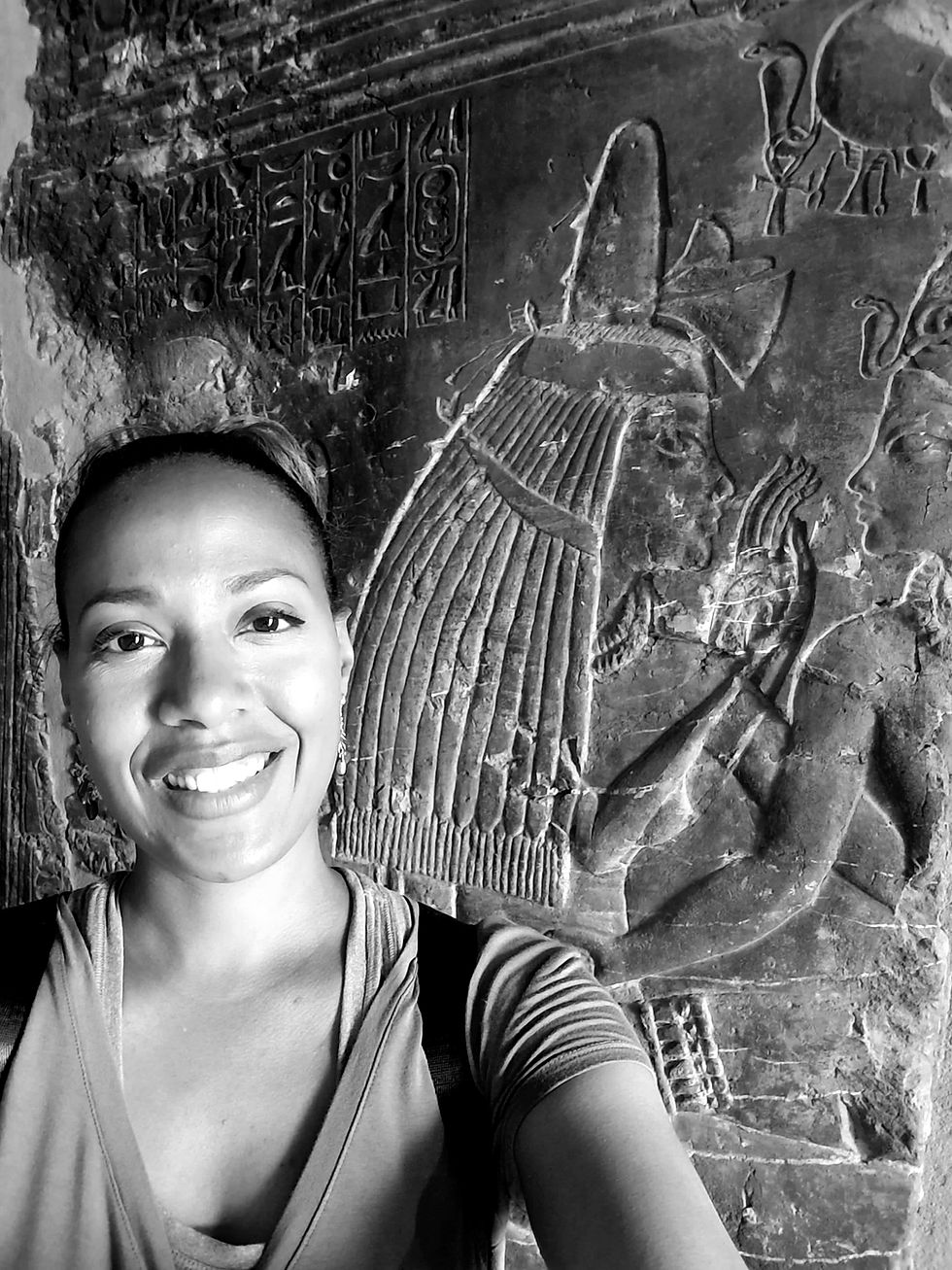
Amanda Victoria Chance, MD, is an Internal Medicine board-certified physician reviving ancient healing practices. Also certified in Lifestyle Medicine, she bridges millennia-old vibrational wisdom with evidence-based lifestyle interventions-- including nutrition, stress resilience, and non-pharmacological therapies-- to activate whole person care. She co-leads transformative healing journeys in Egypt with her husband-- including resonance-based experiences inspired by Saqqara's legendary "healing hospital," a site documented in Gaia's The Pyramid Code through her husband's grandfather's archival legacy.


Comments