Anubis: The Embalmer, the Guardian, and the Foremost of the Divine Booth
"Anubis, the embalmer, has embalmed you." — Pyramid Text Utterance 219

In the Pyramid Texts of the Old Kingdom, Anubis appears not as a distant god of the dead but as the intimate, hands-on worker of resurrection. He is the embalmer who prepares the body, the guardian who watches over the necropolis, and the "foremost of the divine booth"—the one who stands at the threshold between death and rebirth. He is not the judge of the dead (that role belongs to Osiris) and he is not the guide of the soul (that role belongs to Thoth). He is something more elemental: the one who touches the corpse, who wraps the limbs, who restores the body so that the soul can rise.
To understand Anubis is to understand the Egyptian vision of death as a physical process—not an ending, but a preparation. He is the divine technician of transformation, the jackal who stands at the door of the tomb, ensuring that the body is whole, protected, and ready for the journey ahead.
The Name and Its Hieroglyphs
Anubis (𓃢𓈖𓊪𓅱𓀭)
The name Anubis (Egyptian: Inpw) is written with a combination of hieroglyphs that reveal his essential nature:
Hieroglyph | Gardiner Reference | Description | Significance |
𓃢 | E15 | A recumbent jackal The primary determinative. | It identifies Anubis as the jackal god, the guardian of the necropolis. |
𓈖 | N35 | A ripple of water | A phonetic sign (n) |
𓊪 | Q3 | A stool or seat | A phonetic sign (p) |
𓅱 | G43 | A quail chick | A phonetic sign (w) |
𓀭 | A40 | A seated god | The divine determinative |
The name Inpw may mean "royal child" —a title that resonates with his role as the son of Osiris and the protector of the young Horus. It may also be related to the word inp, meaning "to decay" or "to embalm"—a direct reference to his primary function.
The jackal hieroglyph (E15) is significant. The jackal was associated with the desert and the necropolis—the "red land" where tombs were built. Jackals were often seen scavenging around cemeteries, and the Egyptians transformed this natural observation into a theological truth: the jackal-god guards the dead rather than scavenging them. Anubis is the jackal who protects the body from decay, rather than the jackal who would consume it.
In the Pyramid Texts, Anubis is also called "the Foremost of the Divine Booth" (ḫntj-jmntjw), referring to the embalming booth or tent where mummification took place. This title became one of his most enduring epithets.
The Voice of the Old Kingdom: Anubis in the Pyramid Texts
The Pyramid Texts present Anubis in a defined, essential role: the embalmer and guardian of the deceased. He is not the lord of the dead—that is Osiris. He is not the guide of souls—that is Thoth. He is the hands-on worker who prepares the body for resurrection.
Anubis as the Embalmer

The most frequent references to Anubis in the Pyramid Texts describe him as the embalmer who prepares the body of the king:
"Anubis, the embalmer, has embalmed you." — Utterance 219
"Anubis has embalmed you, Horus has wiped you." — Utterance 371
"Anubis has embalmed you, [so that] you may not decay." — Utterance 219
The embalming process was not merely physical preservation. It was a ritual act of transformation—the preparation of the body for its new existence. Anubis's work ensured that the Khat (physical body) would not decay, that the Sahu (spiritual body) could form, and that the Ba (personality) and Ka (life force) could reunite to become an Akh.
Anubis as the Guardian of the Necropolis

Anubis is also described as the guardian of the necropolis—the one who watches over the tomb and protects it from violation:
"Anubis, who is upon his mountain, who is in the place of embalming, the lord of the sacred land." — Pyramid Text (adapted)
The "mountain" here refers to the desert cliffs that surrounded the tombs, and the "sacred land" is the necropolis itself. Anubis is the watchman who ensures that the deceased rests undisturbed.
Anubis and the Restoration of the Body
In some utterances, Anubis is described as reassembling the body—joining limbs, restoring the head, and preparing the deceased for eternal life:
"Anubis, who binds the head, who joins the limbs." — Pyramid Text (adapted)
This reflects the ritual of mummification itself—the physical act of wrapping, binding, and restoring the body to wholeness.
Anubis as "Son of Osiris"
In some passages, Anubis is called the son of Osiris:
"Anubis, the son of Osiris, has embalmed you." — Utterance 219
But this is not a consistent identification. In other passages, he is called the son of Ra or the son of Hesat. The Pyramid Texts do not tell us how Anubis was conceived. The story of his birth—Nephthys disguising herself as Isis and seducing Osiris—is a later development, found in Plutarch (c. 100 CE). The Pyramid Texts simply present Anubis as the embalmer, not as the son of a specific parent.
The Roles of Anubis in the Pyramid Texts
Role | Description | Key Utterance |
Embalmer | Prepares the body for burial, prevents decay | 219, 371 |
Guardian of the Necropolis | Watches over the tomb, protects from violation | Adapted from PT |
Restorer of the Body | Joins limbs, binds the head, reassembles the deceased | Adapted from PT |
Foremost of the Divine Booth | Presides over the embalming booth | Title in PT |
Son of Osiris (sometimes) | Identified as the son of Osiris in some utterances | 219 |
Son of Ra (sometimes) | Identified as the son of Ra in other utterances | 366 |
Son of Hesat (sometimes) | Identified as the son of the cow goddess Hesat | 439 |
Anubis and the Opening of the Mouth
Anubis is called "Foremost of the Divine Booth" (ḫnty zḥ-nṯr)—a title that defines him not merely by location but by primacy within the most sacred space of transformation. To understand this title is to understand Anubis's essential role in the Opening of the Mouth ceremony.
What Was the "Divine Booth"?
The Egyptian word zḥ-nṯr literally means "booth of the god" or "divine booth." It was not a permanent stone temple but a temporary, functional structure—often made of wood or reeds—erected for a specific ritual purpose. The term was flexible and could refer to several related sacred spaces:
The Embalming Booth: Its most critical meaning in funerary contexts was the purification tent or embalming workshop where the body was prepared. This was the zḥ-nṯr par excellence—the place where the corpse was transformed into a mummy, and the mummy into an Akh.
A Portable Chapel: It could denote a small wooden chapel used to house a divine image during processions.
A Temple Chamber: In later periods, the term could even refer to a chamber within a larger temple.
Anubis's specific booth was the embalming tent. He was called its "Foremost" because he was the chief embalmer—the divine technician who first performed the rites on Osiris, creating the prototype for all future mummification.
The Purpose of the Opening of the Mouth

The Opening of the Mouth ceremony was the culminating ritual of the embalming process. It did not merely restore the senses of the deceased; it reanimated the body and reintegrated the nine aspects of the soul. Without it, the Khat (physical body) would remain inert, the Ba (personality) would have no vessel to return to, and the Akh could never form.
The ritual was performed within the divine booth—the embalming tent—under Anubis's supervision. The booth was the threshold between death and eternal life, and Anubis was its gatekeeper. He ensured that the body was whole, the senses were restored, and the soul was ready to reunite with its Ka.
Anubis's Role in the Ritual
In the Opening of the Mouth, Anubis is not the primary celebrant—that role belongs to Horus, the son who avenges and restores his father. But Anubis is the hands-on worker who prepares the body for Horus's touch.
"Horus has opened your mouth for you… with which he opened the mouth of his father Osiris." — Pyramid Text (adapted)
Anubis's presence at this ritual reinforces his role as the guardian of the body—the one who ensures that the physical vessel is ready to receive the Ba and Ka. He holds the ritual instruments. He supports the body. He ensures that the embalming work is complete.
The Booth as Threshold

The divine booth was not merely a workshop. It was a liminal space—a place where the ordinary rules of existence were suspended, and the forces of transformation were concentrated. The body entered the booth as a corpse; it emerged as a prepared vessel for resurrection. Anubis, as the Foremost of the Booth, was the master of that transformation.
This is why Anubis is not the judge of the dead, nor the guide of the soul, but the divine technician of transformation. His work was not to rule or to lead, but to prepare. To wrap. To bind. To restore. To make ready.
"Anubis, the embalmer, has embalmed you." — Pyramid Text Utterance 219
Other "Booths" in Ancient Egypt
The concept of the sacred booth extended beyond the embalming tent:
Sed Festival Shrines: The most prominent other "booths" were the temporary reed shrines erected for the Sed festival (the royal jubilee). These were built in rows, each representing a region of Egypt and housing the image of its local god. The king would visit each booth to symbolically renew his power over the entire land. Pharaoh Djoser even built permanent stone "dummy" booths in his Step Pyramid complex so he could celebrate the jubilee for eternity.
The Booth of Sokar: The god Sokar, a deity of craftsmen and the Memphite necropolis, was also described as presiding over his own "Divine booth of the craftsmen" .

In essence, a "divine booth" was a sacred, liminal structure—whether for embalming, for housing a god during a festival, or for the king's renewal. Anubis being "Foremost" of his booth means he was the supreme master of the most critical of these spaces: the place where the dead were transformed into the eternally living.
The Character of Anubis
The Divine Technician
Anubis is not a god of grand cosmic battles or dramatic myths. He is a worker. His hands are on the body. He wraps the limbs, pours the oils, binds the head. He is the divine technician of transformation—the one whose skill and precision make resurrection possible.
The Silent Guardian

Anubis does not speak much in the Pyramid Texts. He does not argue, plead, or narrate. He acts. He is the silent guardian who stands at the threshold, watching over the dead, ensuring that the body is protected and the tomb is secure.
The Threshold Guardian
Anubis stands at the threshold between death and rebirth. He is the first deity the deceased encounters, and he is the one who prepares them for the journey ahead. He is not the destination—Osiris is. He is not the guide—Thoth is. He is the doorkeeper, the one who ensures safe passage.
The Jackal Who Guards

The jackal was a scavenger, a creature of the desert and the necropolis. The Egyptians transformed this natural predator into a divine guardian. Anubis is the jackal who protects the dead rather than consuming them. He is the wild force tamed and redirected to serve the order of Ma'at.
Anubis and the Family of Geb
In the Pyramid Texts, Anubis is not explicitly placed within the family of Geb and Nut. He is not one of the four children—Osiris, Isis, Set, and Nephthys. But in later tradition, he is drawn into this family as the son of Osiris and Nephthys.
This later genealogy reflects his functional relationship to the family of Geb:
He is the embalmer of Osiris, the one who prepares the body of the murdered god.
He is the protector of Horus, the child who will avenge his father.
He is the son of Nephthys, the goddess who mourns and protects.
He is the stepson of Isis, the great mother who raises him.
Anubis is born into the family of Geb. His function is essential to the family's story. Without Anubis, Osiris cannot be embalmed. Without Anubis, Horus cannot be protected. Without Anubis, the resurrection cannot happen.
Anubis and the Soul
Anubis's work is essential to the integration of the nine aspects of the soul:
Soul Aspect | Anubis's Role |
Khat (Physical Body) | Embalms and preserves the body, prevents decay |
Sahu (Spiritual Body) | Prepares the body so the Sahu can form |
Ba (Personality) | Ensures the body is ready for the Ba's return |
Ka (Life Force) | Protects the tomb where offerings are made to the Ka |
Ib (Heart) | Guards the heart, which will be weighed |
Ren (Name) | Inscribes the name on the tomb, preserving identity |
Sheut (Sunshade) | Protects the body from violation |
Sekhem (Vital Power) | Ensures the body is whole so power can flow |
Akh (Transfigured Spirit) | Makes possible the union of Ba and Ka into Akh |
Anubis is the threshold guardian of the soul's transformation. Without his work, the other aspects cannot achieve their purpose.
Conclusion: The Foremost of the Divine Booth

Anubis is the silent worker of resurrection. He does not rule the underworld. He does not judge the dead. He does not guide the soul. He prepares the body. He wraps the limbs. He pours the oils. He guards the tomb. He ensures that the physical vessel is ready for the journey ahead.
In the Pyramid Texts, Anubis is the embalmer, the guardian, the foremost of the divine booth. He is the jackal who stands at the door of the tomb, protecting the dead from decay and violation. He is the divine technician whose skill makes transformation possible.
"Anubis, the embalmer, has embalmed you." — Pyramid Text Utterance 219
This is Anubis: not the lord of the dead, but the servant of the dead. Not the judge, but the preparer. Not the guide, but the guardian. He is the hands that touch the body, the eyes that watch the tomb, the presence that ensures the dead are not forgotten.
And in that, he is essential. Without Anubis, the body decays and the soul is lost.
He is the foremost of the divine booth—the first worker of eternity.
About the Author
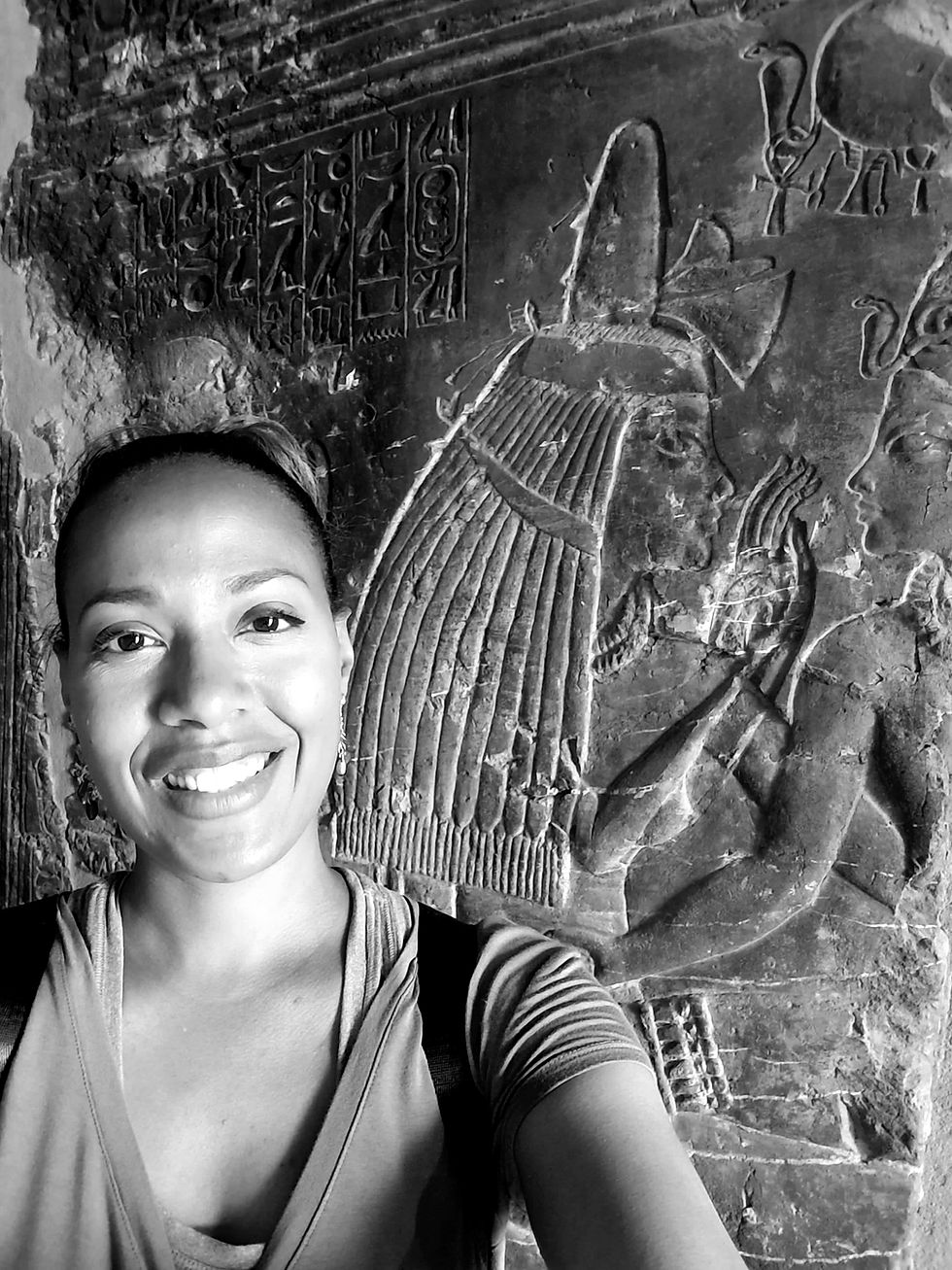
Amanda Victoria Chance, MD, is an Internal Medicine board-certified physician reviving ancient healing practices. Also certified in Lifestyle Medicine, she bridges millennia-old vibrational wisdom with evidence-based lifestyle interventions-- including nutrition, stress resilience, and non-pharmacological therapies-- to activate whole person care. She co-leads transformative healing journeys in Egypt with her husband-- including resonance-based experiences inspired by Saqqara's legendary "healing hospital," a site documented in Gaia's The Pyramid Code through her husband's grandfather's archival legacy.


Comments