Eternal Cycle and the Return to Chaos
SUNDAY EDITORIAL EDITION
Where the week's noise fades, and the ancient signals grow clear.
Time is not a straight line. It is not a circle that ends. It is a field of two eternities—one that stands still and one that turns forever. This was the vision of the Pyramid Age. But centuries later, under foreign rule, a new idea crept in: that the world might one day dissolve back into the waters from which it came. This is the story of how Egypt's understanding of time changed—and why the older vision still holds the deeper wisdom.

Introduction: The Two Eternities
When we speak of "time" today, we often think of a linear progression—a beginning, a middle, and an end. This way of thinking is so natural to us that we assume it is universal. But for the ancient Egyptians of the Old Kingdom (c. 2686–2181 BCE), time was not linear. It was two eternities, moving together like two currents in the same river.
These two eternities were called Djet (𓆇) and Neheh (𓎛). They were not opposites. They were complements.
Djet was the static eternity of the completed, perfected state. It was the world of the ancestors, the mummified body in the tomb, the fixed order of the cosmos. It was time frozen at its peak—the "now" that never fades.
Neheh was the cyclical eternity of the sun's daily journey, the Nile's annual flood, the seasons of planting and harvest. It was time in motion, always turning, always renewing.
The king, in death, was promised both: “You belong to Djet and to Neheh” (Pyramid Text Utterance 373). He would rest eternally in the stillness of Djet and also rise each dawn with the sun in the cycle of Neheh.
There was no "end of time" in this vision. There was only perpetual maintenance.
Part I: The Old Kingdom Vision – Eternity Without End
The Pyramid Texts, inscribed in the tombs of kings at Saqqara, are the oldest religious corpus in the world. They contain no prophecy of a final dissolution. Instead, they are filled with spells to ensure the king's eternal participation in the cycles of the cosmos.

1. The King Joins the Cycle of the Sun
In Pyramid Text Utterance 217 (Pyramid of Unas, c. 2350 BCE), the king is described as entering the solar cycle:
“He goes down, he goes down into the Duat… He rises, he rises like Ra.”
This is not a one-time event. It is an eternal pattern. The verb forms in the original Egyptian are iterative—they describe an action that repeats forever. The king will always set and always rise.

2. The King Becomes a Star Among the Imperishable Ones
In Pyramid Text Utterance 365 (Pyramid of Pepi I, c. 2300 BCE), the king's transformation is described in language that leaves no room for an end:
“The king is an akh with the akhs, a star in the sky, a light on the path of the Duat.”
The akh is the transfigured spirit, the luminous self that has overcome death. The "path of the Duat" is the nightly journey that Ra takes—a journey that has no final terminus. It is a path walked forever.
3. The King Possesses Both Eternities
The most explicit statement comes in Pyramid Text Utterance 373 (Pyramid of Pepi I). This spell, originally for the king's ascension, declares:
“You belong to Djet and to Neheh.”
Here, the king is not promised an escape from time. He is given full sovereignty over time itself. He will exist in the stillness of Djet and the turning of Neheh. Neither will end, because his existence is their foundation.
4. What About the "First Time" (Zep Tepi)?
The Pyramid Texts speak of a zp tpi (First Time)—the primordial moment of creation when the first mound rose from Nun. But this was a beginning, not a prelude to an end. Creation was not a single event that would be undone; it was an ongoing ordering that the king's rituals would maintain forever.
Source: Sethe, K. (1908–1922). Die altägyptischen Pyramidentexte. Leipzig: J.C. Hinrichs.
Translation: Faulkner, R.O. (1969). The Ancient Egyptian Pyramid Texts. Oxford: Clarendon Press.
Part II: The Shift – New Kingdom Innovations and Foreign Influences
By the New Kingdom (c. 1550–1070 BCE), Egypt had undergone centuries of foreign rule (Hyksos) and later found itself an empire interacting with neighboring cultures. The theology of time began to change subtly. While the sun still rose and set each day, new texts began to entertain the possibility that the cycle might cease if proper rituals were not performed—or that a final dissolution might one day come.
1. The Book of the Heavenly Cow: Ra Withdraws
One of the most important New Kingdom texts is the Book of the Heavenly Cow, preserved in royal tombs from Tutankhamun to Ramesses II. It tells the story of Ra withdrawing from the world after humanity rebels. The sky is raised on the back of the celestial cow, and Ra departs to the heavens.
The text does not say the sun stops rising, but it describes a near‑cessation of Ra's direct presence on earth. The implication is that the cycle is now maintained through ritual, not through the sun god's immediate presence. Some scholars interpret this as the introduction of a contingent universe—one that depends on human (or royal) action to continue.
Source: Hornung, E. (1991). The Book of the Heavenly Cow. In The Tomb of Tutankhamun: The Book of the Heavenly Cow.
Translation: See also the edition by A. Piankoff (1954). The Tomb of Ramesses VI.
2. The Netherworld Books: Ritual as Perpetual Maintenance
The Amduat, Book of Gates, and Book of Caverns are designed to be cyclically recited—on tomb walls, in funerary rituals, and by the deceased king himself. Their purpose is to ensure that the sun's nightly journey continues without interruption.

These texts are performative. They do not assume the cycle will continue on its own; they actively work to prevent it from stopping. This marks a shift from the Old Kingdom's confidence in the inherent eternity of the cycle to a New Kingdom anxiety that the cycle might be broken.
Source: Hornung, E. (1999). The Ancient Egyptian Books of the Afterlife. Ithaca: Cornell University Press.
Part III: The Greco‑Roman Period – The Idea of a Final Return to Chaos
Under Ptolemaic and Roman rule (c. 332 BCE – 200 CE), Egyptian priests faced a new reality: their land was governed by foreigners, their temples were supported by a new political order, and their theology was increasingly systematized in ways that incorporated Greek philosophical ideas. It is in this period that we find the first explicit statements that the world might one day return to Nun (the primordial waters of "chaos").
1. The Esna Creation Text
At the Temple of Khnum at Esna (Roman period), inscriptions describe the creator god as one who will, at the appointed time, return to the primordial waters. A typical passage (paraphrased) reads:
“He made himself in the primeval waters. When his moment comes, he will return to the Nun, and all that exists will become again that which existed in the beginning.”
Source: Sauneron, S. (1962). Les fêtes d’Esna. Cairo: Institut Français d’Archéologie Orientale. (Esna V, etc.)
2. The Edfu Building Texts
At the Temple of Horus at Edfu (Ptolemaic period), the temple itself is described as the primeval mound that rose from Nun. The implication is that the temple’s rituals hold back the waters of chaos. If the rituals ever ceased, the world would dissolve back into Nun. This introduces the idea that the cosmos is contingent—not inherently eternal, but dependent on human action.

Source: Cauville, S. (1984). Le temple de Dendara: les inscriptions de la crypte. For Edfu, see Chassinat, É. (1897–1934). Le temple d’Edfou. Cairo: IFAO.
3. The Dendera Cosmological Texts
At Dendera (Temple of Hathor), the ceilings contain the Book of the Day and Book of the Night, which describe the sun's journey. In some passages, there is an implied threat: if the proper rites are not performed, the sun will not rise. The idea of a potential return to Nun is woven into the ritual texts.

Source: Cauville, S. (1997). Le temple de Dendera: les chapelles osiriennes. Cairo: IFAO.
4. The Famine Stela
Although it claims to be from the Old Kingdom, the Famine Stela (Ptolemaic) describes a seven‑year famine that threatened to return Egypt to Nun. It is a literary fiction of the late period, reflecting a new anxiety about the stability of the world.
Source: Lichtheim, M. (1973). Ancient Egyptian Literature, Vol. III: The Late Period. Berkeley: University of California Press.
Part IV: Why the Two Eternities Exist – And Why They Are Important Together
The Old Kingdom understood that the cosmos required both stillness and movement.
Djet is the completed state—the primordial mound, the mummified body, the eternal order of Ma'at. Without Djet, the world would be all flux, no stability. There would be no "now" to anchor the turning.
Neheh is the cyclical process—the sun's journey, the Nile's flood, the seasons. Without Neheh, the world would be frozen, dead, unable to renew itself.
Together, they form a complete system. The king, as the living embodiment of Ma'at, held both eternities together. By his rituals, he ensured that the sun would rise and the Nile would flood—not because the world was fragile, but because his actions were participatory. He was not a passive observer of cosmic time; he was an active maintainer of it.
In the Old Kingdom, there was no "end" because the maintenance was eternal. The king would become an akh, join the sun, and continue the work forever.
Part V: Why We Need to Return to the Original Understanding
Our modern view of time is shaped by apocalyptic thinking—by the idea that things will end, that cycles will break, that the world is fragile. This is not the wisdom of the Pyramid Age. It is a late anxiety, born of foreign conquest and cultural loss, that crept into Egyptian thought when Egypt was no longer sovereign.
The Old Kingdom teaches us something different:
1. Time is not fragile. The cycles of nature—the sun, the seasons, the waters—are not contingent on human action. They are inherent to the order of the cosmos.
2. Our role is participation, not control. We do not "hold back chaos" by our rituals; we join the dance that has always been turning.
3. There is no end. The concept of a "return to Nun" or the primordial waters of chaos is a later idea, born of anxiety. The older, deeper wisdom is that Nun is the source from which we came, but we do not return to "chaos"—we are transformed into the eternal akh that sails with Ra forever.
For those seeking a resonant connection to the ancient world, this distinction matters. The New Kingdom and Greco‑Roman texts reflect a time of fear and contingency. The Old Kingdom reflects a time of confidence and eternal participation.
Conclusion: Choosing Which Time We Inhabit
We live in an age of apocalyptic thinking—climate collapse, political instability, cultural anxiety. It is easy to feel that the world is fragile, that the cycles are breaking, that we are heading toward dissolution.
The Pyramid Texts offer a different way. They invite us to see time as eternal and participatory. The sun has risen for 4.5 billion years. It will rise tomorrow. The Nile still flows. The seasons still turn. We do not "hold back" chaos; we join the order that has always been.
This is the wisdom of the Old Kingdom: we belong to both eternities. We rest in Djet—the stillness that is always now. And we move with Neheh—the turning that never stops. There is no final dissolution. There is only the eternal dance.
An Invitation to Experience the Original Vision
The monuments of the Old Kingdom—the pyramids of Giza and Saqqara, the temples of the sun at Abu Ghurab—were built to embody this vision. They are not anxious structures. They are confident declarations of eternal order.
We invite you to stand where the king became an akh, where the sun was greeted each dawn, where the two eternities were woven into stone.
On our journeys, we explore these ancient places not as ruins of a lost world, but as living technologies of eternal time. To walk among them is to feel, in your bones, the difference between anxiety and confidence, between contingency and participation, between the late fear of an end and the deep wisdom of a time that never stops turning.
Join us, and experience the two eternities for yourself.
Sources
Old Kingdom (Pyramid Texts)
Sethe, K. (1908–1922). Die altägyptischen Pyramidentexte. Leipzig: J.C. Hinrichs.
Faulkner, R.O. (1969). The Ancient Egyptian Pyramid Texts. Oxford: Clarendon Press.
New Kingdom
Hornung, E. (1991). The Book of the Heavenly Cow. In The Tomb of Tutankhamun: The Book of the Heavenly Cow.
Hornung, E. (1999). The Ancient Egyptian Books of the Afterlife. Ithaca: Cornell University Press.
Piankoff, A. (1954). The Tomb of Ramesses VI. New York: Bollingen.
Greco‑Roman Period
Sauneron, S. (1962). Les fêtes d’Esna. Cairo: Institut Français d’Archéologie Orientale.
Cauville, S. (1984). Le temple de Dendara: les inscriptions de la crypte. Cairo: IFAO.
Cauville, S. (1997). Le temple de Dendara: les chapelles osiriennes. Cairo: IFAO.
Chassinat, É. (1897–1934). Le temple d’Edfou. Cairo: IFAO.
Lichtheim, M. (1973). Ancient Egyptian Literature, Vol. III: The Late Period. Berkeley: University of California Press.
About the Author
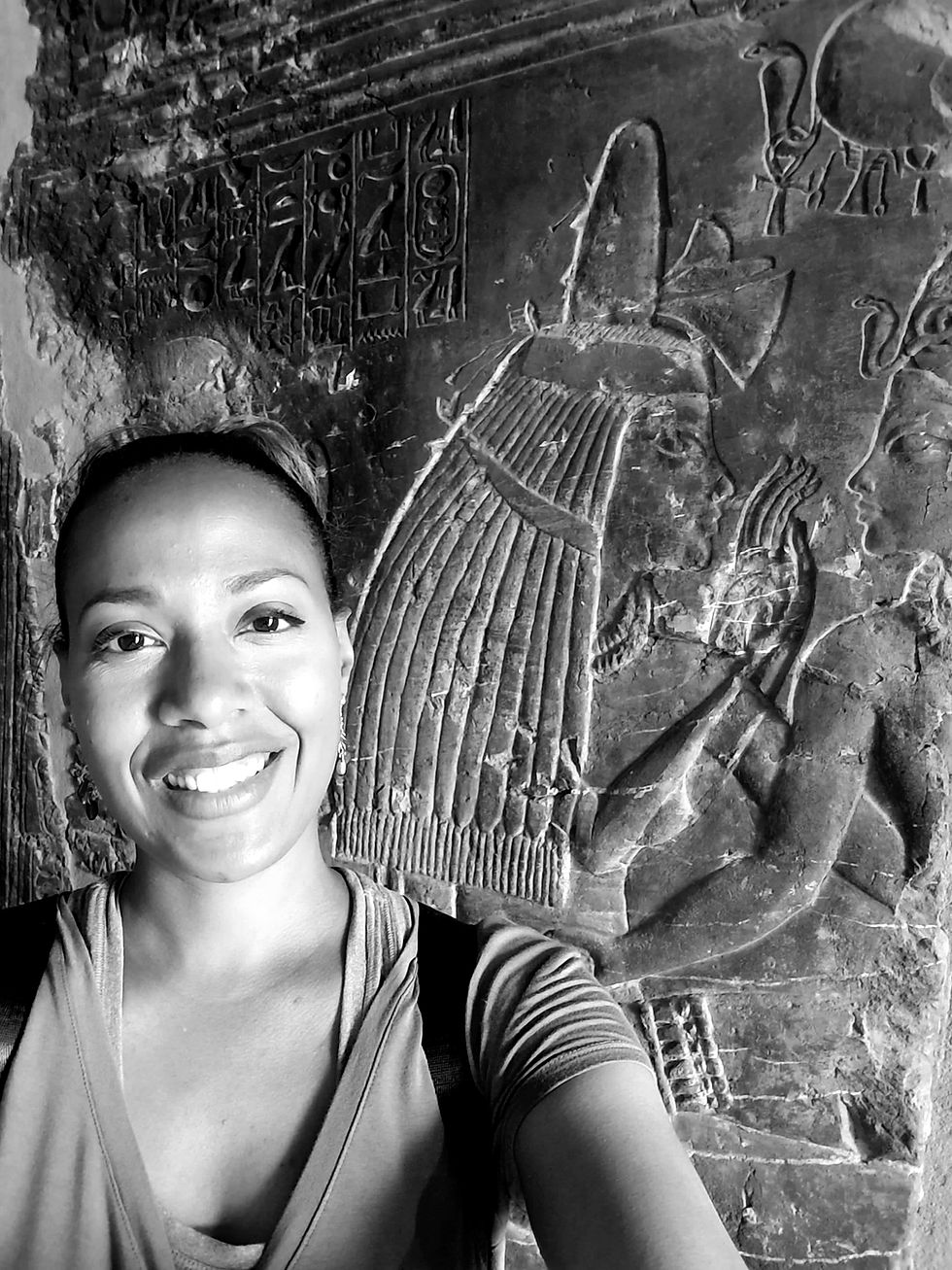
Amanda Victoria Chance, MD, is an Internal Medicine board-certified physician reviving ancient healing practices. Also certified in Lifestyle Medicine, she bridges millennia-old vibrational wisdom with evidence-based lifestyle interventions-- including nutrition, stress resilience, and non-pharmacological therapies-- to activate whole person care. She co-leads transformative healing journeys in Egypt with her husband-- including resonance-based experiences inspired by Saqqara's legendary "healing hospital," a site documented in Gaia's The Pyramid Code through her husband's grandfather's archival legacy.


Comments