The Stones of Eternity: Sacred Materials in the Pyramid of Unas
“Be a soul as a living star” — Pyramid Text Utterance 904
In the Old Kingdom, the ancient Egyptians did not merely build with stone—they built from stone, selecting each material not only for its strength and durability but for its symbolic resonance. Every block, every slab carried meaning. The stones themselves were participants in the king's transformation, chosen to reflect the cosmic order, the solar journey, and the soul's transfiguration.

The Pyramid of Unas—the smallest royal pyramid of the Old Kingdom—is perhaps the most significant, for it is here that the Pyramid Texts first appeared, inscribed on walls of limestone and white alabaster. Its stones tell a story of the king's journey from death to resurrection.
Part I: The Stones of the Pyramid of Unas
The Pyramid of Unas was constructed from a carefully selected combination of stones, each chosen for its specific properties and symbolic associations.

Local Limestone
The core of the pyramid was built from local limestone, quarried from the Giza plateau. This stone was abundant, relatively easy to work, and provided the massive volume needed for the pyramid's bulk. It represented the foundation—the earth itself.
Tura Limestone
The outer casing was made of fine white limestone from the Tura quarries, located across the Nile from Cairo. This stone was smooth, brilliant white, and capable of reflecting the sun's rays with dazzling effect. The casing was not merely decorative—it was functional, catching the first and last light of the sun to symbolize the king's ascension to Ra.
Red Granite
Red granite, quarried from Aswan over 800 kilometers to the south, was the stone of strength and endurance. In the Pyramid of Unas, it was used for:
Three portcullis slabs blocking the passageway
Doorways and monumental gateways
The Three Barriers: A Threshold of Blood
The three red granite portcullis slabs are not merely practical obstacles. They are symbolic thresholds, marking the boundary between the world of the living and the realm of the dead.
In Egyptian symbolism, red (desher) was the color of:
Blood and life force
The sun's disk (Ra)
The horizon (the place where the sun is born)
Red granite, quarried from Aswan in the south, was associated with the sun's life-giving power. The three barriers represent a progression through the stages of transformation:
1. The Outer Barrier: The boundary between the world of the living and the realm of the dead.
2. The Middle Barrier: The passage through the Duat, the underworld of trials and transformations.
3. The Inner Barrier: The final threshold into the presence of Osiris, into the Field of Reeds.
The red granite, by its color and hardness, suggests that this passage is not merely physical but essential. The king must cross through blood—through the life force—to reach his resurrection. The three barriers function like a blood-brain barrier or the three layers of the placenta: they separate the king's body from the profane world while simultaneously connecting him to the divine realm.
As the Pyramid Texts declare: "O Unas, you have not gone dead, you have gone alive to sit upon the throne of Osiris" (Utterance 213).
White Alabaster
White alabaster (Egyptian calcite) was reserved for the most sacred space: the lining of the burial chamber. It was also used for ritual vessels and shrines.
The Light of Transfiguration
Alabaster, when carved thin, is translucent and luminous. It does not merely reflect light; it transmits and diffuses it, glowing from within when illuminated. This property alludes to the transparency and transfiguration of the soul—the process by which the deceased king, having passed through the trials of the Duat, becomes an akh, a transfigured spirit of light.
As the Pyramid Texts declare: "The king is an akh with the akhs, a star in the sky, a light on the path of the Duat" (Utterance 365).
Fluorescence and Phosphorescence
Alabaster also exhibits fluorescence and phosphorescence when exposed to ultraviolet light. This faint, persistent glow is the stone's response to light—a quality that would have been known to the ancients. The alabaster absorbs light and releases it slowly, creating a subtle, otherworldly radiance. This property reinforces the stone's association with the transfigured soul—a being of light that persists even in darkness.
The blue hieroglyphs inscribed upon the alabaster are not merely texts—they are performative utterances, words that bring the king's resurrection into being. The blue color, associated with the sky and the primordial waters of Nun, reinforces the cosmic significance of the words.


Greywacke (Bekhen Stone)
The sarcophagus of Unas was made of greywacke (bekhen stone), a hard, greenish-grey sandstone quarried from the Wadi Hammamat in the Eastern Desert.
The Green Color: Osiris and Resurrection

Osiris is consistently depicted with green or black skin in Egyptian art and texts:
Green symbolized vegetation, rebirth, and the life that emerges from the earth after the Nile's inundation.
Black symbolized the fertile black soil of the Nile Valley, the kemet that gave Egypt its name.
By placing the king's body in a greenish-grey stone sarcophagus, the Egyptians were making a profound statement: the king is Osiris, the one who, like the green shoots of spring, will rise from the earth after his burial.
The Clay-Based Nature: Osiris as Son of Geb
Greywacke is a sedimentary rock—a lithified clay-rich sandstone. Its composition is compressed earth. This is profoundly symbolic for Osiris, the "son of Geb," the earth god. The king's body, returning to the earth, is placed in a stone made of earth, awaiting its rebirth.
Quartzite
In the inner temple (mortuary temple) of the Unas complex, there was a single quartzite column in the Transverse Vestibule. This was the only quartzite column in the entire complex.
The Crystalline Matrix: Light and the Rising Sun
Quartzite has a sharp crystalline matrix with distinct mineral veins, giving it a unique translucency and sparkle when struck by light. Unlike alabaster, which diffuses and glows, quartzite catches and scatters light—a quality reminiscent of the stars themselves.
The column's position in the eastern temple is significant. The Pyramid Texts repeatedly associate the east with the rising sun and the rebirth of the soul:
“You shall rise with Orion in the eastern sky. You shall set with Orion in the western sky.” — Utterance 442
“May you ascend to the sky, may the sky give birth to you like Orion.” — Utterance 2116
The quartzite column, placed in the eastern temple, would have caught the first light of the rising sun, its crystalline matrix scattering the dawn's rays. It is a symbol of the rising sun and the rising stars in the east—the eternal promise of rebirth.
Part II: The Symbolism of Stone—A Summary
Stone | Source | Color | Symbolism | Use in Pyramid of Unas |
Local Limestone | Giza Plateau | Light gray | Earth, foundation | Core of pyramid |
Tura Limestone | Tura quarries | White | Light, purity, solar rays | Outer casing |
Red Granite | Aswan | Red, dark | Blood, life, horizon, thresholds | Three portcullis slabs, doorways |
White Alabaster | Hatnub, Luxor | White, translucent | Luminosity, transfiguration, soul's transparency; fluorescence and phosphorescence | Lining of burial chamber walls |
Greywacke (Bekhen) | Wadi Hammamat | Greenish-grey | Osiris, vegetation, earth, resurrection | Sarcophagus |
Quartzite | Eastern Desert | Sun-colored | Crystalline matrix; rising sun, rising stars | Single column in eastern temple |
Conclusion: The Stones as a Cosmic Diagram
The stones of the Pyramid of Unas are not merely building materials. They are a cosmic diagram—a map of the king's journey from death to resurrection.
The red granite barriers are the thresholds of blood through which the king passes—the three gates of transformation.
The white alabaster is the light of transfiguration that awaits him—the luminous transparency of the akh, glowing with fluorescence and phosphorescence.
The greenish-grey greywacke is the earth from which he will rise—the color of Osiris, the resurrected god, the son of Geb.
The quartzite column in the eastern temple is the rising sun and the rising stars, catching the first light of dawn.
The ancient Egyptians did not choose these stones by accident. They selected them with precision, for their colors, their textures, their optical properties, and their symbolic associations. The Pyramid of Unas is a microcosm of the Egyptian afterlife—a journey through the barriers of blood and darkness to the light of the Field of Reeds.
“O Unas, you have not gone dead, you have gone alive to sit upon the throne of Osiris.” — Pyramid Text Utterance 213
The king, lying in his greywacke sarcophagus, surrounded by alabaster walls and protected by red granite barriers, is already on his journey. And the stones themselves are his companions—silent witnesses to his transformation.
About the Author
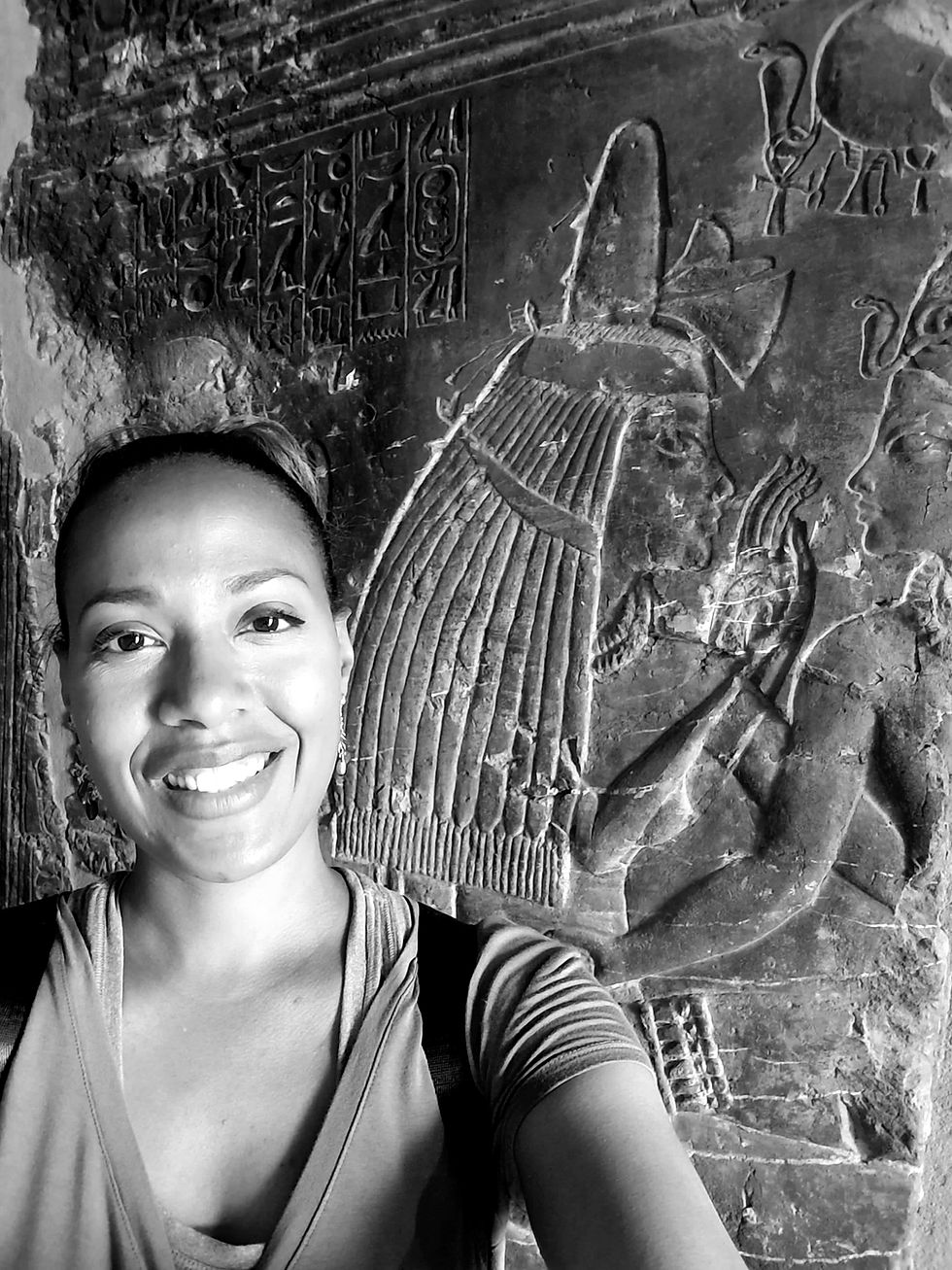
Amanda Victoria Chance, MD, is an Internal Medicine board-certified physician reviving ancient healing practices. Also certified in Lifestyle Medicine, she bridges millennia-old vibrational wisdom with evidence-based lifestyle interventions-- including nutrition, stress resilience, and non-pharmacological therapies-- to activate whole person care. She co-leads transformative healing journeys in Egypt with her husband-- including resonance-based experiences inspired by Saqqara's legendary "healing hospital," a site documented in Gaia's The Pyramid Code through her husband's grandfather's archival legacy.


Comments