The Land of Punt: Egypt's Divine Source of Incense and Ancestry
Imagine a land so fragrant that its very name was synonymous with incense, a place so sacred that the Egyptians called it the "Land of God." This was Punt—a kingdom of abundance, mystery, and spiritual significance that captured the Egyptian imagination for over a thousand years.
What was it about this distant realm that made it the object of Egypt's most ambitious expeditions? Why did the greatest pharaohs send fleets of ships to a place they considered the dwelling of the gods? And what do the treasures they brought back tell us about the botanical and cultural connections that linked the Nile Valley to the Horn of Africa and the Arabian Peninsula?

Join us as we explore the ancient texts, decipher the hieroglyphs, and follow the scent of myrrh and frankincense back to the Land of God.
The Name and Its Hieroglyphs
The Word "Punt"
The ancient Egyptian name for this land was pwnt (often transliterated as Punt or Pwene). The word is attested in Egyptian texts from as early as the Fifth Dynasty (c. 2500 BCE) and was written with a combination of hieroglyphs.
𓊪𓏲𓈖𓏏 (pwnt)
The hieroglyphs include the p (a mat), the w (a quail chick), the n (a wave of water), and t (a loaf of bread), with the final t often indicating a feminine ending. The word's exact pronunciation remains uncertain—Egyptologists conventionally render it as "Punt."
The "Land of God" (Ta Netjer)
More significant for our understanding is the epithet the Egyptians gave to Punt:
𓏏𓄿 𓈖𓏏𓆑𓂋 (tꜣ nṯr)
This phrase means literally "Land of the God" or "God's Land." The term netjer (nṯr) was used for the divine, the sacred, and the ancestral. The Egyptians sometimes spoke of Ta Netjer not as a single finite location, but as a broader concept representing "the Lands-of-Gods"—the myrrh terraces and incense-producing regions that the Egyptians did not fully know.
Why would the Egyptians call a foreign land "God's Land"? The answer lies partly in its treasures—the very substances used to honor the gods—and partly in a deeper belief that Punt was the ancestral homeland of the Egyptians themselves, located "toward the sunrise," the direction of rebirth and divine origin.
Ancient Texts and the Earliest References
The Pyramid Texts
While the name "Punt" does not appear in the Pyramid Texts themselves, the Coffin Texts of the Middle Kingdom link Punt to the moon's movement and the divine birth of the king. This suggests that the land was already embedded in Egyptian cosmological thought by the early second millennium BCE.

The Tale of the Shipwrecked Sailor (c. 2000 BCE)
This famous Middle Kingdom narrative provides one of the most vivid literary references to Punt. The tale describes a sailor shipwrecked on a magical island, where he encounters a gigantic serpent who declares: "I am the lord of Punt, and the myrrh belongs to me."
The serpent goes on to foretell the sailor's rescue and his return to Egypt laden with myrrh, incense, and other treasures. This literary evidence confirms that by the Middle Kingdom, Punt was already a legendary land of aromatic riches.
Hatshepsut's Expedition (c. 1470 BCE)
The most detailed and celebrated account of a Punt expedition comes from the reign of Queen Hatshepsut of the Eighteenth Dynasty. The reliefs at her mortuary temple at Deir el-Bahri depict the voyage in remarkable detail:
The fleet of five ships sailing down the Red Sea
The arrival at Punt, with its distinctive beehive-shaped houses built on stilts
The Puntite chief Parehu and his wife Ati, depicted with the characteristic physique noted by the Egyptians
The loading of ships with myrrh trees, incense resin, ebony, ivory, gold, and live baboons

The accompanying inscription records the queen's words:
"The myrrh of Punt has been brought to me, all the luxurious marvels of this country were brought to my palace in one collection."
Hatshepsut was so proud of this achievement that she had myrrh trees planted in the courtyard of her temple, creating a symbolic "Punt" within Egypt itself.
Later References
Expeditions to Punt continued through the Twelfth Dynasty (Senusret I, Amenemhat II, Amenemhat IV) and the Eighteenth Dynasty. A stela from the reign of Ramesses III (Twentieth Dynasty) records the last known Egyptian expedition to Punt, after which the land faded from Egyptian records.
Where Was Punt?
The location of Punt remains one of Egyptology's most enduring debates. The treasures brought back—and the animals depicted—provide crucial clues.
The Botanical and Zoological Evidence
The key treasures from Punt included:
Treasure | Significance |
Myrrh (Commiphora species) | Aromatic resin from trees native to the Horn of Africa and Arabia |
Frankincense (Boswellia species) | Sacred incense resin from the same regions |
Ebony (Dalbergia melanoxylon) | Dark hardwood from tropical Africa |
Ivory | Elephant tusks, sourced from African elephants |
Gold | Mined in the Eastern Desert and Nubia |
Baboons (Papio hamadryas) | Hamadryas baboons, native to the Horn of Africa and Arabia |
Giraffes | Depicted in the Deir el-Bahri reliefs, unmistakably African |
Cinnamon | Spice from South and Southeast Asia, but traded through the Horn of Africa |
The presence of baboons and giraffes is particularly telling. The hamadryas baboon is not found farther east than the Horn of Africa, and the giraffe is exclusively African. This strongly suggests that Punt was located somewhere along the Red Sea coast of Africa.

The Candidates
Scholars have proposed several locations:
1. Northern Somalia and Djibouti: The traditional view, based on the aromatic resins and the depiction of Somali-style beehive houses.
2. Eritrea and the Sudanese Red Sea coast: Recent excavations at Mersa/Wadi Gawasis, the ancient Egyptian port from which Punt expeditions departed, have provided material evidence linking Punt to this region.
3. Both sides of the Red Sea: Some scholars argue that Punt encompassed both the African coast (Somalia, Eritrea, Sudan) and the Arabian coast (Yemen), as myrrh and frankincense trees grow on both sides.
4. The Horn of Africa broadly: A 2005 analysis of a mummified baboon from the British Museum suggested a location in Eritrea, based on strontium isotope analysis.
The Image of the Puntite Queen
Among the most discussed scenes from Hatshepsut's temple at Deir el-Bahri is the depiction of the Puntite royal couple. The chief Parehu is shown with a beard and a slightly stooped posture, while his wife Ati is rendered with a markedly exaggerated physique— an unusually large, elongaged body and pronounced posterior, often with a suggested curvature of the spine.

The Daughter

The reliefs at Deir el-Bahri originally showed not just the queen, but her two sons and a daughter. An early source noted that "The daughter appears also to be, in spite of her youth, inclined to embonpoint" (plumpness). A more recent description confirms the daughter "was already beginning to acquire the ample proportions of her mother."
A genetic population trait, is inherited and would naturally appear across generations. The presence of a younger female figure with the same developing physical characteristics strongly supports the interpretation that steatopygia was present in this population.
The Khoisan Genetic Line in the Horn of Africa
Here the evidence becomes truly fascinating. While steatopygia is most associated with Khoisan peoples of southern Africa, there is scientific evidence that Khoisan-related genetic lineages once extended into the Horn of Africa.
This genetic evidence is supported by skeletal findings. A landmark 2002 study published in the American Journal of Human Genetics notes that "archeological findings suggest that the Khoisan territory once extended above the equator, to present-day southern Ethiopia and Sudan." Hypotheses about Khoisan ancestors in eastern Africa "have been made on the basis of Khoisan-like skeletal materials found in eastern and northeastern Africa."
This means that populations with Khoisan-related physical characteristics— including the potential for steatopygia— were present in the Horn of Africa region during the prehistoric period. They were not recent migrants from southern Africa; rather, the Khoisan-related populations of southern Africa represent the southern remnant of a distribution that once extended much further north.
A Population Trait
The Puntite queen's physique is best understood as a possible heritable population trait— steatopygia— displayed by an individual whose ancestors carried Khoisan-related genetic lineages that once extended into the Horn of Africa. The presence of a younger daughter showing the same developing characteristics supports the evidence of a genetic trait.
The Egyptians of the Eighteenth Dynasty, in their expeditions to Punt, were encountering populations with a deep and ancient presence in the region— peoples whose genetic heritage stretched back tens of thousands of years, to a time when Khoisan-related peoples ranged across a much wider swath of Africa than they do today.
Why Was Punt Called "Land of God"?
The epithet Ta Netjer carried multiple layers of meaning:
1. The Source of Sacred Substances
The incense, myrrh, and frankincense that came from Punt were essential for Egyptian religion. Without them, the daily temple rituals could not be performed. The land that supplied these divine substances was, by extension, a land beloved by the gods.
2. The Ancestral Homeland
Ancient Egyptian tradition held that the gods themselves originated in Punt. The region was considered the primeval dwelling of the gods and the "Land of the Ancestors." The Egyptians believed their own ancestors had migrated from the south, and Punt was remembered as the "home of Amen" and the "Mother Land" of the Egyptian people.
3. The Direction of the Rising Sun
Punt was located to the east and south, in the direction of the rising sun. For the Egyptians, this was the direction of birth, rebirth, and divine origin. The Luxor temple texts link Punt with the "eastern horizon and the home of the eastern souls."
4. A Realm Beyond Ma'at
Foreign lands were often considered chaotic, lacking Maat (cosmic order). But Punt was different. It was exempt from this judgment—a sacred realm where the gods had walked, and where the very trees wept precious resins for Egypt's temples.
The Treasures of Punt: Ancient Sacred Substances

Myrrh (Commiphora species)
Myrrh was arguably the most important treasure from Punt. Its name in Egyptian was anty (or antyw), and it was used in:
Temple incense: Burned daily to honor the gods
Embalming: Essential for mummification rituals
Medicine: Applied to wounds and used as an antiseptic
The myrrh of Punt was so prized that Hatshepsut's expedition returned with 31 living myrrh trees, complete with their roots, to be replanted in Egypt.
Frankincense (Boswellia species)
Frankincense, known as senetjer (meaning "to make divine"), was the other great aromatic treasure of Punt. It was burned in temples to carry prayers to the gods and was a key ingredient in the sacred incense known as kyphi.
Other Treasures
The Deir el-Bahri reliefs list a staggering array of goods:
"All goodly fragrant woods of God's-Land, heaps of myrrh-resin, fresh myrrh trees, ebony, pure ivory, green gold of Emu, cinnamon wood, khesyt wood, ihmut-incense, sonter-incense, eye-cosmetic, apes, monkeys, dogs, skins of the southern panther, and with natives and their children."
Modern Science and the Botanical Treasures
Myrrh: Anti-Inflammatory and Antimicrobial
Modern research has confirmed the medicinal properties that the Egyptians valued. Myrrh (Commiphora myrrha) contains sesquiterpenoids with:
Strong anti-inflammatory effects
Analgesic (pain-relieving) properties
Antimicrobial activity against bacteria and fungi
Studies suggest myrrh extracts may be useful in treating inflammatory conditions, wound healing, and even certain cancers.
Frankincense: Boswellic Acids and Cellular Health
Frankincense (Boswellia species) contains boswellic acids, which have been shown to:
Inhibit 5-lipoxygenase, an enzyme involved in inflammation
Suppress pro-inflammatory cytokines
Promote cellular regeneration
Clinical trials support frankincense's efficacy in treating osteoarthritis and inflammatory skin conditions like atopic dermatitis.
The Antimicrobial Power of Sacred Resins
A comprehensive 2024 review of plant resins found that frankincense and propolis have the broadest and most consistent antimicrobial spectra, with multiple mechanisms of action including membrane disruption, biofilm inhibition, and immune modulation. The ancient Egyptians' use of these resins was not merely symbolic—it was effective medicine.
Questions for Reflection
As we contemplate the treasures of Punt, several questions emerge:
What does it mean to call a foreign land "God's Land"? Is it a geographical place, a spiritual state, or a concept that transcends both?
Why do we seek "exotic" remedies from distant lands? The Egyptians were drawn to Punt for its sacred substances. Are we so different today, seeking superfoods from the Amazon or adaptogens from the Himalayas?
What was lost when Punt faded from Egyptian memory? After Ramesses III, the expeditions ceased. Did the land change, or did Egypt's worldview?
If Khoisan-related peoples once lived in the Horn of Africa, what happened to them? Were they absorbed into other populations, displaced, or did they simply become invisible in the geneti record?
How can the botanical wisdom of Punt inform our own relationship with nature? Myrrh and frankincense are still harvested today, often in the same regions the Egyptians knew. Are we honoring these plants—or exploiting them?
The Enduring Legacy
The Land of Punt was more than a trading partner. It was Egypt's sacred source—the place from which the gods themselves had come, and from which the incense rose to honor them. Its myrrh trees, replanted in Hatshepsut's temple, were living symbols of the connection between Egypt and the divine. Its people, depicted with physical traits that speak to the deep genetic history of the Horn of Africa, were living representatives of populations whose roots stretched back tens of thousands of years.
Today, the aromatic resins of Punt—myrrh and frankincense—continue to be valued for their medicinal properties, their fragrances, and their spiritual significance. The land that the Egyptians called Ta Netjer may have faded from the map, but its treasures remain woven into the fabric of global wellness.
At Archaeo-Acoustics, we honor this legacy. The plants that perfumed the temples of the Pharaohs still have much to teach us about the connection between nature, medicine, and the sacred.
Note on Sources: The Punt reliefs are published in E. Naville, The Temple of Deir el Bahari (1895-1908). On the daughter's depiction, see A.B. Edwards, Pharaohs, Fellahs and Explorers (1892). On Puntite physical characteristics, see the tomb of Rekhmire. For more information about the possible location of Punt please reference this article: https://landofpunt.wordpress.com/2023/03/11/punt-an-ancient-civilization-rediscovered-2/
About the Author
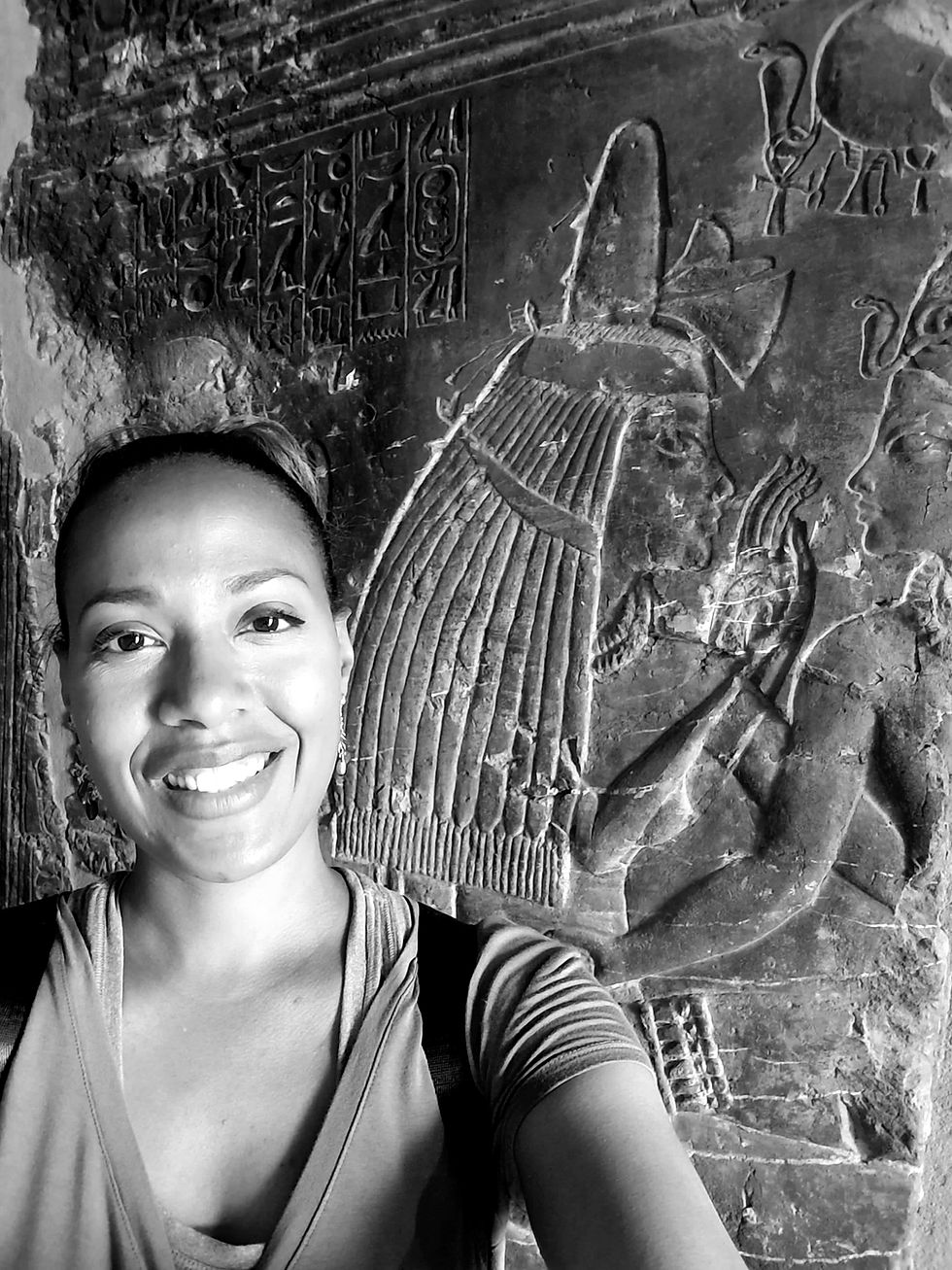
Amanda Victoria Chance, MD, is an Internal Medicine board-certified physician reviving ancient healing practices. Also certified in Lifestyle Medicine, she bridges millennia-old vibrational wisdom with evidence-based lifestyle interventions-- including nutrition, stress resilience, and non-pharmacological therapies-- to activate whole person care. She co-leads transformative healing journeys in Egypt with her husband-- including resonance-based experiences inspired by Saqqara's legendary "healing hospital," a site documented in Gaia's The Pyramid Code through her husband's grandfather's archival legacy.


Comments