The Dendera "Lightbulb": A Question of Ancient Technology or Sacred Symbolism?
In the crypts beneath the Hathor Temple at Dendera, carved into stone, is a relief that has sparked one of the most enduring debates in Egyptology. To the modern eye, it appears to depict a giant lightbulb—an elongated glass vessel containing a wavy filament, connected by a cable to a small box. The image has fueled decades of speculation: Did the ancient Egyptians possess electricity? Were they visited by extraterrestrials? Or is there a simpler, more profound explanation?

The answer lies not in modern technology, but in the most ancient religious texts of Egypt—the Pyramid Texts—which reveal the true identity of the characters in this remarkable scene.
The Mystery: What Does the Dendera "Lightbulb" Relief Show?

The Dendera relief, found in a subterranean crypt, depicts what appears to be a large, oval container supported by a pillar. Inside the container, a wavy snake-like form rises from a lotus flower. A line connects the "bulb" to a small, box-like object nearby. To those unfamiliar with Egyptian iconography, this looks strikingly like an electrical device.
But the hieroglyphic texts carved directly alongside the image tell a very different story. They identify the central figure as Harsomtus (also known as Harsiese), a form of the god Horus, emerging from a lotus flower. This is not a technological device—it is a profound statement of Egyptian cosmology, a visual representation of the moment of creation and the daily rebirth of the sun.
The Characters in the Mural
To understand the relief, we must identify each element and trace its meaning back to Egypt's oldest religious literature.
Harsomtus: The Serpent God

The central figure, Harsomtus, meaning "Horus, the Uniter of the Two Lands," is depicted as a cobra emerging from a lotus. Harsomtus is a form of Horus, the sky god and protector of the pharaoh. While "Harsomtus" is specific to the Greco-Roman period, his identity as Horus is ancient. The Pyramid Texts, the oldest religious literature, show Horus's complex relationship with the serpent, not just as an enemy but as part of Horus himself, seen in the Uraeus, the cobra on the pharaoh's brow.
The cobra goddess in the texts is called wrt-hks, "Great of Magic," rising on Horus's forehead, indicating the Uraeus is part of Horus. The Royal Serpent, or Uraeus, is described as nstr, "Flame of the Uraeus," consuming the king's enemies. The texts equate the Uraeus with the Eye of Horus, showing the serpent as an emanation of Horus's power.
This tradition underpins the Dendera relief, where Harsomtus, the serpent from the lotus, symbolizes the reborn sun, the light of creation. The Pyramid Texts describe the sun god emerging from the primordial lotus at dawn. Harsomtus, rising from the lotus, continues this theme of the sun reborn, emerging from the sky goddess Nut each dawn.
The serpent form of Harsomtus symbolizes not evil but the Uraeus, the protective power of Horus, and the eternal light of creation rising from primordial waters.
The Lotus: The Flower of Creation
The lotus flower from which the serpent rises is one of the most potent symbols in Egyptian cosmology. In the Pyramid Texts, the lotus is associated with the very act of creation. The texts describe the creator god Atum emerging from a lotus floating on the primordial waters of Nun. This lotus is called "wnb" —the primordial lotus from whose calyx the sun rises, accomplishing the daily re-creation of the universe.
Particularly revealing is Utterance 249 of the Pyramid Texts, which likens the resurrected king to "Nefertum, like the lotus that rose from the nose of Ra." Nefertum is the god born from the primordial lotus, symbolizing the creative power of the sun. The lotus, therefore, is not merely a flower—it is the vessel of creation and rebirth, the sacred medium through which light emerges from darkness.
In the Dendera relief, the serpent emerging from the lotus is the sun reborn—the daily miracle of creation made visible.
Nut: The Sky Goddess and the Womb of Rebirth
The oval "bulb" container in the relief is understood by Egyptologists as the womb of the sky goddess Nut. This is not an arbitrary association. In Egyptian cosmology, Nut is the sky goddess who arches over the earth god Geb. Her body is the starry vault of heaven.
The Pyramid Texts preserve the oldest known hymns to Nut, describing her as the mother of the sun. Her core function is the cycle of the sun: she swallows the sun at sunset and gives birth to it at dawn. The dead king ascends to her, and she protects and nourishes him. One Pyramid Text passage states:
"The king is your son, O Nut. You have taken him and placed him in your womb, and you shall give birth to him at dawn."
In the Dendera relief, the oval container is not a glass bulb—it is the womb of the sky goddess. The serpent inside is the sun, waiting to be born. The entire scene is a visual meditation on the eternal cycle of death and rebirth, the nightly journey of the sun through the underworld, and its triumphant emergence at dawn.
The Djed Pillar: The Backbone of Stability
The pillar supporting the "bulb" is the Djed pillar, one of the most recognizable symbols of ancient Egypt. It represents stability, endurance, and the backbone of Osiris. The Djed pillar first appears in the Third Dynasty (c. 2686 BC) in the underground galleries of the Step Pyramid of Djoser, long before the Osiris myth became widespread.
In the Pyramid Texts, the Djed pillar is associated with eternal stability and the resurrection of the king. It is often described as the backbone of the god and is linked to the concept of raising the Djed—a ritual act symbolizing the reestablishment of cosmic order.
In the Dendera relief, the Djed pillar supports the womb of Nut, symbolizing the stable architecture of the cosmos.
Shu: God of Air and Light
Shu is one of the first pair of deities created by Atum, representing air, wind, and breath. The Pyramid Texts record: "Atum... spat out Shu, vomited Tefnut." Shu's name means "emptiness" and "dryness" - he is the space itself that appears when things are separated.
Shu's most prominent role in the Pyramid Texts is supporting the sky goddess Nut. The texts repeatedly describes Shu's arms lifting the sky: "like Shu's arms beneath the sky, he lifts it." His arms are described as long and powerful, the force that supports the celestial vault. In the Dendera relief, the figure kneeling and supporting the middle of the container with his head is Shu- he holds Nut's womb with his own body, allowing the reborn sun to gestate within it.

Heh: God of Eternity and Infinity
Heh is the embodiment of eternity and infinity. His name in hieroglyphs is used to denote "one million," thus closely associating him with millions of years. Heh is already recorded in the Pyramid Texts (Utterance 558), usually appearing alongside other primordial deities.
Heh's core function is supporting the sky. In the Book of the Heavenly Cow, Shu and eight Heh-gods together support the sky goddess Nut- Nut, transformed into a heavenly cow, trembles from the height, and Ra creates the Heh-gods to support her. Heh is typically depicted squatting or kneeling, holding palm ribs (the palm rib is the symbol of "year"), symbolizing eternal time supporting the cosmos.
The Dendera relief, the standing figure on the left and the figure on the right with one knee on the ground and arms raised are both Heh. Their posture— hands lifting the container— is the classic reenactment of the Heh-gods supporting the sky in the Pyramid Texts. Their presence proclaims: the sun's rebirth is not a one-time miracle but part of an eternal cycle, carried and sustained by infinite time itself.
What Do the Texts Actually Say?
The hieroglyphs accompanying the Dendera relief are explicit. In one crypt, the text above the serpent reads:
"Words spoken by Harsomtus, the great God, who dwells in Dendera... whose Ba caused the Rising [woman] to rise in the sky... the power of Ra in the land of Atum (Dendera), the father of the Gods, who created that which exists."
This is a theological statement, not a technical manual. It describes the god's power to cause the sun to rise—a central act of creation and cosmic order. The "Ba" (soul) of the god causes the "Rising" to occur. This is the language of faith, not machinery.
The "Lightbulb" Theory: A Modern Misreading
The "lightbulb" interpretation of the Dendera relief was popularized in the 20th century, most notably by Erich von Däniken and later by the History Channel's Ancient Aliens series. Proponents argue that the absence of soot deposits in some tombs proves the use of electric light.
However, this theory is rejected by Egyptologists for several reasons:
1. The Texts: The accompanying hieroglyphs explicitly describe a myth, not a machine.
2. The "Filament": The wavy line is clearly the body of the serpent Harsomtus, a common religious symbol.
3. The "Socket": The object at the base is a Djed pillar, a symbol of stability and Osiris, not an electrical socket.
4. The "Cable": The line connecting the "bulb" to the "socket" is part of the lotus stem or a supporting structure, not a wire.
5. Anachronism: Ancient Egyptians had no knowledge of electricity, vacuums, or glass-blowing on this scale. The entire interpretation projects modern technology onto an ancient symbol.
6. No Physical Evidence: No wires, batteries, or electrical components have ever been found in Egypt.
As Egyptologist Dr. Zahi Hawass has stated: "The so-called 'lightbulb' is a complete misinterpretation. It is a depiction of a creation myth, not a technological device."
The Vibrational Wisdom Perspective
From the perspective of vibrational wisdom, the Dendera "lightbulb" is not a failed attempt at technology, but a successful representation of a deeper truth. The ancient Egyptians were not trying to depict an electric light; they were trying to depict the principle of light itself—the moment of creation, the daily rebirth of the sun, the triumph of order over chaos.
The image is a sacred technology, a visual mantra designed to convey the mystery of creation to initiates. The snake is not a filament but a living, conscious force of renewal. The lotus is not a glass bulb but a vessel of divine birth. The Djed is not a socket but the stable backbone of the cosmos. The oval container is not a vacuum tube but the womb of the sky goddess.
To read it as a lightbulb is to miss the profound spiritual science that the ancients were encoding in stone. The "light" it depicts is the eternal light of creation itself—a light that the ancient Egyptians understood not as a physical phenomenon to be harnessed, but as a sacred mystery to be revered.
Conclusion
The Dendera "lightbulb" is one of the most powerful examples of how modern eyes can misinterpret ancient art. The relief is not evidence of lost technology, but of a sophisticated and enduring mythology. The characters are gods: Harsomtus, the reborn sun; Nut, the sky goddess whose womb holds the promise of rebirth; the lotus, the vessel of creation; and the Djed pillar, the backbone of cosmic stability.
The Pyramid Texts, carved into stone over four thousand years ago, provide the key to understanding this image. They tell us that the ancient Egyptians were not concerned with electric light—they were concerned with the eternal light of creation, the daily miracle of the sun's rebirth, and the promise of their own resurrection. The Dendera relief is not a blueprint for a machine. It is a hymn in stone, a visual prayer to the eternal forces of life and light.
About the Author
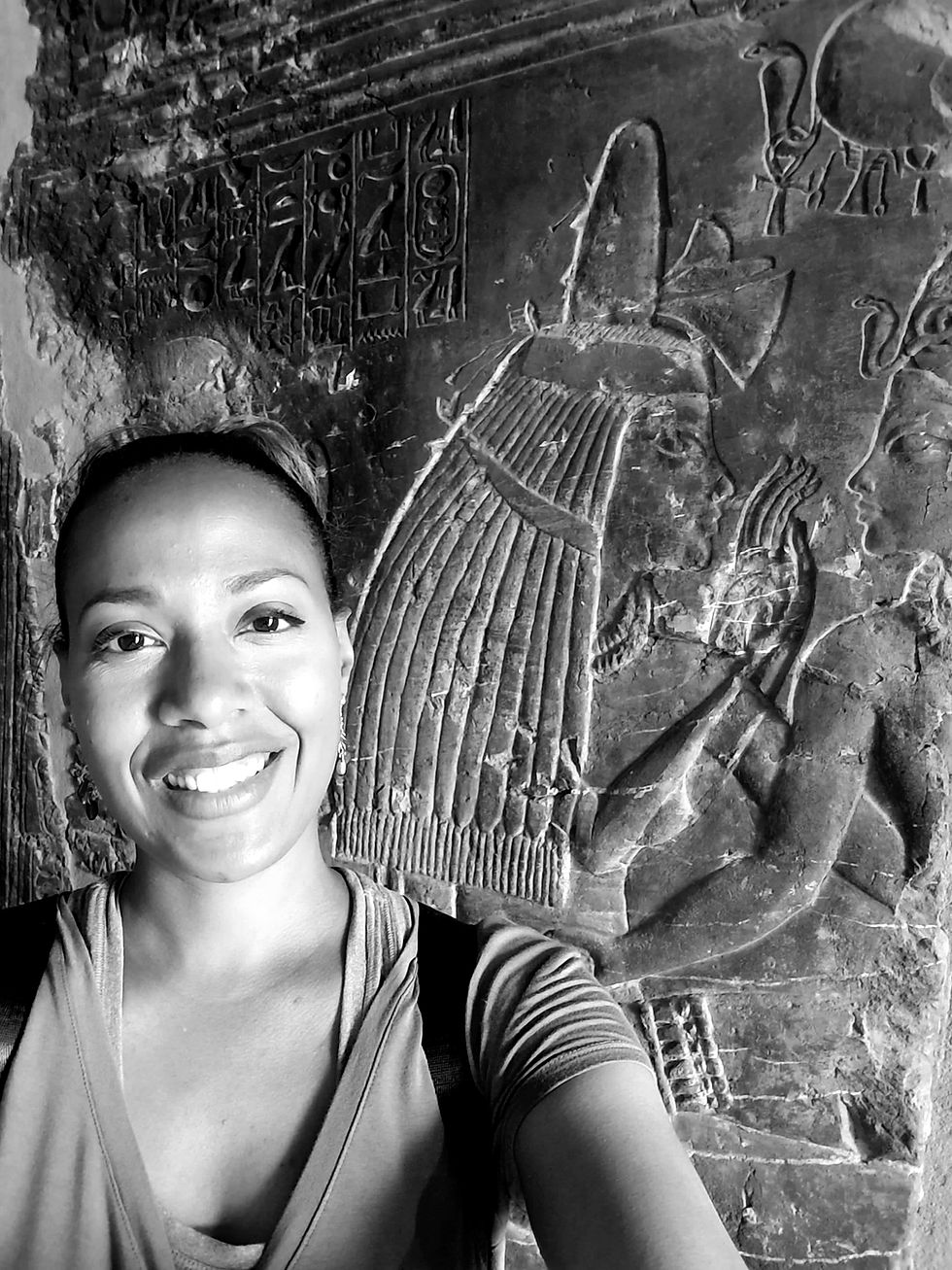
Amanda Victoria Chance, MD, is an Internal Medicine board-certified physician reviving ancient healing practices. Also certified in Lifestyle Medicine, she bridges millennia-old vibrational wisdom with evidence-based lifestyle interventions-- including nutrition, stress resilience, and non-pharmacological therapies-- to activate whole person care. She co-leads transformative healing journeys in Egypt with her husband-- including resonance-based experiences inspired by Saqqara's legendary "healing hospital," a site documented in Gaia's The Pyramid Code through her husband's grandfather's archival legacy.


Comments