Inheritance of the Tyrant: Understanding Your Ancestral Ka
Updated: Sep 14
“The messengers of your Ka have come to you, the messengers of your father have come to you, the messengers of Re have come to you.” — Pyramid Text Utterance 214
The ancient Egyptians understood something that modern psychology is only beginning to rediscover: we are not isolated individuals, but the living continuation of a chain that stretches back through countless generations. At the heart of this understanding is the Ka—the life force, the spiritual double, the vital essence that is both personal and ancestral.
But what happens when one of those ancestors was a tyrant? What if the person whose Ka flows through your veins was not a benevolent patriarch but a figure of cruelty and destruction? The Pyramid Texts offer a nuanced perspective on this profound question.

What Is the Ka?
The Ka is one of the most fundamental concepts in ancient Egyptian spirituality. In the Pyramid Texts, the Ka is described as the vital essence that accompanies every person, both in life and after death.
“He goes who goes with his Ka! Horus goes with his Ka, Seth goes with his Ka. Thoth goes with his Ka, The God goes with his Ka… You yourself also go with your Ka.”
The Ka is not merely an abstract life force; it is the spiritual container of a person's entire identity. Egyptologists have described it as the “divine counterpart of the man which corresponds to the memory‑image” — a complete record of one's life history, personal nature, and individual characteristics. It is a “database” of everything a person was.

This is where the question of ancestral inheritance becomes significant. The Ka was believed to be transferred through the family lineage, meaning that the spiritual essence of your ancestors is part of your own Ka. As the Pyramid Texts affirm:
“Your Ka is enduring, your Ka is with you… the Ka of your fathers is with you, the Ka of your children is with you.”
You are not separate from your ancestors. Their spiritual essence flows through you.
The Tyrant's Ancestral Ka: A Complicated Inheritance
If a person was a tyrant in life, their Ka contains the complete imprint of that tyranny. The Pyramid Texts make clear that the Ka preserves all that a person was:
“The messengers of your Ka have come to you, the messengers of your father have come to you, the messengers of Re have come to you.”
The Ka of a tyrannical ancestor would hold the memory of their cruelty, their oppression, and the harm they caused. But the ancient Egyptians did not view this as a simple curse. They understood that the Ka was not a conscious judge; it was a passive, static imprint. It contained the “memory” of the tyrant's actions, but it did not actively reflect upon them with guilt or remorse.
However, a neglected Ka could become a source of danger. The Pyramid Texts speak of a “Satisfied Ka” — a Ka that has been properly nourished and honored. The implication is clear: a Ka that is not satisfied, that is forgotten or neglected, could become restless and even malevolent.
The Threat of the Dissatisfied Ka
In ancient Egyptian belief, the worst fate for a soul was to be forgotten. If a Ka was not sustained through offerings and remembrance, it could become a source of harm.
“It would wander forth from the tomb and eat any kind of offal and drink any kind of dirty water which it might find in its path.”
This is not a description of a moral judgment; it is a description of spiritual neglect. The Ka, like any living thing, requires sustenance. When it is denied, it becomes desperate and potentially dangerous.

For the descendants of a tyrant, this presents a profound dilemma. How do you honor a tyrannical ancestor? How do you feed the Ka of someone who caused great harm? The Pyramid Texts suggest that the act of remembrance is not about approving the ancestor's deeds. It is about acknowledging the unbroken chain of life that connects all generations.
The Pyramid Texts also contain hymns to protect against those who would cause harm, even from beyond the grave:
“Osiris, seize every one who hates Unas, who speaks evil against his name! O Thoth, go, seize him for Osiris! Bring the one who speaks (evil) against the name of Unas, place him in your hand!"
The Fate of the Evil Heart
It is important to note that the ancient Egyptians believed in personal judgment. Each individual was responsible for their own actions. The heart of the deceased was weighed against the feather of Ma'at, the principle of truth and cosmic order. For those whose hearts were truly evil:
“The goddess Ammit waited patiently behind Wesir's judgment seat to consume them. She was a composite creature resembling three of the deadliest animals in Egypt: the crocodile, the hippopotamus and the lion.”
This was the fate of the truly evil heart — not merely a flawed or struggling soul, but one that was intentionally, persistently destructive. The tyrant's own heart faced this judgment. The tyrant's own soul, not the souls of their descendants, would bear the ultimate consequence of their actions.
Modern Science and Ancient Wisdom: The Evidence for Ancestral Inheritance
The ancient Egyptian belief in ancestral inheritance finds remarkable resonance in modern scientific research. The most striking evidence comes from the field of epigenetics—the study of how environmental factors can change gene expression without altering the DNA sequence itself.
The Mouse Study: Inherited Fear
In a landmark 2013 study published in Nature Neuroscience, researchers Brian Dias and Kerry Ressler at Emory University demonstrated that trauma could be inherited across multiple generations.
First Generation: Male mice were trained to fear a specific odor (acetophenone, which smells like cherry blossom) by pairing it with a mild electric shock. The mice learned to fear the odor.
Second Generation: The offspring of these trained mice were born without ever experiencing the shock. Yet, they showed an abnormal sensitivity and fear response to the same odor.
Third Generation: When the second generation bred, their offspring—the third generation—also inherited the fear response.
The mechanism was epigenetic. The traumatic experience had left chemical marks (DNA methylation) on the sperm of the traumatized fathers, altering the expression of genes related to the odor receptors. The offspring inherited not a change in their DNA sequence, but a change in how their genes were expressed—a "software" modification passed down through the generations.
Other Scientific Corroboration
This study is not an isolated case. Research by Isabelle Mansuy's team at the University of Zurich has shown that early trauma in mice can affect their offspring for up to five generations. Human studies have also suggested that trauma from large-scale historical events—such as systemic oppression, famine, and war—may have transgenerational effects through epigenetic mechanisms.
The Parallel with the Ka
Concept | Ancient Egyptian "Ka" | Modern "Epigenetics" |
Mechanism | A spiritual life force connecting ancestors and descendants, forming the family's bloodline inheritance. | A biological "memory" passed down through generations via chemical marks (rather than changes to the DNA sequence). |
Content | The complete spiritual imprint of the ancestor, including their character, actions, and experiences. | The traces left by ancestral experiences (especially trauma and stress) on gene expression. |
Transmission | Transmitted and sustained through the family bloodline and ongoing rituals of remembrance. | Transmitted via epigenetic marks carried in germ cells (sperm and eggs). |
Impact | The positive traits or negative "debts" of ancestors could influence the spiritual and material lives of descendants. | Ancestral trauma can make descendants more susceptible to specific stresses and increase the risk of certain diseases. |
The mouse study reveals that ancestral fears and traumas can be "imprinted" on our biology. This provides a scientific framework for understanding the ancient belief that the "ancestral Ka" influences descendants.
Ancestral Beliefs Across Cultures
The concept of ancestral inheritance is not unique to ancient Egypt. Similar beliefs appear in cultures across the globe:
East Asian Cultures (China, Japan, Korea): Ancestors are expected to be benevolent, but if neglected or forgotten, they may bring illness or misfortune. Japanese folklore speaks of sorei—ancestral spirits who can become angry and curse their families if not properly honored.
West African Cultures (Yoruba, Akan, Soninke): The Yoruba believe that newborns may be reincarnations of ancestors, with names like "Babatunde" (father has returned). The Akan believe ancestors reincarnate within the family to fulfill unfinished destinies. The Soninke speak of barake—a supernatural life force passed down through generations, closely paralleling the concept of the Ka.
South Asian Cultures (Hinduism): The concept of Karma is linked to ancestral actions. Scriptures mention that "the sins of ancestors are borne by their descendants," while also emphasizing individual responsibility.
Ancient European Traditions (Greek, Roman, Slavic): The Romans believed that neglecting the Manes (ancestral spirits) could bring crop failure and disease. Unburied or improperly honored dead could become vengeful Lemures (malevolent spirits).
Indigenous American Peoples (Yuchi, Sioux, etc.): The Yuchi believe that children may be reincarnations of ancestors, and that a father's violations of taboo can affect his child. The Sioux believe that truly evil souls are punished after death by being reincarnated into animals.
This cross-cultural pattern is not coincidental. It reflects a deep, intuitive understanding that the actions of our ancestors—both good and ill—leave their mark on us, and that we have a responsibility to acknowledge and honor that inheritance.
Mixed Bloodlines and Multiple Inheritances
In the modern world, many people carry the heritage of multiple cultures and bloodlines. For individuals with mixed ancestry the ancestral inheritance is particularly complex. They carry not one but multiple lineages, each with its own history of triumphs, traumas, and legacies.
From the perspective of historical trauma, mixed bloodlines often mean bearing the weight of multiple intersecting histories of oppression, displacement, and resilience. This can feel like an additional burden—a layering of pain that must be acknowledged and processed.
However, mixed heritage also brings unique strengths. It represents a convergence of survival strategies, wisdoms, and cultural resilience. Those who carry multiple lineages have the opportunity to draw from a broader well of ancestral resources. The challenge—and the gift—is to integrate these diverse strands into a coherent identity that honors all of one's ancestors.
The Mathematics of Ancestry: Are We All Related to Tyrants?
A profound question arises: are most people related to tyrants? From a genetic and statistical perspective, the answer is almost certainly yes.
The mathematics of ancestry is exponential. Each of us has two parents, four grandparents, eight great-grandparents, and so on. Going back just 30 generations (approximately 900 years), the number of ancestors would be over one billion—far exceeding the human population at that time. This means that all of our family trees inevitably converge at various points in history.
Historical rulers—kings, warlords, conquerors—often had more children than the average person, and their genes spread more widely through the population. Therefore, it is virtually certain that most people alive today, especially those in regions with long histories of empire and conquest, carry the genetic legacy of some historical tyrant.
However, this genetic connection does not carry moral weight. There is no "tyrant gene." A person's character is shaped by a complex interplay of environment, upbringing, and personal choice—not by bloodline. The presence of a tyrant in one's ancestry is a historical fact, not a moral inheritance.
What This Means for the Descendant
If your ancestor was a tyrant, their Ka still flows through you. Their spiritual imprint is part of your inheritance. But this does not mean you are cursed or condemned. The ancient Egyptian understanding—supported by modern insights— offers a more nuanced perspective:
1. The Ka is a record, not a judgment. The Ka of a tyrannical ancestor contains the memory of their actions, but it does not actively condemn you. It is a passive imprint, not an accusing voice.
2. Remembrance is not approval. You can honor the chain of life without approving the deeds of the tyrant. The act of offering remembrance is about maintaining the continuity of the lineage, not about endorsing the ancestor's actions.
3. Your own heart is what matters. The judgment that counts is your own. The heart of the descendant is weighed on its own merits, not on the deeds of ancestors. You are responsible for your own life, your own choices, your own heart.
4. You can transform the inheritance. The ancient Egyptians believed in rituals of purification, in the power of offerings and remembrance to transform a restless Ka into a satisfied one. The same principles can be applied to the inheritance of a tyrant: through conscious remembrance, acknowledgment, and ritual, you can transform the burden of the past into a source of understanding and, ultimately, healing.
5. Mixed ancestry is a source of complex strength. If you carry multiple bloodlines, you inherit not only the burdens of each lineage but also their unique wisdom and resilience. You have the opportunity to draw from a broader ancestral resource—to honor all of your ancestors and to weave their diverse strengths into your own identity.
6. We are all connected, and we are all responsible for our own choices. The mathematical reality is that we are all related to tyrants—and to saints. But our own choices, our own hearts, are what define us. We cannot choose our ancestors, but we can choose how we respond to their legacy.
7. The science supports the possibility of healing. Just as trauma can be inherited, healing can also be transmitted. Conscious practices of remembrance, acknowledgment, and transformation can break the cycle of inherited trauma and create a new legacy for future generations.
Conclusion: The Unbroken Chain
“You did not pass away, your Ka does not pass away. You are Ka.”
The ancient Egyptians understood that we are not isolated beings. We are part of an unbroken chain that stretches back to the dawn of time. The Ka of our ancestors flows through us — the good and the bad, the benevolent and the tyrannical.
The presence of a tyrannical ancestor in your lineage is not a curse. It is a reminder of the complexity of human inheritance, the weight of history, and the power of conscious remembrance. By understanding the nature of the Ka, we can acknowledge the full spectrum of our ancestry — the light and the shadow — and choose, with our own hearts, how we will carry it forward.
“The messengers of your Ka have come to you, the messengers of your father have come to you.”
The messengers are here. The question is: how will you receive them?
About the Author
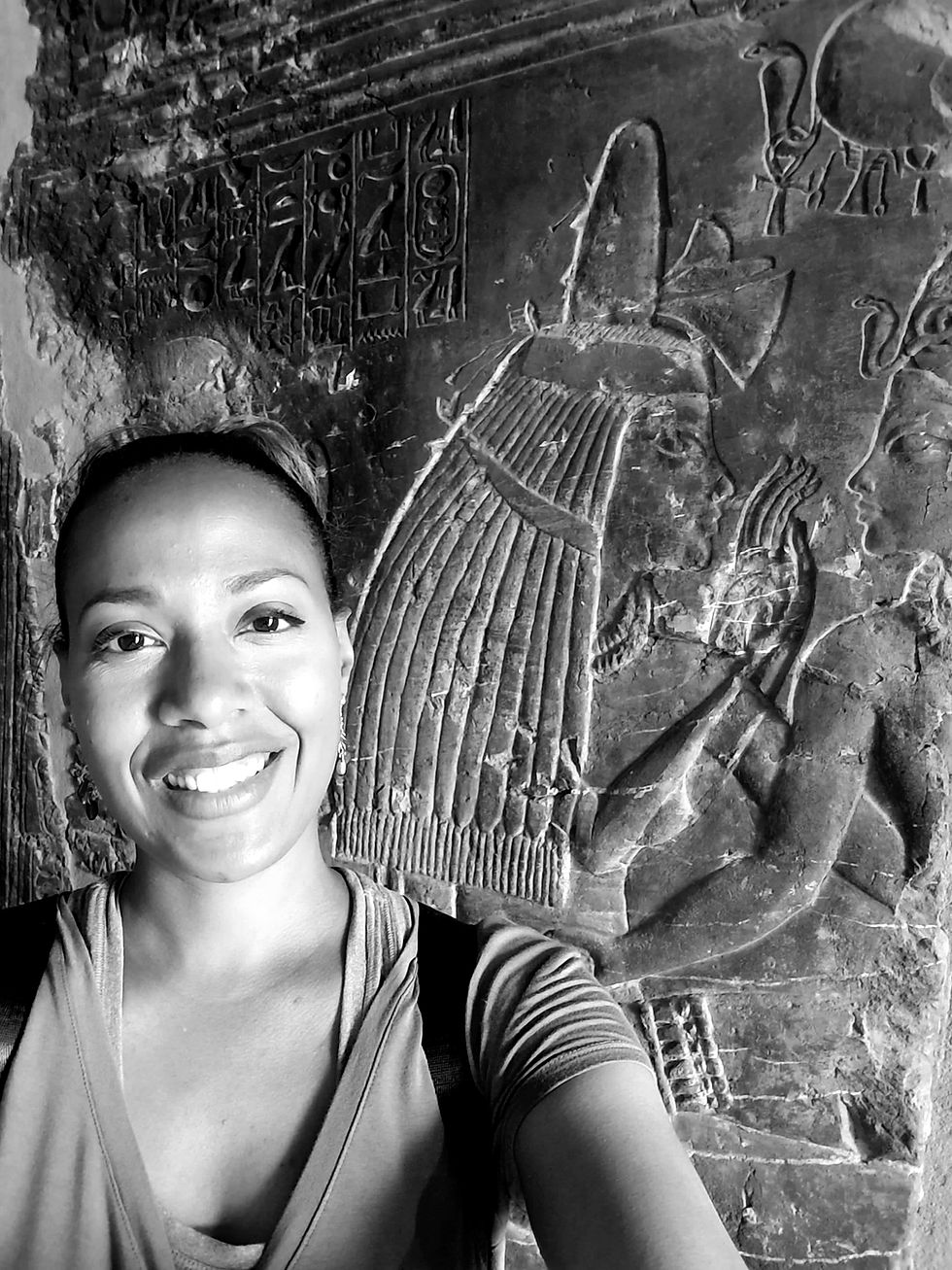
Amanda Victoria Chance, MD, is an Internal Medicine board-certified physician reviving ancient healing practices. Also certified in Lifestyle Medicine, she bridges millennia-old vibrational wisdom with evidence-based lifestyle interventions-- including nutrition, stress resilience, and non-pharmacological therapies-- to activate whole person care. She co-leads transformative healing journeys in Egypt with her husband-- including resonance-based experiences inspired by Saqqara's legendary "healing hospital," a site documented in Gaia's The Pyramid Code through her husband's grandfather's archival legacy.


Comments