The Ancient Egyptian Past Life Connection: Evidence, Texts, and Modern Meaning
"I am Yesterday, Today, and Tomorrow, and I have the power to be born a second time."
— From the Egyptian Book of Coming Forth by Day
The modern fascination with "feeling a past life connection to ancient Egypt"—experiencing inexplicable familiarity with hieroglyphs, deep emotional pulls toward specific temples, or vivid dreams of a life along the Nile—is a widespread phenomenon. While this experience is deeply personal and metaphysical, it finds a profound echo in the oldest spiritual texts of humanity. The ancient Egyptians didn't just believe in reincarnation; they built an entire civilization around the cyclical renewal of the soul and the possibility of conscious return. Let's examine the evidence, from Old Kingdom foundations to modern interpretations.

Part I: The Old Kingdom Blueprint for Eternal Return
The Pyramid Texts (c. 2400-2300 BCE), the world's oldest religious corpus, establish a core doctrine: the deceased king does not merely go to a static afterlife. He undergoes a transformative cycle to be reborn into a divine, enduring state.
1. The King as the Eternal Star and Seed:
The Texts are clear that death is a transition to another form of life. In Utterance 245, the king declares: "The sky conceives me, the dawn-light bears me... I am the seed of a god." This isn't a metaphor for a one-time ascension; it's a statement of perpetual regenerative potential. In Utterance 325, he states: "I am a star which illumines the sky, I mount up to the god that I may be protected, for I am a star which illumines the sky."
2. The "ba" and the Mobile Soul:
A key concept for past-life potential is the ba. Often translated as "soul" or "personality," the ba was the mobile, conscious aspect of a person that could travel between the realms of the living and the dead. The Pyramid Texts command the ba to remain connected to the body and the world. This established the idea of a conscious essence that persists and can interact across the veil, a prerequisite for any concept of return.
3. Union with Osiris: The Archetype of Death and Rebirth:
The primary goal in the Pyramid Texts is for the king to merge with Osiris, the god murdered and restored to life. By becoming "an Osiris," the king didn't just imitate a myth; he entered into the archetypal cycle of death and regeneration that governs all nature (the Nile flood, the crops, the sun). This union made him part of an eternal, repeating pattern—a cosmic blueprint for cyclical return.
Part II: The Evolution of the Doctrine
Later texts make the idea more inclusive for non-royals:
Coffin Texts (Middle Kingdom): Spell 1130 states: "I am he who comes from the waters, the inundation which endures... I return as I was in the time that was."
Book of Coming Forth by Day (New Kingdom): The famous "Weighing of the Heart" was a judgment to see if the soul was worthy of continuing its journey, not to end it. A successful soul could "go forth by day" in various forms.
Greek Period Testimony: The Greek historian Herodotus (5th century BCE) explicitly wrote: "The Egyptians are the first who propounded this doctrine, that the human soul is immortal, and that each time the body perishes it enters another animal that is being born."
While a linear, sequential reincarnation (human to human) as understood today isn't the only model in Egyptian thought, the core principles are unequivocal: the soul is immortal, death is a transition, and the conscious essence can return or be reborn in alignment with cosmic cycles.
Part III: Modern Evidence and the "Connection" Phenomenon
Scientifically, "proof" of past lives remains outside the domain of empirical validation. However, several fields of study document phenomena that fuel this belief:
1. Ian Stevenson's Research:
The most cited work is that of psychiatrist Dr. Ian Stevenson (University of Virginia). For decades, he investigated cases of young children who spontaneously recalled detailed, verifiable information about deceased individuals they could not have known. While his methods are debated, he documented thousands of cases globally, proposing "verified anomalous memories" as a hypothesis worthy of study.
2. The Psychology of "Cryptomnesia":
Mainstream psychology explains many" past life" memories as cryptomnesia—a forgotten memory that is later recalled without recognition of its source. A story read in childhood, a documentary seen, or a powerful imaginative synthesis can feel like a genuine memory. The emotional "pull" to Egypt can also stem from collective unconscious archetypes (a la Carl Jung)—Egypt represents mystery, immortality, and sacred knowledge, powerful symbols that can resonate deeply on a psychic level.
3. The Transformative Power of Narrative:
Regardless of origin, the feeling of a past-life connection has demonstrable effects. It can be a powerful narrative for personal transformation, sparking intense interest in history, ethics, or spirituality. The key is whether the narrative leads to a more engaged, compassionate, or curious life.
The Resonance of the Eternal Soul
At Archaeo-acoustics, we view this not through the lens of empirical proof, but through the lens of resonance and memory.
The Egyptian worldview saw the soul (ba and ka) as a vibrational pattern of consciousness. If ancient sites were built to hold and transmit specific frequencies, then a powerful experience within them could be interpreted as a form of acoustic or energetic resonance—a tuning fork within the mind and spirit being struck by the same frequency that once shaped a civilization's consciousness.
The "past life connection" may be less about a literal previous biography and more about tapping into the enduring vibrational memory of a culture that mastered the language of nature, community, and well-being. The deep familiarity some feel could be a recognition of these archetypal patterns and frequencies, etched into the monuments and, perhaps, into the collective human experience.
An Invitation to Explore the Feeling of an Egyptian Past Life
We invite you to explore this connection not as a question to be definitively answered, but as a feeling to be deeply experienced.
Listen to the Memory in the Stone: Explore our Radio Waves archive. As you hear the frequencies of a sacred chamber, ask not "Was I here?" but "What does this resonance awaken in me?"
Walk as a Conscious Soul: On a journey with us, you can walk the path of the ancient soul. We visit sites designed for transformation—the Osireion at Abydos (the tomb of Osiris), the deep chambers of the pyramids. In these places, you can engage with the feeling of cyclical return, allowing the architecture designed for eternal life to prompt your own inner exploration.
Whether a literal truth or a profound metaphor, the Egyptian past-life connection endures because it addresses a deep human hope: that our consciousness is part of an eternal, intelligent pattern, and that the story of the soul does not end with a single lifetime. In that, the ancients and modern seekers are completely aligned.
This article is part of our ongoing exploration.
For the full context and next week's insight, subscribe below.
About the Author
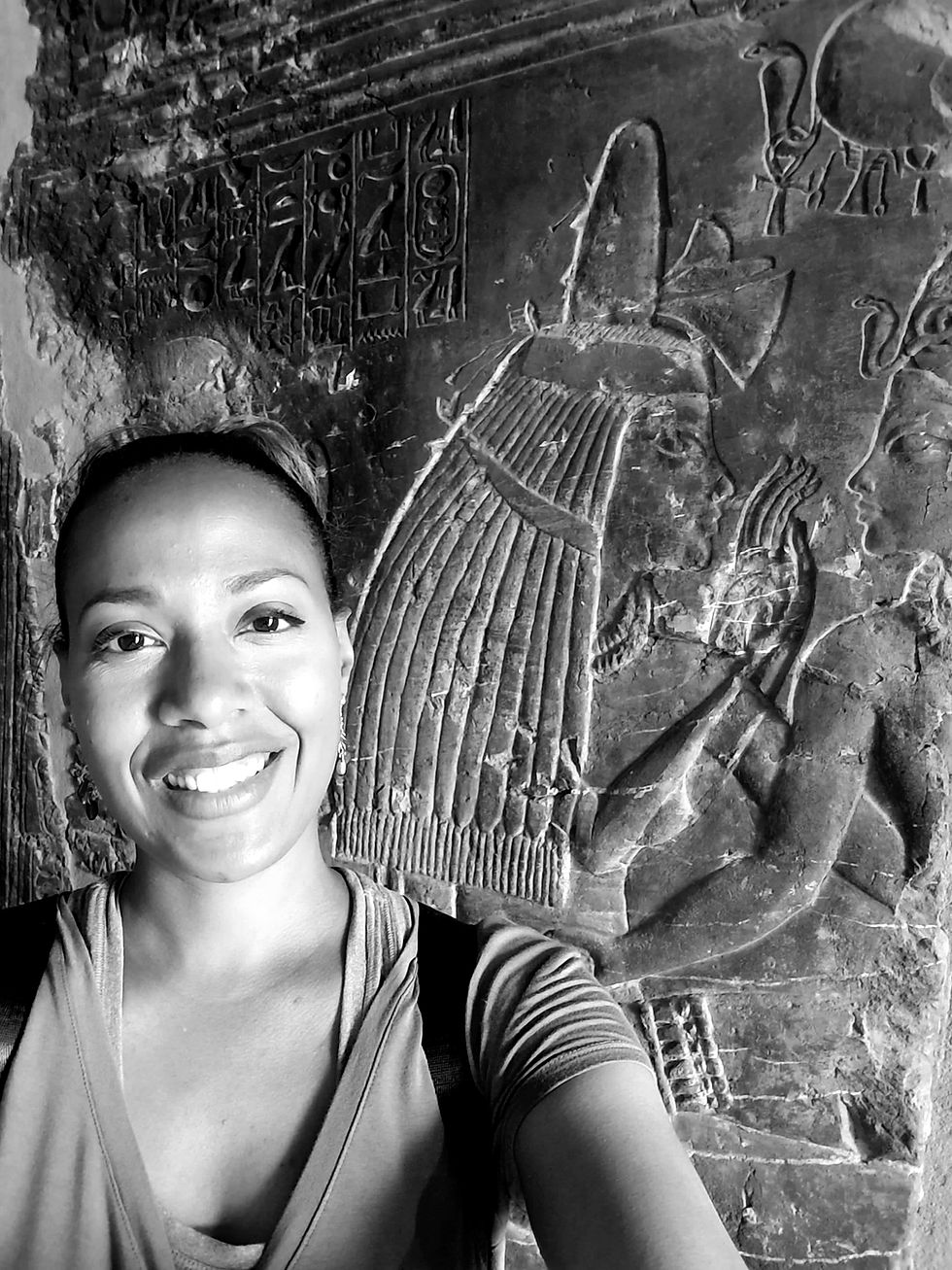
Amanda Victoria Chance, MD, is an Internal Medicine board-certified physician reviving ancient healing practices. Also certified in Lifestyle Medicine, she bridges millennia-old vibrational wisdom with evidence-based lifestyle interventions-- including nutrition, stress resilience, and non-pharmacological therapies-- to activate whole person care. She co-leads transformative healing journeys in Egypt with her husband-- including resonance-based experiences inspired by Saqqara's legendary "healing hospital," a site documented in Gaia's The Pyramid Code through her husband's grandfather's archival legacy.


Comments