The Silent Symphony: Did Ancient Egyptians Use Sound to Heal and Build?
Updated: Feb 3
The stones of Egypt do not just stand in silence—they resonate with a forgotten song that modern science is just beginning to hear.
For decades, scholars have marveled at the precision and scale of ancient Egyptian monuments, often asking how such feats were possible with simple tools. A growing body of interdisciplinary research now suggests a fascinating part of the answer may lie not in what we can see, but in what we can hear.

At the intersection of archaeology, acoustics, and spirituality, a compelling theory emerges: the ancient Egyptians may have intentionally harnessed sound and frequency for both healing and building, viewing vibration as a fundamental creative and curative force woven into the fabric of Ma'at—cosmic order. Let’s explore the evidence.
The Evidence for Ancient Egyptian Sound Healing: Medicine, Music, and Metaphysics
The concept of healing with sound in Egypt is supported by a triad of evidence: medical texts, ritual objects, and temple inscriptions.
1. The Medical Texts: The "Incantation of the Mother"
While direct references to"frequency" are absent, medical papyri blend physical treatment with spoken words. The Ebers Papyrus (c. 1550 BCE), a vast medical treatise, prescribes remedies that often include ritual recitation. This reflects a worldview where sound was a carrier of ka (life force), capable of invoking divine healing forces. Spoken words (Hu) and divine utterances were seen as powerful forces that could create, animate, and sustain the ka. This concept highlighted the Egyptians' belief in a creative power of speech and names. An example from a later protective charm states: "Words to be spoken to dispel sickness... May you flow out, he who breaks the bones, who destroys the skull." The power was in the divine vibration of the spoken word itself.
2. An Instrument of Resonance: The Sistrum
The most potent acoustic artifact is the sistrum, a ceremonial rattle used in temple worship, often associated with the goddess Hathor. Its distinct, shimmering sound was not mere musical accompaniment. Plutarch described it as an instrument for "soliciting, summoning, and invocating" energy. Modern psychoacoustic research suggests that the non-melodic, broad-frequency noise of a sistrum can induce mild trance states, reduce stress, and focus attention—a form of sonic control for communal ritual.
3. The Temple as a Resonant Body
Inscriptions at Philae Temple describe it as the "place of the sound of heaven." At the Kom Ombo Temple, a frieze shows a set of surgical instruments next to a menit necklace (another sound-making ritual object), symbolically linking acoustic vibration with physical healing. The temples themselves, with their echoing sandstone walls and columned halls, were likely designed to amplify specific chants and harmonics, bathing participants in a "therapeutic" sonic bath.
The Science of Acoustic Architecture: Building with Resonance
The theory that sound aided construction is more speculative but is grounded in measurable acoustic phenomena at ancient sites.
1. The Karnak Hypothesis
A seminal 2017 archaeoacoustic study, presented at the Journal of the Acoustical Society of America, mapped the standing waves in the Hypostyle Hall at Karnak. Researchers found that specific columns act as resonant filters, dramatically amplifying certain frequencies produced by the human voice or percussion. This was almost certainly an intentional design feature for rituals, proving the Egyptians understood acoustic engineering. If they could amplify sound for ceremony, could they have used resonant frequencies to test stone integrity or guide precision placement? It’s a logical extension of their demonstrated skill.
2. The Enigma of the Serapeum
The Serapeum at Saqqara, with its multi-ton, precision-boxed granite "sarcophagi," presents an acoustical marvel. Independent acoustic measurements, reveal an extraordinarily long reverberation time and powerful infrasound frequencies within the coffer. Some engineers, like those in the Dunn-Khan Kardasik Report, have theorized that vibrating the granite at a specific resonant frequency could reduce its apparent weight and friction, a principle known as acoustic levitation. While mainstream Egyptology rejects this as a construction method, the site’s undeniable acoustic properties suggest something sonically significant occurred there.
3. The Great Pyramid's Internal Acoustics
Research by the Spanish-based ATGRI group has shown that the King’s Chamber and Grand Gallery of the Great Pyramid have unique acoustic signatures, with resonant frequencies that fall within the range of human brainwave entrainment (i.e., Delta = 0.5-4 Hz for deep sleep, Theta = 4-8 Hz for meditation/light sleep, Alpha = 8-12 Hz for relaxation/daydreaming, Beta =12-30 Hz for focus/alertness, and Gamma = above 30 Hz for hyperfocus/insight). Again, while this doesn't prove sonic lifting, it shows the structure has spaces with specific, powerful acoustic behaviors.
Which piece of evidence for sound use is most compelling to you?
The acoustic properties of the sites themselves
The textual references from the Pyramid/Coffin Texts
The logical necessity for advanced techniques
The continuity with indigenous wisdom traditions
Connecting to the Whole: Sound as the Thread of Ma'at
This isn't just about historical curiosity. The potential use of sound connects directly to our core theme: we are all connected through natural vibration.
The ancient Egyptians likely perceived sound not as entertainment, but as a tangible, structuring force—akin to how we understand gravity or electromagnetism today. The "word" of the creator god Ptah brought the world into being. Healing chants sought to restore the healthy vibration of the body. Temple harmonics aimed to align the community with cosmic order.
When we listen to the resonant frequency of a granite coffer in the Serapeum or the echo in Karnak, we are not just hearing a cool sound effect. We are sensing a technological application of a spiritual principle: that alignment with nature's frequencies—from the macrocosm of celestial cycles to the microcosm of a vibrating cell—is a path to better health, and understanding.
An Invitation to Listen Deeply
The evidence suggests a profound truth: ancient Egypt was a culture that thought in resonance. They built an entire civilization on principles of harmonic alignment with natural forces.
We invite you to move from reading about frequency to truly experiencing it.
Feel the Resonance: On a Top 20-Question Expedition, we guide you into these spaces not just as a tourist, but as a participant. Experience firsthand the palpable, vibrational atmosphere of chambers designed with acoustic intent.
The road to understanding our past—and preparing for our future—may depend less on what we see, and more on what we are finally ready to hear.
Ready to tune in? Explore the silent symphony of ancient Egypt.
This article is part of our ongoing exploration.
For the full context and next week's insight, subscribe below.
About the Author
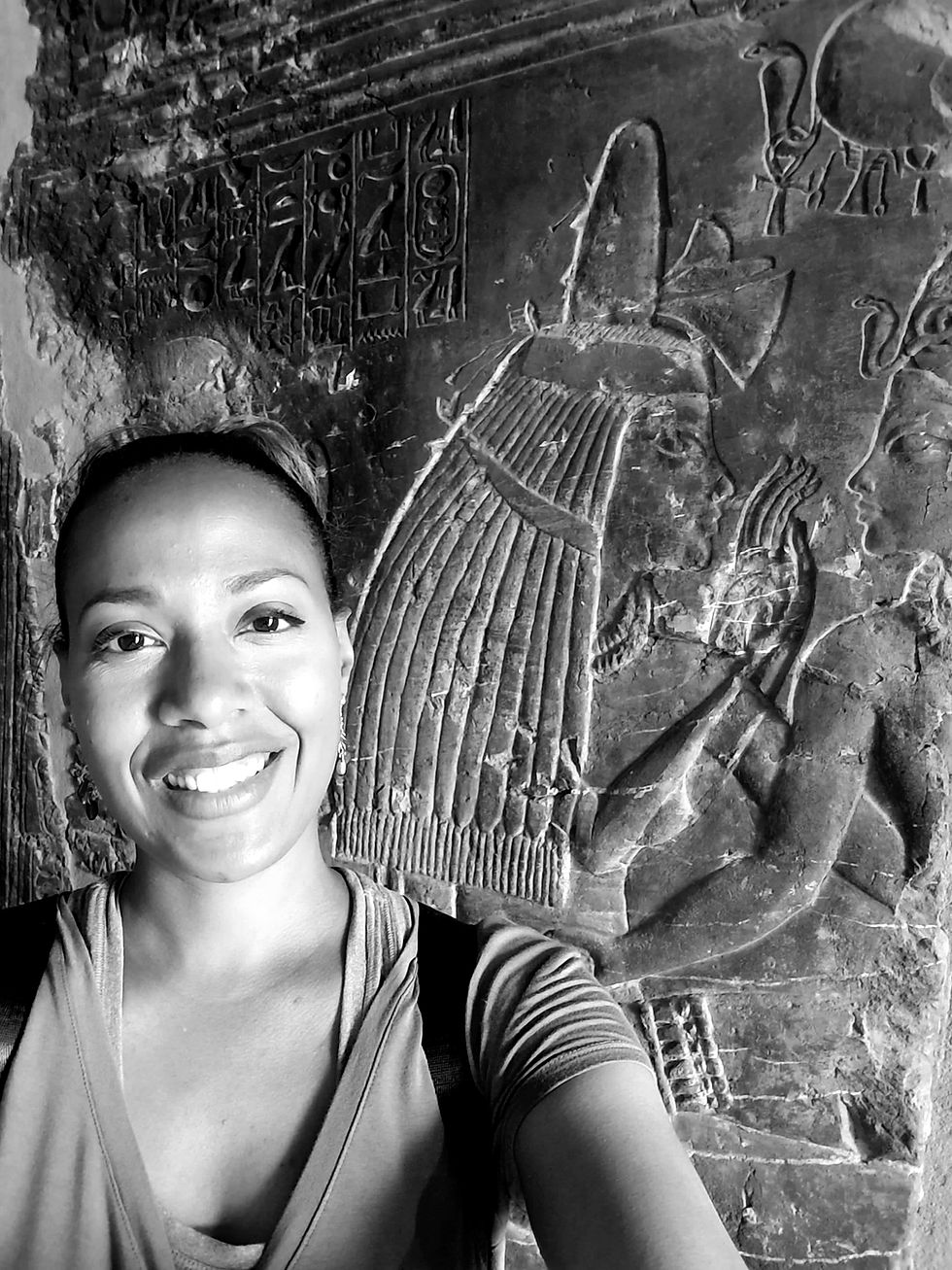
Amanda Victoria Chance, MD, is an Internal Medicine board-certified physician reviving ancient healing practices. Also certified in Lifestyle Medicine, she bridges millennia-old vibrational wisdom with evidence-based lifestyle interventions-- including nutrition, stress resilience, and non-pharmacological therapies-- to activate whole person care. She co-leads transformative healing journeys in Egypt with her husband-- including resonance-based experiences inspired by Saqqara's legendary "healing hospital," a site documented in Gaia's The Pyramid Code through her husband's grandfather's archival legacy.


Comments