The Saqqara Bird: Artifact, Icon, or Ancient Technology?
Deep within the sands of Egypt’s Saqqara necropolis, an unassuming wooden artifact has ignited one of modern archaeology’s most persistent debates. Is it a humble religious icon, a child’s toy—or could this tiny carving, shaped like a bird yet reminiscent of a modern aircraft, offer evidence of advanced aerodynamic knowledge in the ancient world?

Discovery and Description
The object known as the Saqqara Bird was unearthed in 1898 during an excavation of the tomb of Pa-di-Imen in Saqqara, Egypt. It is currently housed in the Egyptian Museum in Cairo, where it bears the inventory number “Species Registration No. 6347”. Made from locally abundant sycamore (or sycamore fig) wood, the artifact measures approximately 14 cm (5.6 in) in length with a wingspan of about 18 cm (7.2 in). It weighs approximately 31.5 grams, though sources cite slightly varying weights.
The carving depicts a bird in a soaring, wings‑outstretched posture. Yet its design departs from naturalistic avian representation—the wings are remarkably flat, the body is streamlined, and, most intriguing of all, the tail is vertical like that of an airplane, rather than the horizontal fan typical of real birds. A small protrusion on the back may have served as a mount, suggesting the object was once attached to a stick.
Symbolic Context: The Falcon in Ancient Egypt
To understand the Saqqara Bird, we must first appreciate the powerful symbolism of its avian form. In ancient Egyptian religion and kingship, birds—especially raptors—played a central role.
The falcon was the earthly manifestation of Horus, the sky god and divine protector of the pharaoh. Every living king was considered the “Horus on earth.” Falcon cults thrived throughout Egypt, and at Saqqara itself, thousands of mummified falcons have been discovered in vast underground galleries, testament to the bird’s profound religious importance.
Beyond Horus, several other deities appeared in falcon form: Sokar, the god of the Saqqara necropolis and the land of the dead; Ra-Horakhty, the sun god as a falcon merging the horizons; and Montu, the war god of Thebes. The Ba, or soul, was also frequently depicted as a human-headed bird whose wings derived from those of a falcon or vulture.
Thus, any bird-shaped object from a Saqqara tomb is far more likely to be a religious or funerary artifact than a technological prototype. The Saqqara Bird may well be a simple votive offering or a model of a sacred falcon, intended to accompany its owner in the afterlife.
The Riddle Emerges: Bird or Airplane?
This straightforward interpretation was turned on its head when modern observers noticed that the Saqqara Bird’s form unintentionally resembles a delta‑wing aircraft. Its straight, unswept wings, slender fuselage, and upright tail recall the layout of early experimental gliders rather than any known bird species.
In 1969, Dr. Khalil Messiha, an Egyptologist and model‑airplane enthusiast, rediscovered the artifact lying forgotten in the Cairo Museum’s basement alongside other bird figurines. He immediately recognized that the object did not look like a real bird. “The wing is … tapered towards the tips. One can note … a Dihedral angle,” he wrote, referring to the upward tilt of the wings that gives modern aircraft their lift.
Messiha was convinced that he was looking at a scale model of an ancient glider—and that the Egyptians had possessed knowledge of aerodynamics millennia before the Wright brothers. In 1991 he published a paper titled “African Experimental Aeronautics: A 2,000‑Year‑Old Model Glider”.
From that moment, the Saqqara Bird became a cause célèbre for proponents of alternative history, including Erich von Däniken and other advocates of ancient astronaut theories. It was hailed as “proof” that the Egyptians had either built flying machines or had been visited by a technologically advanced civilization.
The Evidence for Flight
During the 1970s and 1980s, several experimenters attempted to fly replica models of the Saqqara Bird with mixed results. Dr. Messiha himself built a balsa‑wood version, added a tailplane (horizontal stabilizer) that he assumed had been broken off the original, and successfully launched the model by hand for a “few yards” of glide. Later tests by Simon Sanderson (featured on the History Channel) in a wind tunnel appeared to show that the replica could generate lift.
In 2019, researchers at China’s Tongji University, led by Professor Shen Haijun, took a rigorous scientific approach. They used 3D scanning to create an exact digital model of the artifact. Using computational fluid dynamics (CFD) and a 3D‑printed replica tested in a wind tunnel, they concluded that the Saqqara Bird has a lift‑to‑drag ratio of about 2.5 and is aerodynamically stable in gliding flight with the addition of a tail. Headlines around the world pronounced: “4,000‑Year‑Old Egyptian Wooden Bird Model Can Fly.”
The Critical Response
However, the “ancient glider” hypothesis is far from universally accepted.
Most damaging was the 2002 experiment by Martin Gregorie, a professional glider and aircraft designer. Gregorie crafted a precise replica of the Saqqara Bird from balsa wood, using the original artifact as his guide. He then tried to hand‑launch it, with sobering results: “It is totally unstable without a tailplane.” He added that “even after a tailplane was fitted, the glide performance was disappointing.” The replica refused to fly straight; it would pitch up, stall, or roll uncontrollably.
Gregorie’s verdict was blunt: “In my opinion the Saqqara Bird was probably made as a child’s toy or as a weather vane.”
In 2023, the most comprehensive aerodynamic study to date was published. Michel Zierow and colleagues created a high‑precision 3D scan of the artifact and performed numerical flow simulations for a range of angles of attack. Their key findings were:
The maximum glide ratio is low, meaning its gliding properties are poor.
The center of gravity lies far back, near the trailing edge of the wing and behind the neutral point.
The resulting longitudinal stability does not meet modern specifications, and the lift distribution leads to uncontrolled roll.
Conclusion: The Saqqara Bird could not have flown as a glider, and its connection to ancient knowledge of aerodynamics could not be confirmed.
Given that the tailplane is fundamental to stabilizing any heavier‑than‑air craft, the absence of a horizontal stabilizer on the original artifact is a fatal flaw. Proponents argue that the tail may have been lost in antiquity, but there is no archaeological evidence for this—no tool marks or broken surfaces that would indicate the clean break of a separated piece. The model appears complete as is.
Alternative Explanations
Mainstream archaeologists and Egyptologists have offered several far more mundane, but persuasive, explanations for the Saqqara Bird:
1. Ceremonial Object / Votive Offering – The most widely accepted view. Falcons were sacred to Horus, Sokar, and other gods. A beautiful wooden falcon would have been a fitting grave good or temple dedication.
2. Child’s Toy – The artifact is light and small, easy for a child to hold. Gregorie notes that it feels like a toy: something to be tossed around for amusement rather than a precise aerodynamic model.
3. Weather Vane – Some Egyptologists have suggested it could have been mounted on a stick and placed as a wind direction indicator on a rooftop. Its vertical tail would have helped it align with the wind.
4. Masthead Ornament – Reliefs in the Temple of Khonsu at Karnak show sacred barques (ceremonial boats) with bird‑shaped finials on their masts. The Saqqara Bird could be just such a boat ornament.
Each of these explanations fits comfortably with what we know of ancient Egyptian culture, materials, and craftsmanship. They require no lost technologies or extraterrestrial intervention.
A New Perspective: The Saqqara Bird as a Functional Weather Vane
In the preceding sections, we reviewed the mainstream arguments that the Saqqara Bird was a ceremonial object, a votive offering, a child's toy, or a masthead ornament for a sacred boat.
From the perspective of vibrational wisdom, these conventional interpretations overlook a crucial piece of evidence: the artifact's vertical tail fin. The ancient Egyptians were masterful artisans whose artistic conventions had been perfected over millennia. Their depictions of birds—whether in temple reliefs, tomb paintings, or wooden models—consistently feature horizontal, fan-shaped tails that faithfully mirror the anatomy of real birds. The Saqqara Bird does not follow this established tradition. Its upright tail is not an artistic error or a stylistic departure; it is a deliberate functional design.
Feature | Saqqara Bird | Typical Ancient Egyptian Bird Art |
Tail | Vertical, rudder‑like tail fin | Horizontal, fan‑shaped tail |
Legs | No legs depicted | Almost always carved or painted with legs |
Posture | Wings flat, with a slight dihedral angle | Wings typically bent at the joint, resembling a bird in profile |
We propose that the Saqqara Bird was neither a religious object nor a child's plaything, but a functional instrument: a weather vane. Its bird-like form, lightweight construction (approximately 31.5 grams), and mounting attachment (a small protrusion on the back, likely for securing to a pole) are entirely consistent with known ancient wind direction indicators from other cultures. Consider the evidence:
Ancient Mesopotamia (c. 1800–1600 BCE): The earliest written reference to a wind direction indicator appears in the Akkadian "Fable of the Willow," in which people are described as looking at a weather vane to know the wind's direction. This demonstrates that the principle of a rotatable wind indicator was understood in the ancient Near East more than a millennium before the Saqqara Bird was carved.
Ancient Greece (c. 100–50 BCE): The Tower of the Winds in Athens was originally crowned with a bronze Triton weather vane. The Roman architect Vitruvius attributed its design to the astronomer Andronicus, yet it was one of the oldest buildings in the Roman Agora. It served as the world's first meteorological station, equipped with a water clock, sundials, and a wind vane.
Ancient China (Han Dynasty, 3rd century CE): Chinese weather vanes were specifically shaped like birds and were known as xiangfeng wu, or "wind‑indicating birds". The Sanfu huangtu, a third‑century text, describes a bird‑shaped weather vane situated on a tower roof. Earlier, during the Eastern Han Dynasty, the scientist Zhang Heng (78–139 CE) invented a "copper bird" mounted on a pole that rotated to indicate wind direction. The concept of a bird as a wind indicator was thus widespread and practical.
When we view the artifact through this lens, its anomalous features become coherent. The vertical tail fin would have provided a stable surface for catching the wind, while the flat, slightly drooped wings would have allowed the device to pivot smoothly on its mounting pole.
Who Was Pa-di-Imen and Why Would He Need a Weather Vane?
The Saqqara Bird was discovered in 1898 within the tomb of Pa-di-Imen, an individual whose name translates to "He whom Amun has given". He was an official of the Ptolemaic period, dating to approximately 200 BCE—a time when Greek influence was interwoven with traditional Egyptian culture. Pa-di-Imen may have served as an overseer or a priest, roles that often involved ritual activities connected to the rhythms of nature and the Nile.
Within this context, the need for a weather vane becomes plausible. As someone who may have overseen agricultural planning, river navigation, or temple ceremonies, knowing the direction of the wind would have been of practical significance. A weather vane in the form of a bird—long a symbol of the divine (Horus, the sky god)—would have been both a functional instrument and a sacred object, blending Egyptian symbolism with practical utility. It would have served as a reminder that the natural world, with all its invisible forces, was a realm to be observed.
Conclusion
The Saqqara Bird remains one of Egyptology’s most intriguing minor artifacts. It is a small object that raises large questions: about how we interpret the past, about the limits of our own imagination, and about the universal human desire to reach for the sky.
Mainstream research overwhelmingly favors a ritual or decorative purpose. Attempts to prove it was an ancient aircraft have consistently failed to overcome its aerodynamic deficits, while the most rigorous modern studies have confirmed that the Saqqara Bird could not function as a glider. The explanations that best fit the evidence are the simplest: a votive falcon, a child’s toy, a weather vane, or a boat ornament.
Timeless Journey
Explore the sacred landscapes of Saqqara—and the many mysteries they hold—on one of our curated journeys.
References
1. Gregorie, Martin. “The Saqqara Bird.” Catchpenny Mysteries, 2002.
2. Messiha, Khalil. “African Experimental Aeronautics: A 2,000‑Year‑Old Model Glider.” Proceedings of the First International Conference on Experimental Aeronautics, Cairo, 1991.
3. TIME Magazine. “Cryptids: The Saqqara Bird,” June 9, 2010.
4. Zierow, Michel, et al. “Aerodynamic Investigation on the Artefact ‘Bird of Saqqara.’” Acta Mechanica et Automatica, vol. 17, no. 1, 2023, pp. 405‑409.
5. Shen Haijun, et al. Tongji University studies on the Saqqara Bird, 2019.
6. “Saqqara Bird.” Wikipedia, 2025.
7. “木鸟模型 / 萨卡拉鸟.” 百度百科, 2025.
About the Author
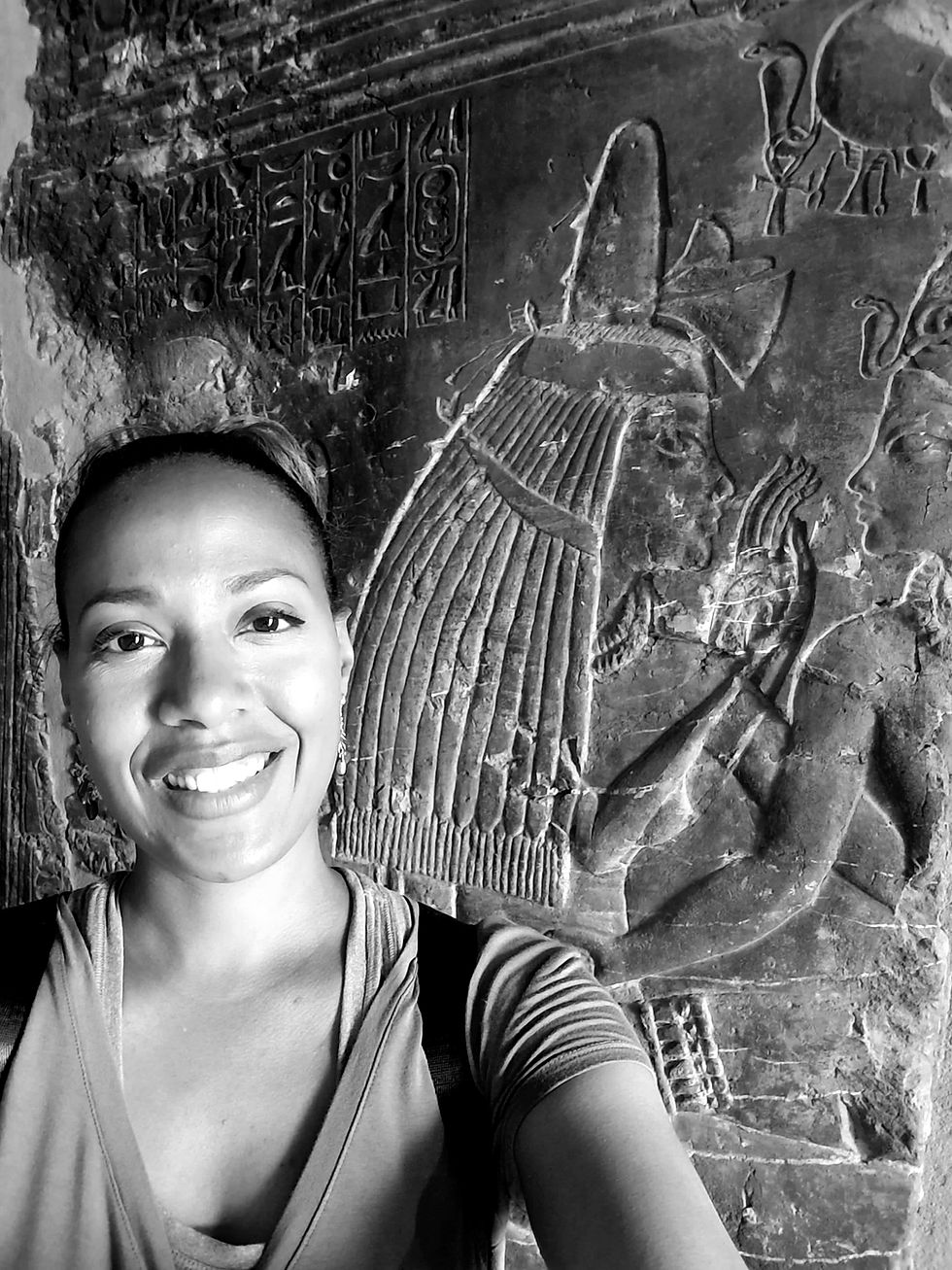
Amanda Victoria Chance, MD, is an Internal Medicine board-certified physician reviving ancient healing practices. Also certified in Lifestyle Medicine, she bridges millennia-old vibrational wisdom with evidence-based lifestyle interventions-- including nutrition, stress resilience, and non-pharmacological therapies-- to activate whole person care. She co-leads transformative healing journeys in Egypt with her husband-- including resonance-based experiences inspired by Saqqara's legendary "healing hospital," a site documented in Gaia's The Pyramid Code through her husband's grandfather's archival legacy.


Comments