Light and Water at Abydos: A Photographic Journey
Updated: 1 day ago
SUNDAY EDITORIAL EDITION
Where the week's noise fades, and the ancient signals grow clear.
Introduction: The Sacred Landscape of Abydos
No site in Egypt holds more concentrated spiritual power than Abydos. For millennia, it was the premier cult center of Osiris—god of resurrection, and the renewal of all things. Here, the living came to honor their ancestors, and the dead hoped to join the god in his eternal realm.
At the heart of this landscape stand two extraordinary structures: the Temple of Seti I, with its remarkable light apertures that direct sunlight into sacred spaces, and the Osireion, a mysterious subterranean structure behind the temple—its channels once filled with water the color of Osiris himself.
This Sunday, we explore both through ten images that trace light through stone and descend into water and the story of the end of time.
Image 1: The Outer Facade—First Light on Seti's Temple

The entrance to the Temple of Seti I is among the most photographed in Egypt—and for good reason. Its pylon gateway opens onto a courtyard that once held gardens and offering tables, leading toward the inner sanctuaries where the gods resided.
Fun Fact: The temple is L-shaped rather than rectangular—a unique architectural choice. Some scholars believe this was to accommodate an already-existing structure (perhaps an earlier Osiris shrine) on the site. Others suggest it intentionally mimics the shape of a hieroglyphic sign meaning "horizon"—the place where the sun is reborn each morning.
Image 2: The Abydos "Helicopter" Hieroglyphs—Palimpsest of Power

Just inside the temple, on a stone architrave, visitors encounter one of Egypt's most famous anomalies: carved shapes that resemble a helicopter, a submarine, and other modern vehicles. These are not, of course, ancient depictions of future technology—but the story of how they came to be is fascinating.
Fun Fact: The "helicopter" is actually a palimpsest—a stone surface that was carved over. Seti I originally carved his royal titles here. Later, Ramses II (his son and successor) had his own names carved over his father's. Over centuries, the deeper and shallower carvings eroded at different rates, creating the illusion of overlapping shapes that modern eyes interpret as machines. It is a physical record of dynastic transition, not ancient aviation.
(We will explore this phenomenon in greater depth in a future article.)
Images 3-6: Light in the Inner Temple—The Seven Chapels and the Offering Scene
Image 3: The Hypostyle Hall—Light on Pilgrim Faces

The great hypostyle hall of Seti I is a forest of sandstone columns, their surfaces covered with finely carved reliefs. High on the eastern wall, a small opening allows the morning sun to enter—a pinhole gnomon that projects a beam of light across the floor.
Today, the beam falls on bare stone. The floor's original surface—perhaps painted, perhaps inscribed—is long worn away by centuries of feet. The columns themselves, however, once bore more than we see now. Their bases would have been painted in bright colors, their shafts wrapped in linen or decorated with gilded elements that caught the light. What remains is a skeleton—beautiful, but missing the flesh of ancient color.
When tourists sit at the column bases and let the light illuminate their faces, they recreate an ancient experience: standing where the gods' light fell, being momentarily touched by the divine.
Images 4, 5, 6: The Chapel of Horus—Seti Offers Incense


The Temple of Seti I contains seven sanctuaries at its rear—one for each of the major deities honored here: Ptah, Re-Horakhty, Amun-Re, Osiris, Isis, Horus, and the deified Seti himself. This is unusually inclusive; most temples honored only one primary god.
Images 4, 5, and 6 show a visitor standing in the Chapel of Horus, where a relief depicts Seti I offering incense to the falcon-headed god. The light entering through a small aperture falls across her face—from one side, then from another.
About this chapel:
Horus, son of Osiris and Isis, was the divine protector of kingship. Every pharaoh was considered the "Living Horus."
The incense offering shown in the relief was not merely symbolic. In temple ritual, burning incense created a physical medium—visible smoke rising toward the gods—that carried prayers and purified the space.
The chapel's position ensures that sunlight strikes this specific scene at certain times of year, perhaps marking festivals in Horus's honor.
The visitor's face, illuminated in the same spot where the king once stood, becomes a living connection to 3,000 years of ritual continuity.
Image 7: The Opening—Light Through the Hole, Lions and the Dead

This is perhaps the most extraordinary image in the collection: a close-up of a light aperture, showing the beam emerging from the darkness beyond. Although this was taken at a nearby temple in Dendera, we can see that around the opening, carved into the stone, are four mummiform figures on lion-headed biers—one on each side.
What we see:
The lion bier is a funerary symbol, representing the transformation of the dead. The lion, as an animal of both danger and power, guarded the deceased during their journey to the afterlife.
The mummified figures are likely representations of the blessed dead—or perhaps of Osiris himself in his role as lord of resurrection.
Above the aperture are two rows of hieroglyphs. While I cannot read them fully, inscriptions in this area typically invoke protection for the king, praise for the gods, or declarations of the temple's enduring nature.
This opening is not merely architectural. It is a liminal space—a boundary between the world of the living (outside) and the realm of the gods (within). The light that passes through it carries the sun's power into the darkness, illuminating the dead who await resurrection. The four biers, placed at cardinal directions, suggest completeness—all the dead, everywhere, touched by Ra's transforming rays.
Image 8: The Osireion—Green Water, Living Memory


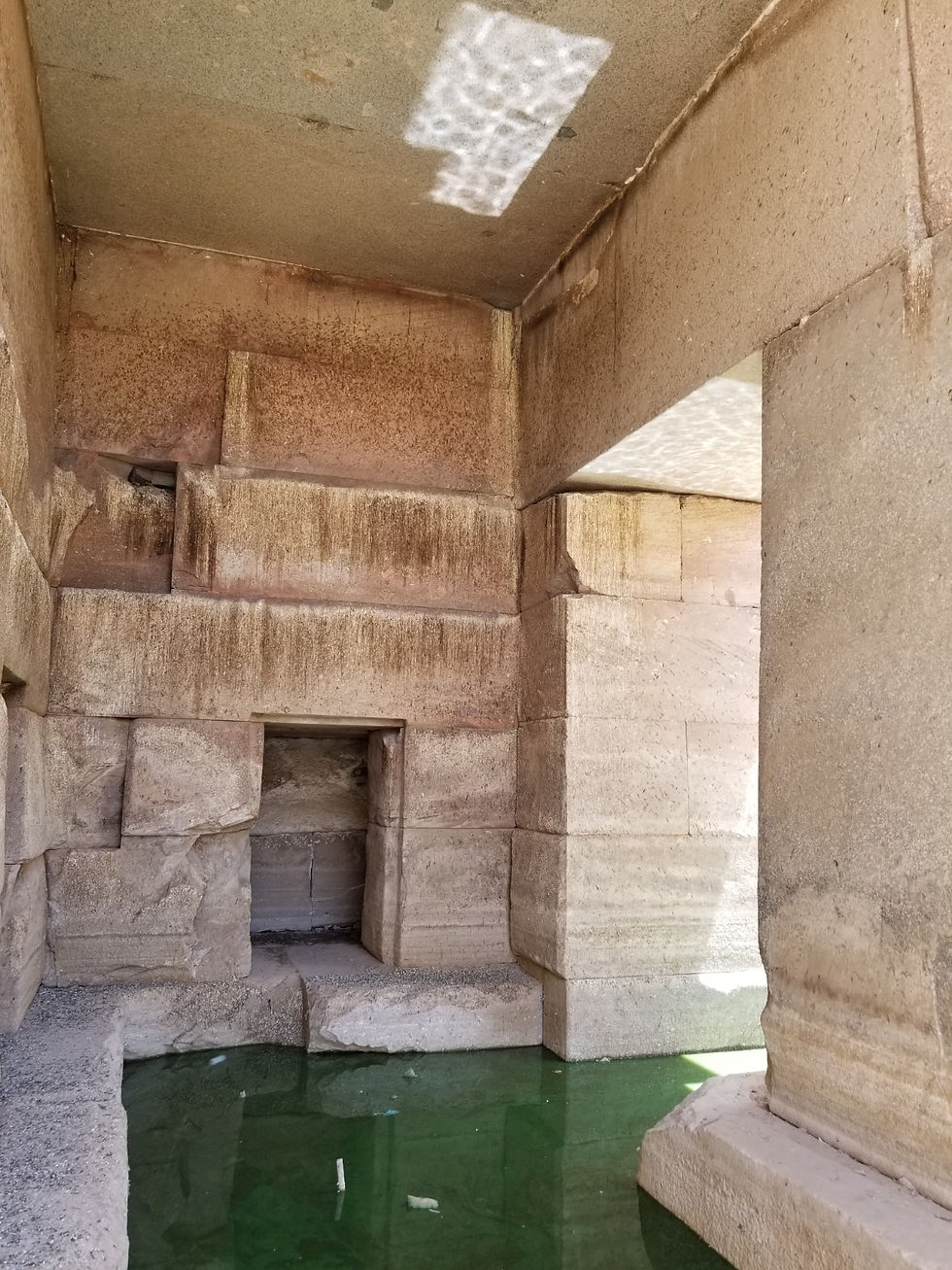
Behind the Temple of Seti I lies the Osireion—a subterranean structure built of massive granite blocks, traditionally identified as the cenotaph of Seti I, or possibly a symbolic tomb of Osiris himself.
When I visited in 2019, the water in its surrounding channels was startlingly green—the exact color of Osiris's skin in temple paintings. Small fish darted through the water, proof that it was connected to a living source, perhaps still reaching the Nile through underground passages.
What the water means:
Osiris was called the "Great Green"—a reference both to the life-giving Nile and to the god's role as lord of vegetation and rebirth.
The green water reflects not algae alone, but theological intent. This was not a drainage ditch; it was a primordial ocean in miniature, the Nun from which all life emerged.
The fish were messengers—proof that even now, beneath the sand and stone, Egypt's ancient waters still flow.
Since the construction of modern dams, the water table has dropped. The channels hold less than they once did. But in 2019, they held enough. Osiris was still green.
Image 9: The Twelfth Gate—The End of Time and the Restoration of Order

Along one wall of the Osireion's transverse hall are carved scenes from the Book of Gates—the great funerary text describing the sun god's journey through the twelve divisions of the underworld. Only the final gates remain visible; earlier ones have been lost to time and damage.
The Twelfth Gate represents the last hour of night, the moment before sunrise—the end of time itself. Here, the forces of chaos (the serpent Apep) are finally defeated. The blessed dead are reborn. The sun emerges in triumph. Order—ma'at—is restored.
What the relief shows:
The sun god stands in his barque, raised aloft by the primordial god, Nun.
Nun holds aloft the boat of the sun god, who is in the form of Khepri.
We see Isis standing on the right of the sun looking out of the hallway into the light, Nephthys to the left looking into the hallway at the prior gates.
Nine other gods on the boat are seen.
Geb and Nut are upside-down above the solar disc that Khepri is holding.
The hieroglyphs above Nun describe the moment: "These two arms come forth from the waters, and they bear up the god. The god takes up his place in the Matetet Boat with the gods who are in it. Nut receives Ra."
This is not merely a depiction of nightly events. It is a cosmic promise: that no matter how long the night, no matter how powerful chaos may seem, the sun will rise. Order will be restored. The end of time is not destruction—it is renewal.
Image 10: Dusty Boots—The Pilgrim's End

At the end of a long day in Abydos—after the temple, after the Osireion, after the light and the water and the ancient promises—there is only this: a pair of dusty boots.
The dust of Abydos is not ordinary dust. It contains particles of 3,000-year-old offerings, of limestone worn by a million pilgrim feet, of sand carried from the Sahara when the temple was still young. To walk here is to carry the past with you—literally, in the grit between your toes.
These boots have walked where Seti walked, where Horus was honored, where Osiris ruled. They have stood in beams of light that have fallen on the same spot for millennia. They have seen water that remembers the flood.
And now they rest.
Conclusion: Light and Water, Promise and Fulfillment
The Temple of Seti I and the Osireion together form a complete statement of ancient Egyptian belief.
In the temple above, light travels through darkness to illuminate the gods. The apertures ensure that Ra visits Osiris daily, that the king's offerings are accepted, that the sun reads the prayers and affirms their power.
In the Osireion below, water surrounds the island of the god. Green as Osiris's skin, it reflects the promise of resurrection. The walls tell the story of the end of time—but their message is not doom. It is hope.
The Twelfth Gate teaches that the final moment is not destruction but restoration. Chaos is defeated. Order returns. The sun rises.
In 2019, the water was green. The fish swam. The light still fell on pilgrim faces.
And at the end of the day, dusty boots reminded us: we are the pilgrims now. The promise is still for us.
Afterword:
This article is based on:
Personal observation and photographs from visits to Abydos in 2019 and subsequent years.
Architectural documentation in Calverley & Broome, The Temple of King Sethos I at Abydos (1933-1958).
Scholarly studies of Egyptian temple alignments, particularly Belmonte & Shaltout, In Search of Cosmic Order (2009).
The excavation reports of Henri Frankfort, The Cenotaph of Seti I at Abydos (1933).
Translations and interpretations of the Book of Gates by Erik Hornung and others.
The specific light phenomena described are documented architectural features; their precise ritual meanings are interpreted based on scholarly consensus regarding Egyptian solar theology. The Osireion observations are from the author's 2019 visit.
All images © Archaeo-Acoustics / Amanda. All rights reserved.
About the Author

Amanda Victoria Chance, MD, is an Internal Medicine board-certified physician reviving ancient healing practices. Also certified in Lifestyle Medicine, she bridges millennia-old vibrational wisdom with evidence-based lifestyle interventions-- including nutrition, stress resilience, and non-pharmacological therapies-- to activate whole person care. She co-leads transformative healing journeys in Egypt with her husband-- including resonance-based experiences inspired by Saqqara's legendary "healing hospital," a site documented in Gaia's The Pyramid Code through her husband's grandfather's archival legacy.

Comments